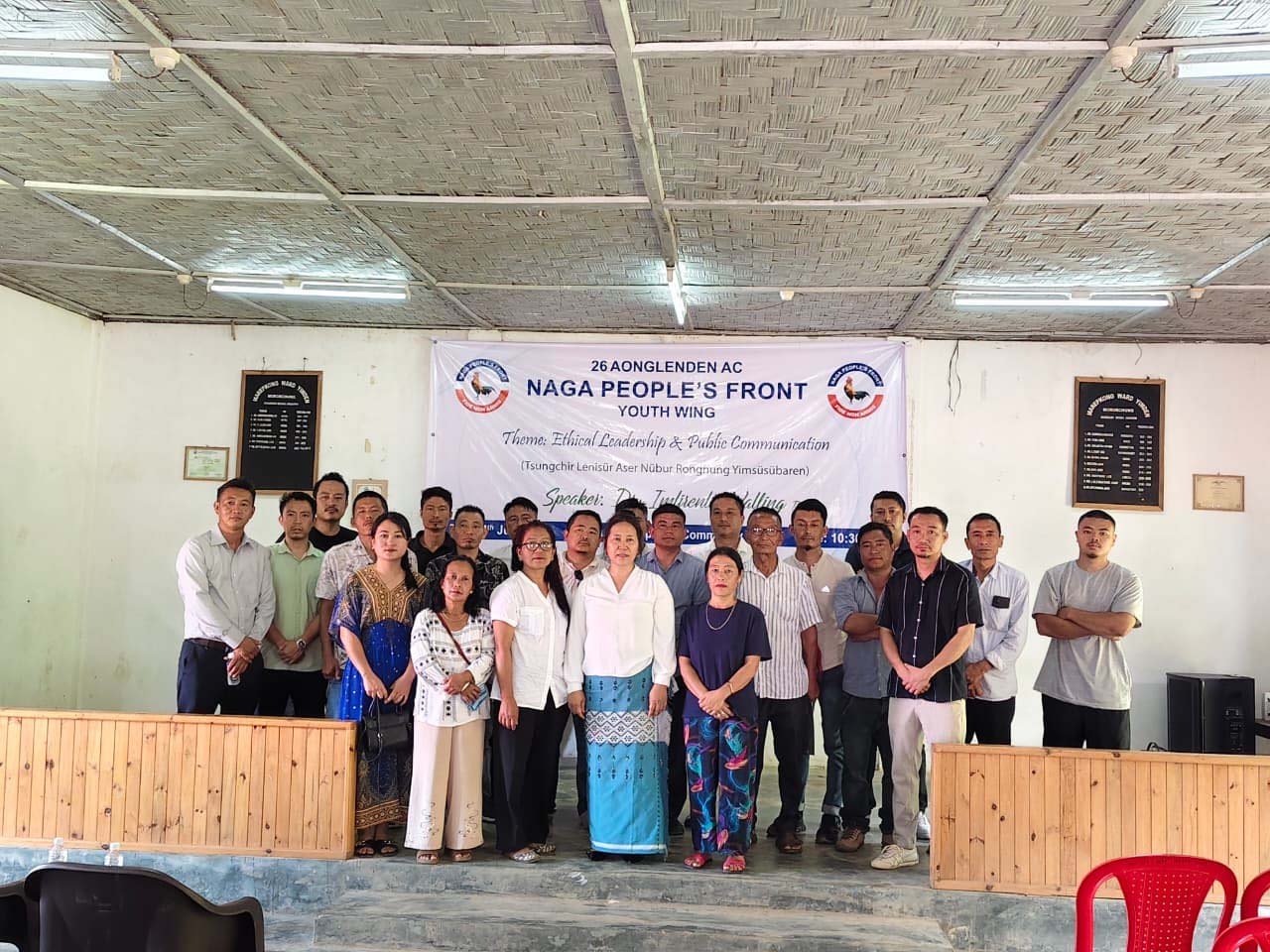
The Youth Wing of the 26 Aonglenden Assembly Constituency (AC) of the Naga People’s Front (NPF) organised a seminar on “Ethical Leadership and Public Communication” (Tsungchir Lenisür Aser Nübur Rongnung Yimsüsübaren) at Marepkong Community Hall on July 4.
The seminar was attended by members from the seven units of the 26 Aonglenden AC NPF Youth Wing – Dilong, Sangtemla, Arkong, Marepkong, Ungma, Kubza and Settsü and invited participants.
Delivering the opening exhortation, Takonungsang, President of the NPF Youth Wing, Mokokchung Division, spoke on the historical evolution of the Naga People’s Front and its relevance in the political history of Nagaland. He said the party emerged during a crucial period following the attainment of Nagaland’s statehood in 1963, when Naga society was undergoing major political developments.
He narrated how the Nagas, who had long asserted their political rights and sovereignty, gradually entered the democratic process under the Indian Constitution through the formation of the State. Against this backdrop, he said, the NPF was established as a regional political platform to represent and protect the political aspirations, identity and rights of the Nagas.
Describing the NPF as a party built on the sacrifices of earlier Naga leaders, Takonungsang said, “This is not just another political party. It is a party earned through the tears and sacrifices of our past leaders.”
He said the party has remained one of the strongest regional political forces in Nagaland since its formation and has been led by seven presidents over the years, two of whom belonged to the Ao community, reflecting the contribution of the Aos in shaping the party’s leadership.
Recalling the party’s electoral history, he said all ten Ao legislators were elected to the Nagaland Legislative Assembly on the NPF ticket in one election, which he described as one of the party’s major political achievements and an example of strong organisational leadership.
However, he cautioned against associating political parties with particular tribes.
“People often say the NPF is a Tenyimia party and Congress is an Ao party. Politics should not be tribalised. A political party must stand for its ideology and not for any particular tribe,” he said.
Stressing the need for continuous political engagement, Takonungsang said many political workers become active only during elections while remaining inactive for the rest of the term.
“If leaders work only during elections and spend the remaining three or four years doing nothing, the party remains only in name,” he said.
He commended the organisers for initiating a political education programme, saying such seminars were essential to keep the party’s vision, objectives and ideology alive among young members instead of limiting political activities to election campaigns.
He further said that in an era when national parties wield enormous political influence, regional parties must remain united and strong to safeguard the interests of the Nagas.
“When national parties become very powerful, regional voices tend to weaken. We must strengthen our regional party.”
Calling 26 Aonglenden Assembly Constituency the “political nerve centre” of the party, he urged the youth to actively contribute towards strengthening the organisation.
“If the NPF is not strong enough, we must remember that we are moving backward,” he added.
Speaking during the programme, Mokokchung Municipal Council (MMC) Chairperson Imkongchuba encouraged young party workers to view themselves as active participants in shaping society rather than waiting for the future.
“Youth are not just the future; they are the moving force of change,” he said.
He encouraged them to pursue politics with commitment, creativity and confidence despite the challenges ahead.
“There will be many obstacles. Accept them as challenges. Dare to dream big and have faith in your abilities. The youth have the power to transform society,” he said.
Download Nagaland Tribune app on Google Play


Resource person Dr Imlienla Walling, speaking on the theme “Ethical Leadership and Public Communication,” described the seminar as a positive beginning, observing that political education programmes of this nature were uncommon within political parties. She urged the organisers to make such initiatives a regular feature to nurture informed and capable political leaders.
Speaking on ethical leadership, Dr Walling said leadership is not about occupying a position but about character, integrity, responsibility and service. She stressed that every party worker must first understand the origin, history, philosophy, principles and motto of the party before aspiring to lead.
“You cannot become a leader if you do not know the origin and history of the party you have joined. You must understand and master the principles and ideology of your party before you can guide others,” she said.
Expressing concern over what she described as a growing leadership crisis, Dr. Walling said the lack of principled leadership remained one of the biggest challenges confronting society today. She said effective leadership must be anchored on a clear vision, mission and goals, adding that these three elements should complement one another. Goal-setting, she said, must always be time-bound to ensure accountability and measurable progress.
Referring to different leadership styles, she said leaders must adapt to different situations while remaining committed to their principles. Citing the political journey of former Meghalaya Chief Minister and former Lok Sabha Speaker, PA Sangma, she said leaders from the Northeast have demonstrated that strong leadership can reach the national stage.
Speaking on politics as a profession, Dr Walling said many people enter politics either out of passion or as a last resort, but urged young people to pursue it as a serious profession rooted in service and responsibility rather than personal ambition.
Addressing the common perception of “dirty politics”, she remarked, “Politics is considered dirty because we have made it dirty. The problem lies in our mindset. If we want clean politics, we must first change ourselves.”
She also cautioned against opportunistic leadership and leadership without principles, saying such practices weaken public confidence and erode democratic values. Young political workers, she said, must instead uphold truth, integrity and ethical conduct in public life.
Calling for greater participation of women in politics, Dr Walling said women possess qualities such as sincerity, honesty and commitment that are essential for ethical leadership. She encouraged more women to enter active politics and contest elections within the constitutional framework.
On public communication, Dr Walling described it as the backbone of every political organisation, saying transparency and accountability were essential for building public confidence. She said political parties must clearly communicate their ideas, policies, vision and manifestos, warning that organisations lose public trust when they drift away from their founding principles.
Emphasising accountability in public life, she said, “You cannot correct others if you yourself are at fault. When mistakes are committed, leaders should acknowledge them and apologise. That is how public trust and sympathy are earned.”
Quoting former President APJ Abdul Kalam, she reminded participants that “Youth power is the most powerful resource on earth.” Noting that nearly 40 per cent of India’s population falls within the youth category, she urged young people to reject corruption, opportunistic politics and leadership without principles, and instead embrace ethical leadership, truth and public service.
Earlier, the programme was chaired by Youth Wing Vice President Alemtuba Imsong. Longri, Clerk of Marepkong Baptist Church (MBC), pronounced the invocation. The vote of thanks was proposed by Youth Wing President Meshen, while the benediction was pronounced by general Secretary Lanuakum.