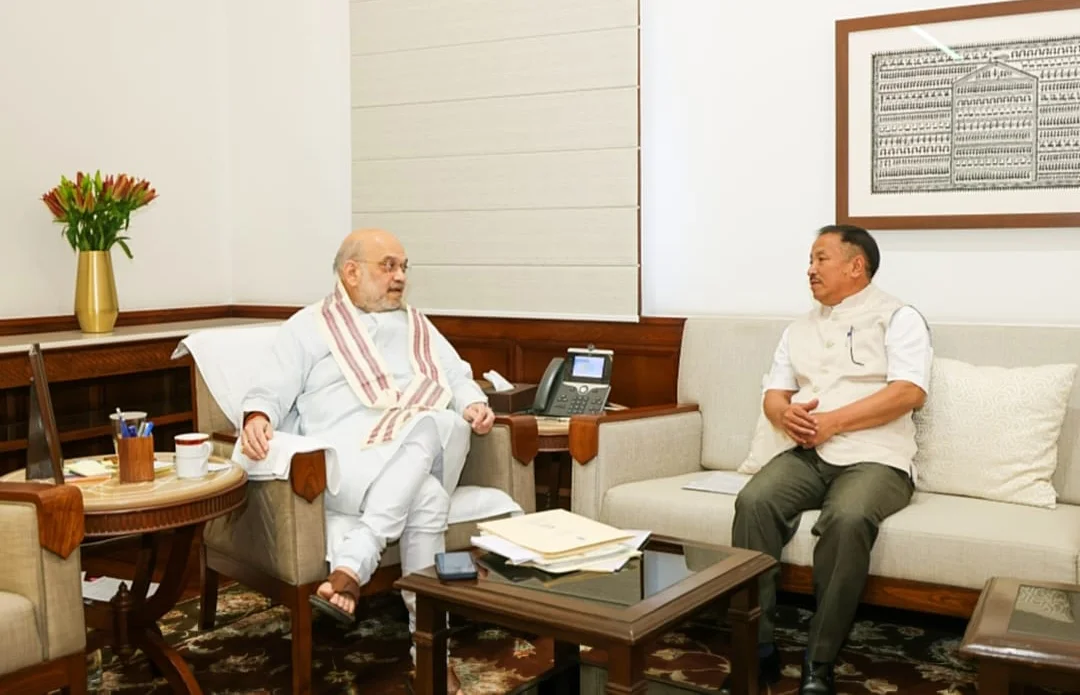
Member of Parliament (Lok Sabha), S Supongmeren Jamir has appealed to Union Home Minister, Amit Shah to defer the proposed Foreign Contribution (Regulation) Amendment Bill, 2026 until comprehensive consultations are held with all stakeholders and political parties.
In a letter to the Union Home Minister, Jamir expressed deep concern over the possible impact of the proposed legislation on India’s secular and diverse social fabric, particularly on institutions involved in education, healthcare, orphanage care, charitable activities and humanitarian services.
Jamir stated that while regulation of foreign contributions is necessary to ensure that foreign funding does not adversely affect national security, sovereignty or public order, any new legislation must also safeguard legitimate institutions working for the welfare and development of citizens.
Drawing the attention to the scale of the FCRA situation across the country, Jamir pointed out that 22,498 FCRA registrations have been cancelled in India and 15,212 FCRA registrations could not be renewed and have expired.
In Nagaland, out of 262 FCRA registrations, approximately 70% have been cancelled, according to the figures cited in his appeal, he added.
The letter also refers to approximately 14,444 organisations engaged in activities including colleges, orphanages, healthcare, social responsibilities and charitable work.
The latest FCRA portal figures cited by PRS Legislative Research, as of July 15, 2026, record 14,449 active FCRA certificates, 22,498 cancelled certificates and 15,212 certificates deemed expired.
Jamir particularly raised concern over the proposed creation of a “Designated Authority” under the 2026 Bill. The Bill proposes a framework for the vesting, supervision, management and disposal of foreign contributions and assets of organisations whose FCRA certificates cease to exist through cancellation, surrender or non-renewal.
Download Nagaland Tribune app on Google Play


PRS Legislative Research
The MP cautioned that such provisions could have serious consequences for institutions whose activities directly benefit vulnerable sections of society, especially where foreign contributions have been utilised for the creation of educational, healthcare, charitable or other public-service infrastructure.
Jamir also expressed concern that the proposed framework must be carefully examined in light of constitutional protections, including Article 300A of the Constitution of India, which provides that no person shall be deprived of property except by authority of law.
He emphasised that legislation dealing with property, charitable institutions and public welfare must provide adequate safeguards, transparency, accountability and due process.
“The proposed FCRA Bill, 2026 should not be taken up until all stakeholders and political parties are given an opportunity for wide consultation in the greater interest of the country,” he said.
Jamir further stated that organisations involved in education, healthcare, orphanage care, charity and humanitarian services perform important nation-building functions and that legitimate institutions should not be adversely affected by regulatory measures intended to address misuse of foreign contributions.
He, therefore, urged the Union Government to hold extensive consultations with all stakeholders before proceeding with the FCRA Amendment Bill, 2026, and to ensure that the final legislation balances national security and financial accountability with constitutional rights, humanitarian concerns and the legitimate welfare activities of civil society organisations.
