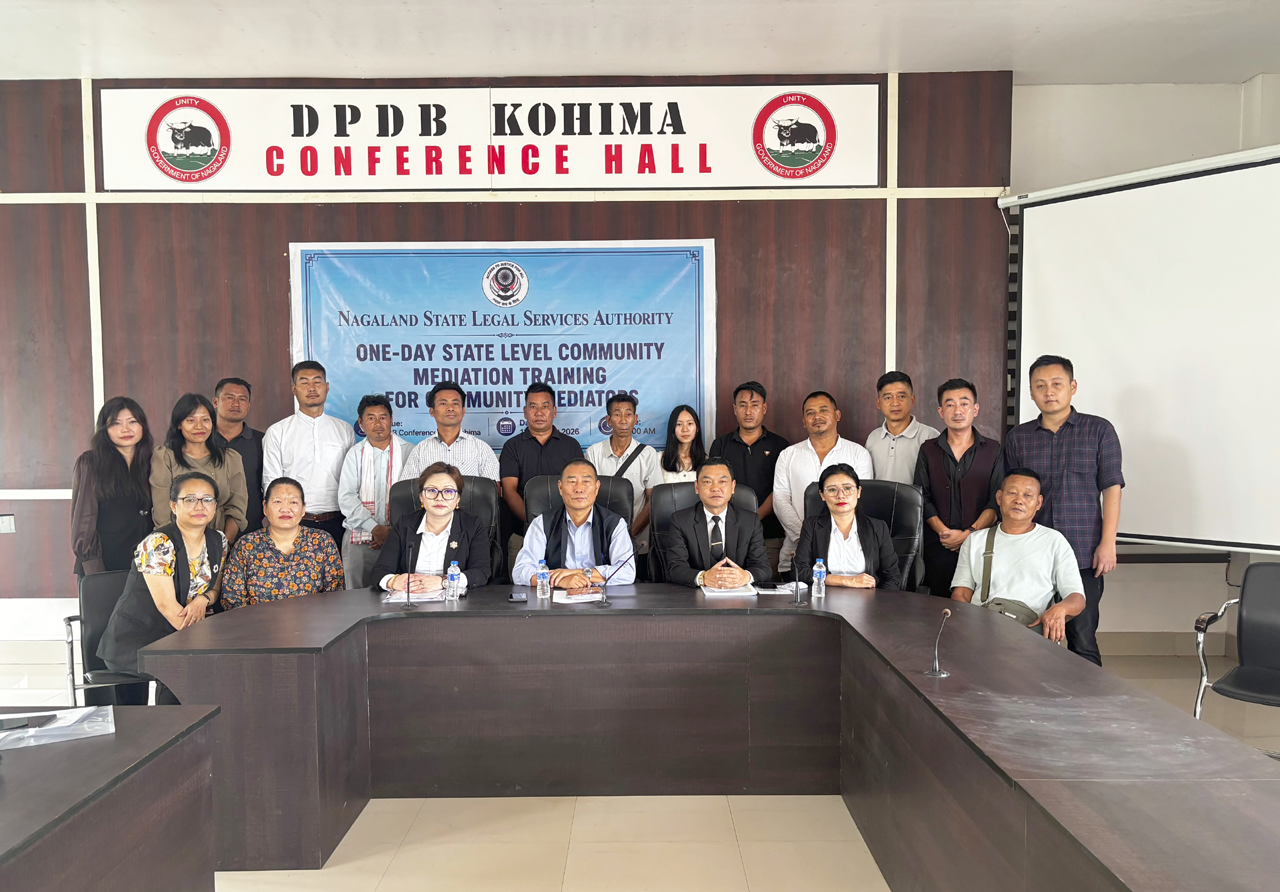
The Nagaland State Legal Services Authority (NSLSA) organised a One-Day State-Level Community Mediation Training for Community Mediators at the DPDB Conference Hall, Kohima, today.
Delivering the keynote address, Member Secretary, NSLSA, Neiko Akami, NJS, highlighted the role of Legal Services Authorities in ensuring equality and access to justice for all. He noted that differences in social and economic status can often contribute to disputes and vulnerability, making legal awareness and accessible legal assistance essential.
Akami informed that Legal Services Authorities provide free legal assistance to eligible persons, including help in understanding legal rights, preparing legal documents and accessing remedies. He said Front Offices are functioning in all 11 districts, manned by Panel Lawyers and Para-Legal Volunteers, to facilitate access to such services.
Referring to the growing concern over drug-related offences in the State, Akami said more than 700 cases had been registered during the last three years. He cited latest figures as of 31st July, of 474 male and 14 female accused, totalling 488, to underline the widespread impact of drug-related offences.
He further noted that a significant proportion of persons lodged in prisons come from less privileged backgrounds and stressed that legal aid enables every citizen to exercise their constitutional rights.
Highlighting the burden on the justice delivery system, Akami stated that 543 new cases had been instituted this year, 525 cases have been disposed of, while 4,635 cases remained pending. He pointed to Lok Adalat as an effective alternative dispute resolution mechanism, noting that more than 600 cases had been settled through Lok Adalats during the year.
He also highlighted the importance of victim compensation and community intervention in ensuring that victims receive appropriate assistance. Referring to human-wildlife conflict, he said NALSA has introduced a scheme providing legal assistance, relief and compensation to affected persons, and urged communities to bring cases to the attention of the appropriate authorities.
Download Nagaland Tribune app on Google Play


Emphasising the need for trained community mediators, Akami said many petty disputes are first brought before community leaders for resolution. While matters that require judicial intervention should proceed through the courts, mediation and other alternative dispute resolution mechanisms can provide a quicker, less adversarial and amicable means of resolving disputes.
In the technical session, Trained Mediator and Advocate Medohonu Kharutso led a session on “Understanding Community Mediation”, covering conflicts and disputes, the concept of community mediation, common disputes handled at the community level and the mediation process.
The second technical session was conducted by Trained Mediator and Panel Lawyer, Kohima DLSA, Sunjib Rana, on “Effective Community Mediation: Skills, Ethics, Documentation and Referrals.” The session covered communication skills, the role of community mediators, cultural sensitivity and bias, ethics and legal referrals, and settlement agreement drafting and documentation.
15 leaders in the community, representing districts of Kohima, Dimapur, Phek, Wokha and Mokokchung recieved certificates of completion.
The programme was chaired by Nulhuvolu Rhakho, Panel Lawyer, Kohima DLSA.