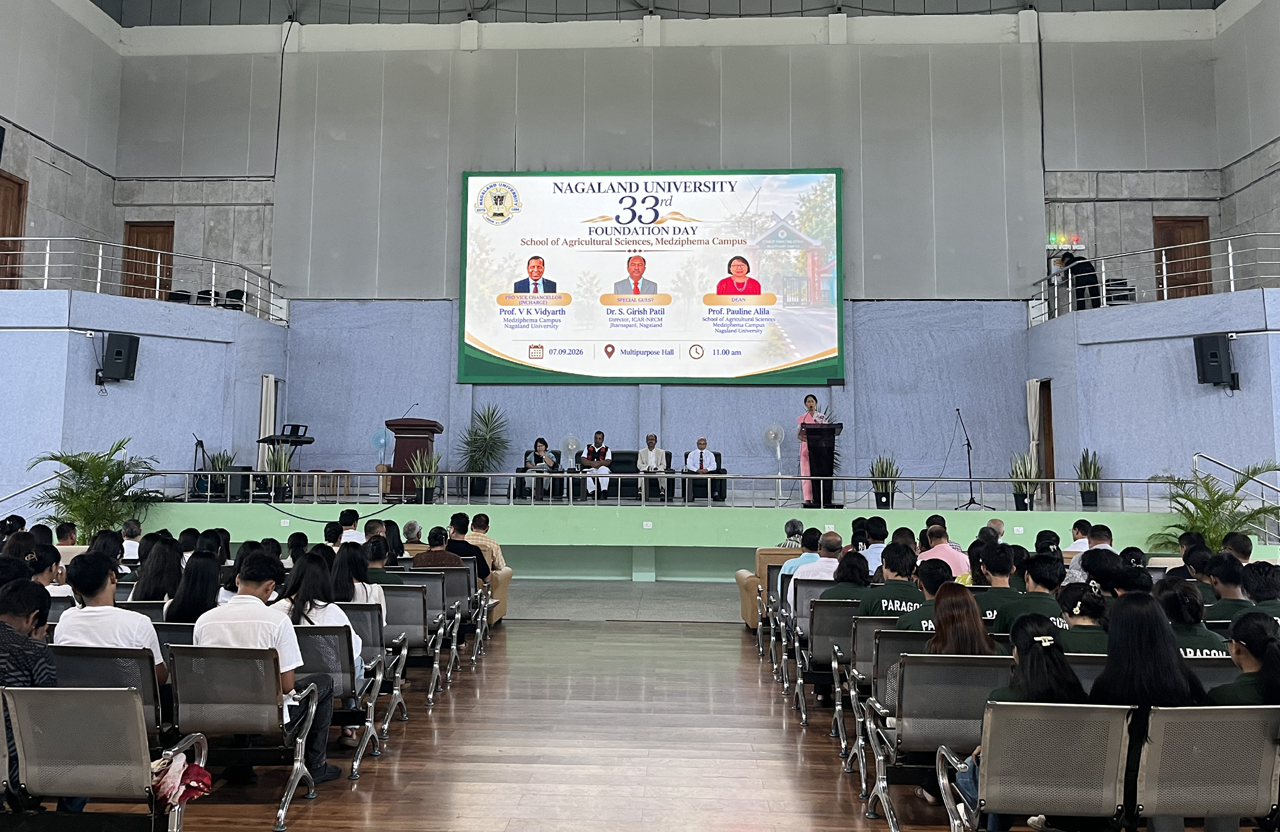
Nagaland University celebrated its 33rd Foundation Day on September 7 at the Multi-Purpose Hall, Medziphema Campus, bringing together university administrators, faculty members, staff, students and distinguished guests to commemorate the University’s journey and achievements and to reflect on its future vision and responsibilities.
The celebration commenced with the hoisting of the University flag by Dr S Girish Patil, Director, ICAR-NRCM, Jharnapani, Nagaland, followed by the Nagaland University Anthem. The Chief Guest, dignitaries, faculty members, staff and students thereafter proceeded to the hall for the formal programme.
The programme was chaired by Dr Waluniba, Department of Entomology, School of Agricultural Sciences (SAS), Nagaland University, Medziphema Campus, and commenced with an invocation prayer by Prof R Zuyei, Department of Livestock Production and Management, SAS. The welcome address was delivered by Prof Pauline Alila, Dean, SAS, Medziphema Campus.
In her address, Prof Pauline Alila emphasised that Foundation Day is not merely a day of commemoration, but a celebration of a shared journey and a renewed commitment to excellence. Remembering the pioneers of Nagaland University, she said that the School of Agricultural Sciences was proudly carrying forward their legacy.
She emphasised that every milestone achieved by an institution is the result of perseverance, dedication and hard work. She also highlighted the importance of new collaborations in education and research and acknowledged the benefits of the collaboration between Nagaland University and NRC-Mithun, particularly in strengthening research and creating opportunities for students and research scholars.
Addressing the gathering, Prof V K Vidyarthi, Pro Vice-Chancellor-in-Charge, Nagaland University reflected on the University’s journey since its establishment in 1987 and the laying of its foundation stone at Lumami.
He highlighted the University’s growth from a young institution with limited resources into a major centre of higher education, research and scholarship, with 6 schools and 44 academic departments, besides its network of affiliated colleges.
Prof Vidyarthi highlighted the University’s achievements in research publications, book chapters, intellectual property rights and patents, as well as its growing recognition in scientific rankings. He noted that four professors of Nagaland University have been recognised among the world’s top 2% of scientists. He also highlighted the University’s strong performance in patent grants among government universities during the relevant assessment period.
Emphasising the importance of people in building an institution, he remarked, “Infrastructure creates possibilities and students create universities.” He described the University’s continuing journey as being “from foundation to expansion, from expansion to excellence, and from excellence to impact.” He stressed that the University’s achievements should inspire greater responsibility rather than complacency and urged faculty members, researchers and students to focus on addressing local challenges through research, innovation and community engagement.
Prof Vidyarthi also made a strong appeal for ethics, integrity and social responsibility, urging members of the University community to stand against corruption and unethical practices in institutions and society. Encouraging everyone to contribute according to their capacity, he stated, “If you cannot fight, speak. If you cannot speak, write. If you cannot write, support. And if you cannot support, at least do not pull the leg of those who are doing a noble cause.”
The Foundation Day Lecture was delivered by Dr S Girish Patil, Director, ICAR-NRCM, Jharnapani, Nagaland, who highlighted the crucial role of the University, particularly the School of Agricultural Sciences, in the development of agriculture in Nagaland and the Northeast.
Describing agriculture as the backbone and lifeline of Nagaland, Dr Patil emphasised the importance of the SAS:NU in strengthening the agricultural sector through education, research, extension and institutional collaboration.
Dr Patil stressed that research must address local problems and provide practical solutions for farmers and communities. He discussed major challenges and opportunities related to agricultural production, surplus, marketing, value addition, climate change and increasingly erratic climatic conditions. He emphasised that processing, value addition and marketing of agricultural produce need greater attention to enhance farmers’ income and build a stronger agricultural economy.
Download Nagaland Tribune app on Google Play


He further called for a transition from subsistence agriculture to commercial and market-oriented agriculture, pointing out that substantial quantities of livestock, poultry, fish and other agricultural products are brought into Nagaland from outside the state. He observed that this presents considerable scope for strengthening local production, generating employment and increasing farmers’ income.
He urged researchers to develop practical roadmaps and evidence-based policy recommendations and policy papers that could support policymakers in addressing the state’s developmental challenges.
Dr Patil also highlighted the importance of taking research innovations beyond academic publications. He emphasised that patents and research innovations should ultimately contribute to entrepreneurship, employment generation and economic benefits for society.
Speaking on the changing technological landscape, Dr Patil highlighted the growing influence of Artificial Intelligence and digital technology and urged students to become digitally literate. He emphasised that future-ready students must develop skills beyond technological knowledge, including emotional intelligence, time management, lifelong learning and interdisciplinary knowledge. He encouraged students to use digital technologies to improve efficiency and productivity while developing the ability to contribute meaningfully to society.
He also emphasised the importance of collaboration between Nagaland University and NRC-Mithun, noting that institutions must work hand in hand to strengthen research and development in agriculture and allied sectors. He acknowledged the contributions of AICRP programmes and other externally funded projects towards research and extension activities and encouraged the University community to ensure that research translates into meaningful societal outcomes.
The formal programme also featured a special song by the EU Choir, SAS, Medziphema Campus, and a special number presented by Dr Chuba Ozukum, Technical Assistant, AICRP Kharif Pulses and Friends, SAS.
The programme concluded with the vote of thanks delivered by Dr Anthony Richa, Deputy Registrar, SAS, Medziphema Campus, who expressed gratitude to the Chief Guest, university administration, dignitaries, faculty members, staff, students, organising team, security personnel, musicians, EU Choir and all others who contributed to the successful conduct of the celebration. He acknowledged the contributions of Prof J Longkumer (Programme Convener), Prof L Dhaio, (retired) and Prof Malini B Sharma, Associate Dean, Student Welfare, along with the continued collaboration between Nagaland University and NRC-Mithun and thanked its director for his support and cooperation.
Emphasising the importance of teamwork, Dr Richa compared the collective contributions of members of the University community to the “mixture of spices that makes the curry tasty,” highlighting that institutional success is the outcome of collective effort. Describing the University community as a family, he thanked everyone for coming together to celebrate the University’s Foundation Day.
The Foundation Day programme also included a Blood Donation Drive and Medical Camp coordinated under the direction of Dr Vitseilie Phewhuo, an exhibition match and a Movie Night, adding dimensions of community service, health awareness and student engagement to the celebration.