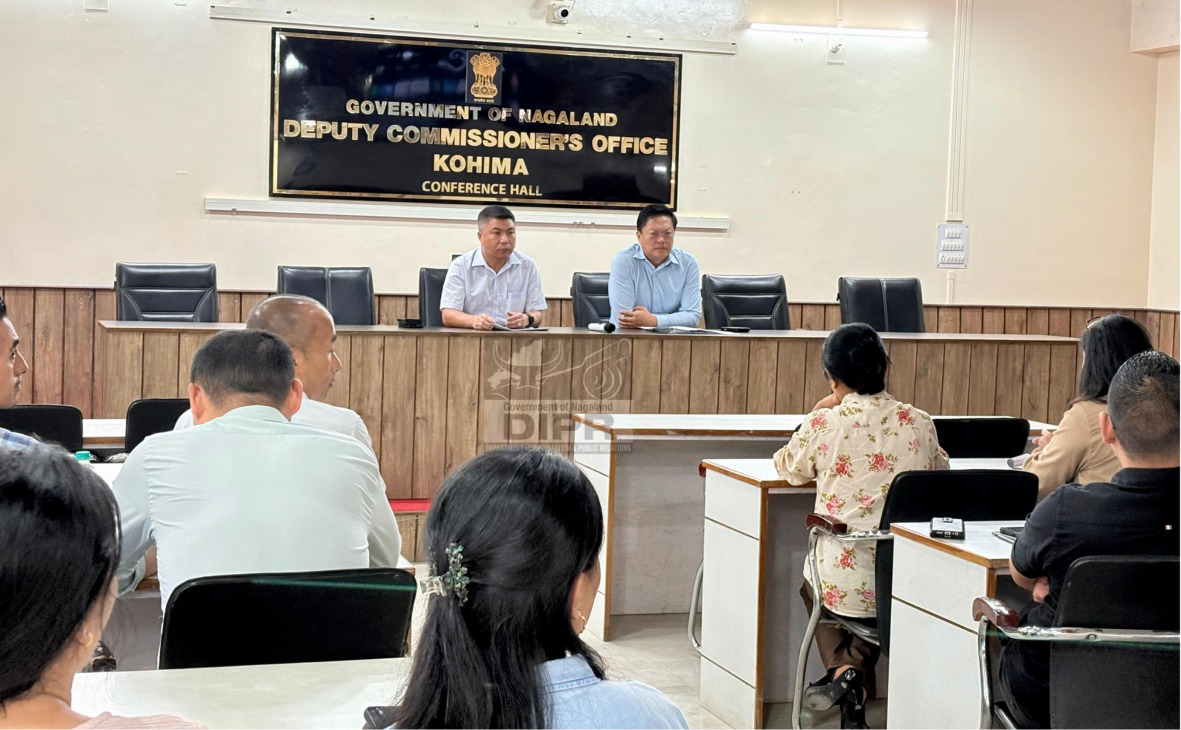
A sensitisation programme on Reform Utsav, a citizen-driven initiative aimed at identifying and implementing systemic reforms through citizen participation, was held in Kohima on September 11 with State Nodal Officer for Kohima District (SNOD), Limawabang Jamir, IAS, Secretary, Social Welfare, convening the programme.
Jamir said that the programme was organised to sensitise Heads of Departments (HoDs) and create awareness on the objectives and implementation of Reform Utsav, a time-bound and outcome-oriented campaign of the Government aimed at institutionalising a bottom-up approach to reforms in governance.
Reform Utsav seeks to source, deliberate upon and implement reform suggestions received from citizens, with emphasis on procedural and structural reforms that can have wider public impact. It follows a whole-of-government approach involving Central and State Governments and provides a mechanism for taking genuine reform suggestions from citizens through to implementation.
A presentation was made by Theodre Yanthan, Joint Secretary, Social Welfare, who highlighted that the campaign will be implemented in three broad phases – Jan Manthan (Discover), Vimarsh (Deliberate) and Jan Samadhan (Deliver).
Jan Manthan (Discover) will focus on gathering reform suggestions from citizens through the Reform Utsav portal and extensive outreach activities. The first phase will commence on October 2, 2026, with the launch of the portal through which citizens will be able to submit suggestions for systemic reforms. Awareness activities, including Jan Sabhas, community outreach and other public mobilisation programmes, will also be undertaken.
Vimarsh (Deliberate) will involve departments examining and deliberating on the suggestions received to identify actionable reforms. The suggestions will be assessed and categorised into quick-win reforms and medium-term reforms, with inter-departmental issues taken up through the appropriate coordination mechanism.
Download Nagaland Tribune app on Google Play


Jan Samadhan (Deliver) will focus on implementing identified quick-win reforms and initiating medium-term reforms through defined implementation roadmaps. Progress on the reforms will be monitored and updated through the Reform Utsav portal.
The State-level coordination mechanism has recommended that all districts constitute district-level committees for effective implementation of the campaign. The district committees will include representatives from relevant public organisations, Urban Local Bodies and Chief Executive Officers of Municipal Councils, among others, to provide inputs relevant to their respective districts.
The district-level mechanism will also focus on creating awareness, ensuring active participation of concerned departments and stakeholders, and soliciting reform suggestions from elected representatives.
The meeting emphasised that Reform Utsav is focused not merely on individual grievances but on identifying systemic issues and workable solutions that can benefit citizens more broadly. A reform suggestion is expected to address a systemic cause, be applicable beyond an individual case, be implementable on a wider scale and provide a constructive solution.
The campaign will be followed by Sankalp Siddhi in December 2026, providing an opportunity to showcase reforms undertaken and outcomes achieved at the national, State and district levels.
The overall objective of Reform Utsav is to ensure that citizens’ voices are captured as suggestions, converted into actionable reforms and ultimately implemented or placed on a committed roadmap for implementation.