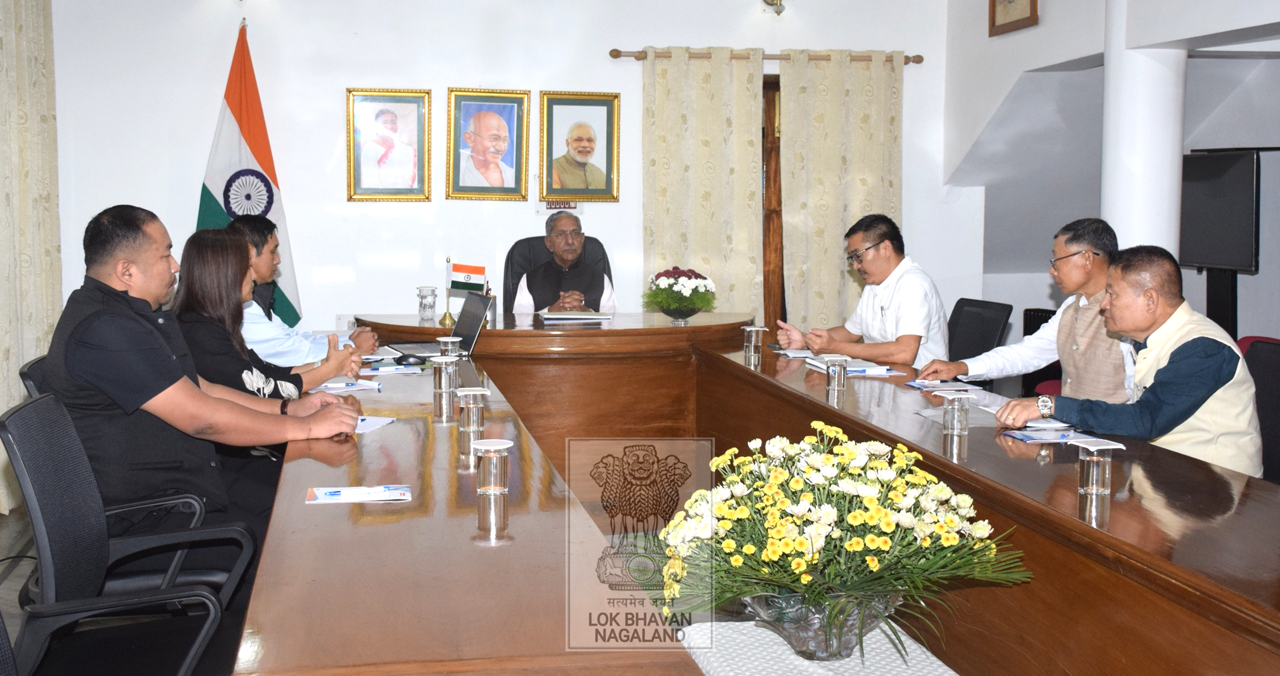
Governor of Nagaland, Nand Kishore Yadav reviewed the programmes, achievements and ongoing projects of the Nagaland Khadi & Village Industries Board (NKVIB) at Lok Bhavan, Kohima, on September 25, with emphasis on strengthening entrepreneurship, skill development, employment generation and promotion of indigenous Khadi, handloom and handicraft products.
During the review meeting, NKVIB officials presented an overview of the Board’s activities and programmes aimed at promoting Khadi and village industries, entrepreneurship, skill development and employment opportunities across the State.
The Board informed that NKVIB is a statutory body constituted by the State Government under the Nagaland Legislative Assembly Act No. 5 of 1978 and has been functioning since January 1979. Its principal mandate is to implement programmes in accordance with the Khadi and Village Industries Commission (KVIC).
The implementation of the Prime Minister’s Employment Generation Programme (PMEGP), a flagship KVIC initiative, was a key focus of the review. Under the scheme, margin money assistance is provided to individual artisans, entrepreneurs, institutions and societies to promote self-employment and village industries. The Board stated that around 600–700 entrepreneurs, particularly unemployed youth, are setting up units every year under the programme.
District-wise PMEGP performance for the last three years was also reviewed. The meeting examined targets and bank sanctions for 2023-24, 2024-25 and 2025-26, covering all 16 districts, based on data from the PMEGP e-portal.
The Board highlighted several challenges in implementing PMEGP, including limited bank sanctions, demands for collateral, inadequate loan amounts in some cases and delays in credit processing at rural bank branches.
The functioning of the Multi Disciplinary Training Centre (MDTC), Dimapur, was also reviewed. Established with KVIC approval, the centre provides vocational training to unemployed youth to enable them to establish their own units and pursue self-employment. Current training programmes include weaving, knitting, tailoring and embroidery, leather work, carpentry, laundry soap making, beekeeping, Entrepreneurs Awareness Programme and Entrepreneurs Development Programme.
Download Nagaland Tribune app on Google Play


The Board also apprised the Governor of infrastructure initiatives undertaken under the North Eastern Council (NEC), including the Common Facility Centre and Emporium for Handloom and Handicraft at Agri Expo, Dimapur, and the Centre for Promotion of Indigenous Handloom and Handicrafts at Diezephe, Dimapur.
The Diezephe centre is intended to provide opportunities for training and production of handicraft products while promoting indigenous handloom and handicrafts.
The meeting further reviewed the Handicraft Facility Centre at Kohima, where construction commenced on April 1, 2026, and is currently underway. The Board also informed the Governor about the Common Facility Centre-cum-Training Centre at Kohima, which is nearing completion and is intended to facilitate skill acquisition, skill upgradation, employability and self-employment opportunities.
The Khadi Plaza at Dimapur was another project discussed during the meeting. Envisaged as a centre for displaying and selling handloom and handicraft products from the North Eastern States, the project is aimed at generating direct and indirect employment. The Board stated that the Khadi Plaza is expected to be inaugurated soon.
Looking ahead, the Board plans to identify efficient artisans to operate handicraft facility centres at Dimapur and Kohima under the public-private partnership (PPP) mode. It also plans to provide training in handicraft production and marketing and establish centres for the display and sale of handicraft products.
The Governor reviewed the various programmes and projects with emphasis on strengthening entrepreneurship and skills, expanding employment opportunities and promoting Nagaland’s indigenous Khadi, handloom and handicraft products.