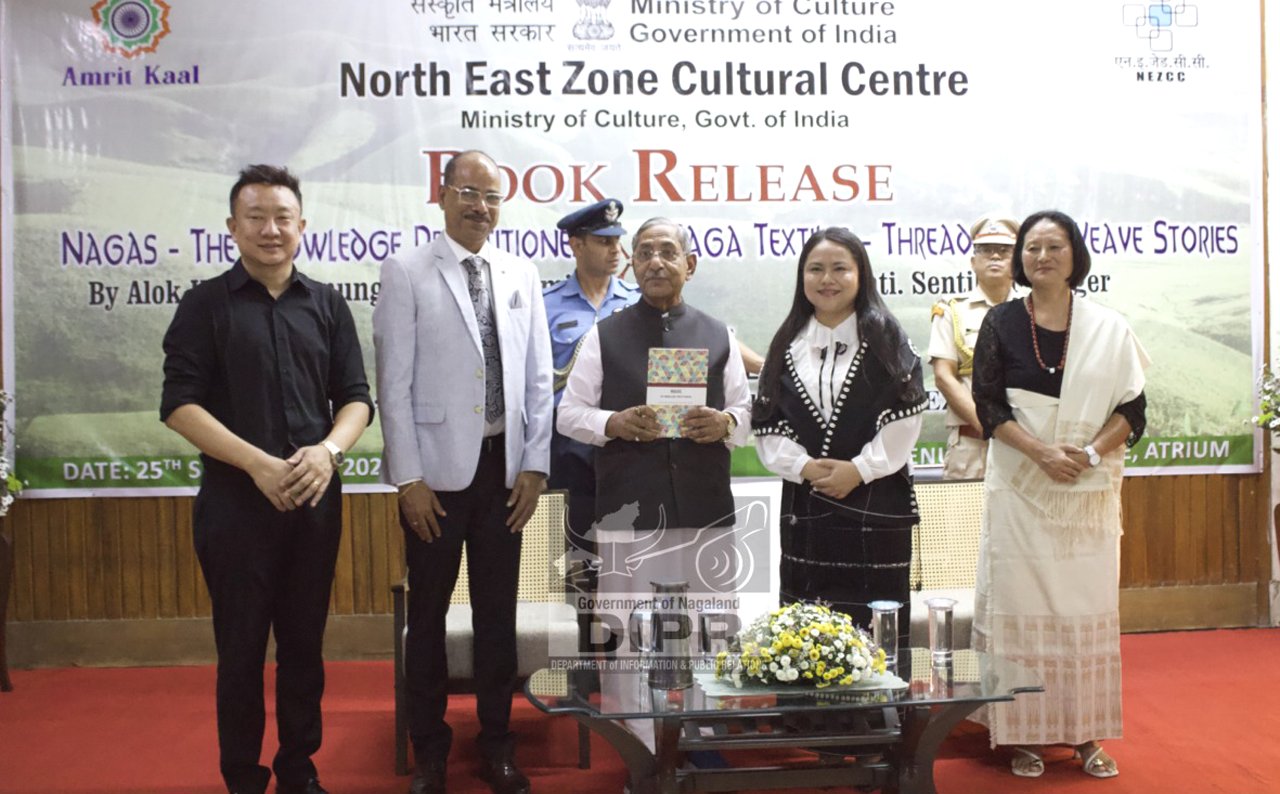
Nagaland Governor and Chairman of the North East Zone Cultural Centre (NEZCC), Nand Kishore Yadav, on Friday called for greater documentation, research and transmission of Naga indigenous knowledge, saying cultural heritage should be viewed not merely as a legacy of the past but as a valuable knowledge resource for the future.
Yadav was speaking at a book release function at the NEZCC Complex, Dimapur, where two publications—Nagas: The Knowledge Practitioners, authored by Dr Alok Kumar Kanungo and Dr Alino Sumi and published by Routledge, and Padma Shri Sentila T Yanger’s Naga Textiles—Threads that Weave Stories—were released.
Congratulating the authors, the Governor said that although the two books deal with different subjects, they tell a common story about culture as a body of knowledge created, practised, refined and transmitted across generations.
He said indigenous knowledge should not be viewed simply as folklore, pointing out that it is developed through observation, experience, experimentation and adaptation. Farmers possess knowledge of soil, seasons, rainfall and biodiversity, while craftsmen possess knowledge of materials, tools and techniques, he noted.
Similarly, communities that have developed methods of conserving resources, managing forests, producing salt, making tools and understanding the natural environment are custodians of knowledge, he said.
“When we speak of preserving Naga heritage, we must not limit ourselves to preserving objects. We must preserve the knowledge associated with those objects,” Yadav said.
Referring to Naga Textiles—Threads that Weave Stories, the Governor said Naga shawls are much more than pieces of cloth, describing them as a “visual language” carrying identity, memory, social meaning and artistic expression.
He said colours, patterns, motifs and weaving methods have, in different contexts, communicated stories of community, status, tradition and belonging. Traditional textiles could therefore be read almost like historical documents, he added.
According to Yadav, behind every traditional textile are generations of accumulated knowledge involving fibres, dyes, weaving techniques, aesthetic choices, symbols and motifs. He stressed that such knowledge is transmitted from one generation to another and therefore requires proper documentation.
The Governor said documentation should go beyond photographs and descriptions, as it could provide permanence to knowledge that might otherwise disappear. Such records could benefit researchers, students, artisans, museums and future generations.
At the same time, he stressed the need for sensitivity towards the communities from whom indigenous knowledge originates, saying issues of identity, ownership, dignity and intellectual rights must be respected. Communities and practitioners, he said, should be appropriately acknowledged while their knowledge is documented.
Yadav also called for a balance between technological advancement and cultural memory. With young people increasingly exposed to smartphones, artificial intelligence and digital platforms, he said technological progress should not result in “cultural amnesia”.
“The challenge is not to choose between tradition and modernity. The challenge is to build a meaningful dialogue between the two,” he said.
He suggested that modern education should be connected with indigenous knowledge, saying young people should learn contemporary science and technology while also understanding traditional knowledge involving wood, bamboo, fibre, metal, stone, soil, natural resources and textile design.
He said traditional ecological knowledge could also offer insights into contemporary challenges such as climate change, biodiversity conservation, sustainable agriculture, responsible use of natural resources and sustainable livelihoods.
Download Nagaland Tribune app on Google Play


The Governor appreciated scholars, researchers and institutions engaged in documenting indigenous communities, noting that such work requires patience, field engagement, listening and cooperation from communities.
He said the publication of Nagas: The Knowledge Practitioners by Routledge would give wider visibility to Naga knowledge traditions and place them within broader academic discussions in archaeology, anthropology and Indigenous Studies.
He also appreciated the documentation work undertaken by Padma Shri Sentila T Yanger and NEZCC on Naga textiles, saying it could provide a foundation for further research, education, cultural preservation and responsible promotion.
Yadav urged that the publications should not remain confined to libraries and academic institutions but should reach schools, colleges, researchers and young people and, importantly, return to the communities whose knowledge and traditions they document.
He called upon universities and educational institutions in Nagaland to encourage more research by young Naga scholars on languages, oral traditions, architecture, agriculture, traditional medicine, music, textiles, craftsmanship, customary institutions, environmental practices and material culture.
He also stressed the importance of village-level documentation before knowledge disappears with the passing of its last practitioners.
“A community that forgets its knowledge risks losing a part of its identity,” the Governor said, adding that documentation, study and transmission of knowledge would enable future generations to understand their origins and decide their own path forward.
He urged people to “document before we lose, research before we forget, teach before the knowledge becomes inaccessible” and transmit traditions in ways that enable younger generations to carry them forward with confidence.
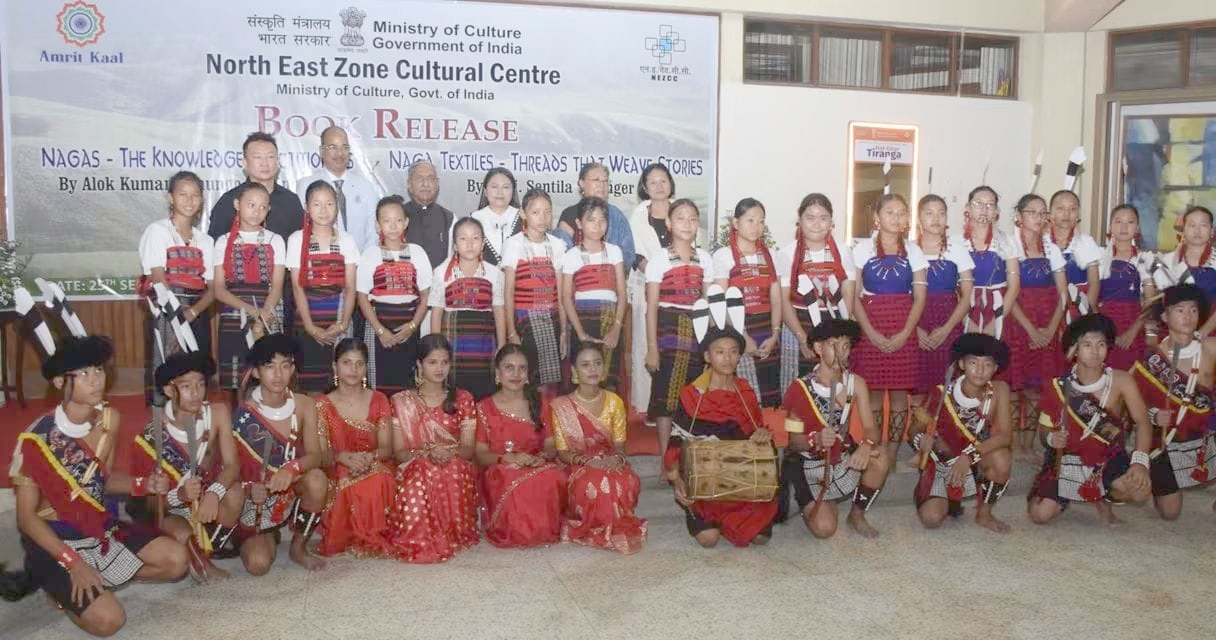
Yadav congratulated Sentila T Yanger, Dr Alok Kumar Kanungo, Dr Alino Sumi, NEZCC, researchers, field workers, artisans and elders associated with the publications and expressed hope that the books would stimulate further scholarship on the diversity of Naga knowledge systems.
Director, NEZCC, Alobo Naga, in his welcome address said the two publications were valuable contributions towards documenting and preserving Naga knowledge, traditions, craftsmanship and cultural narratives.
He said NEZCC had been supporting scholars, artists and cultural practitioners in documenting traditional knowledge, folk practices, indigenous art forms and other cultural traditions and stated that such efforts helped preserve aspects of Naga cultural identity and pass them on to future generations.
Short speeches were also delivered by the authors, Alok Kumar Kanungo, Associate Research Professor (Archaeology), Department of Humanities and Social Sciences, IIT Gandhinagar, Dr Alino Sumi and Padma Shri, Sentila T Yanger.
The programme also featured cultural presentations by Woniro Von representing the Lotha tribe, Eklavya School representing the Ao tribe, and Nagaland Bhojpuri Samaj, Dimapur.
The programme concluded with a vote of thanks by Assistant Director, NEZCC, Temsunaro.