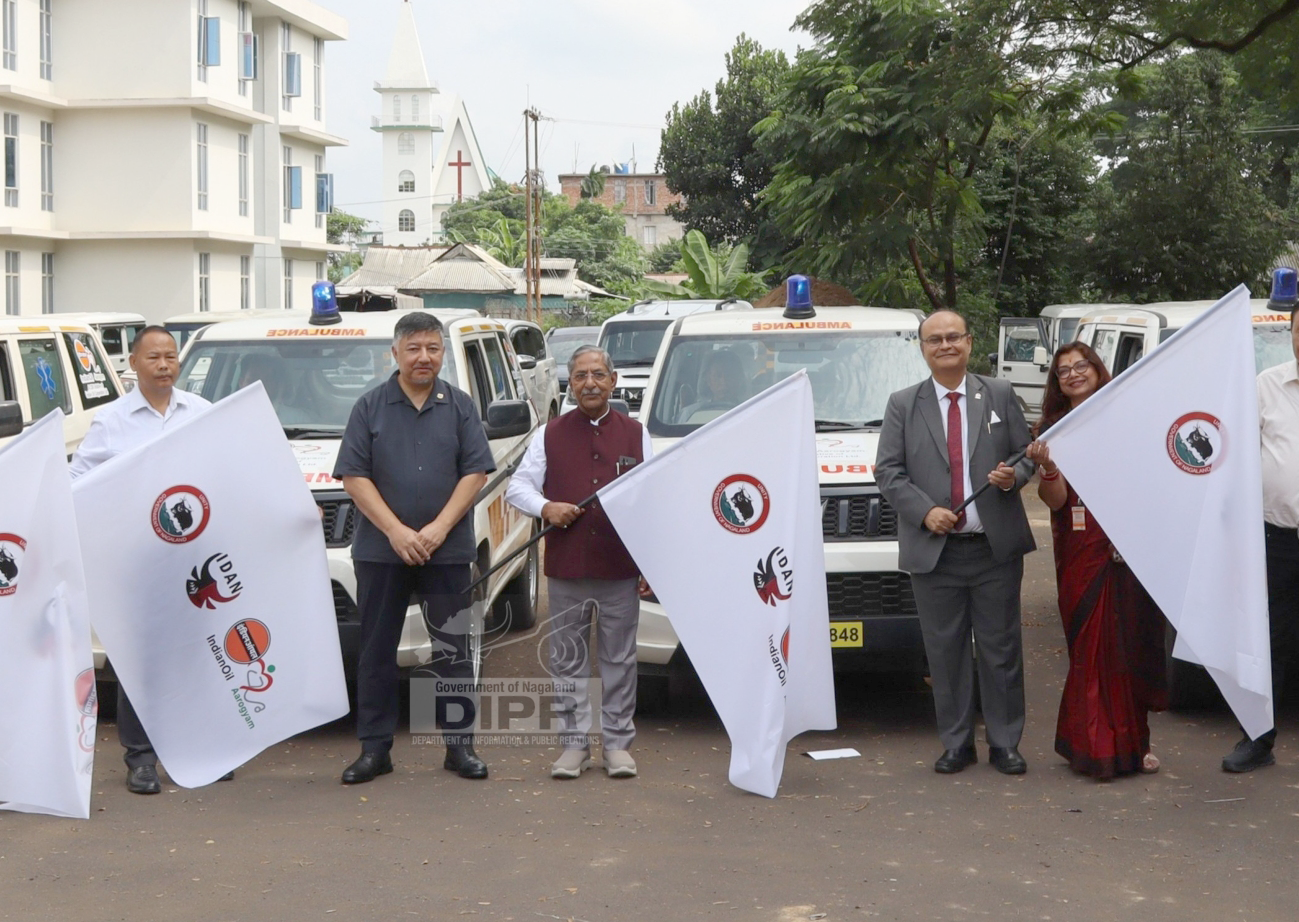
Governor of Nagaland Nand Kishore Yadav on Friday flagged off four Basic Life Support (BLS) ambulances supported by Indian Oil Corporation Limited (IOCL) and virtually inaugurated an Apple Cider Vinegar (ACV) Processing Unit at Thanamir village in Pungro, Kiphire district, under initiatives aimed at strengthening emergency healthcare and promoting agricultural value addition in the State.
According to a DIPR update, the programme, organised by the Investment and Development Authority of Nagaland (IDAN) at the Integrated Business Hub and Innovation Centre (IBH & IC), Forest Colony, Dimapur, also featured the formal handover of the processing unit and the ambulances, along with the ceremonial handover of allotted rooms at the IBH & IC.
Addressing the gathering, Governor Yadav congratulated IDAN, IOCL, the concerned departments and other stakeholders, saying the initiatives shared the common objective of improving quality of life and promoting inclusive development in Nagaland.
He said the ambulances would strengthen access to emergency healthcare, while the ACV Processing Unit would create opportunities for entrepreneurship, agricultural value addition and sustainable livelihood generation.
Appreciating IOCL’s support to emergency healthcare, the Governor observed that Nagaland’s mountainous terrain, dispersed settlements and long distances between villages and healthcare institutions often posed challenges to timely medical assistance, particularly during emergencies. Properly equipped BLS ambulances, he said, would strengthen emergency response and facilitate the safe and timely transportation of patients from remote areas and peripheral health facilities to higher medical centres.
Emphasising the importance of Corporate Social Responsibility (CSR), Yadav expressed hope that the initiative would encourage other public and private sector organisations to complement government efforts through interventions with measurable social benefits. He stressed that geographical challenges and distance should not become permanent barriers to development and that essential services must reach remote communities.
Turning to the ACV Processing Unit at Thanamir, the Governor said Nagaland had considerable agricultural and horticultural potential, but greater economic value could be generated by moving beyond the sale of raw produce through processing, packaging, branding and market development.
Describing the facility as an example of locally rooted, market-oriented development, he said farmers should be able to participate in the wider value chain and benefit not only from selling fresh apples but also from processing and marketing apple-based products.
He underscored the need for a comprehensive ecosystem encompassing storage, processing infrastructure, quality standards, packaging, branding, logistics, finance and reliable market access to help farmers realise the full economic potential of their produce.
The Governor said the two initiatives complemented each other by addressing fundamental aspects of human and economic development: while ambulances helped protect and preserve lives, the processing unit could create opportunities for sustainable livelihoods and economic growth.
He called for sustained partnerships among government departments, public sector organisations, private companies, financial institutions, entrepreneurs, communities and civil society to ensure that development reached every part of the State. He also stressed the need to strengthen healthcare, improve opportunities for farmers, empower youth through skills and enterprise, expand women’s participation in economic activities and connect local products with markets within Nagaland, across the country and internationally.
Advisor to the Chief Minister and Chairman of IDAN, Abu Metha, called for greater collaboration among the government, corporate institutions and local communities to promote inclusive economic growth and ensure that development initiatives reached the grassroots.
Metha said IOCL had invested more than ₹3.5 crore in CSR activities in Nagaland over the past few years and was exploring further initiatives through gap analysis to identify areas where corporate support could make a meaningful difference. He also appreciated the corporation’s investment of more than ₹300 crore in upgrading its facilities in the State.
Download Nagaland Tribune app on Google Play


Referring to the ACV Processing Unit at Thanamir, Metha described it as a small but significant step towards addressing the economic challenges faced by farmers in remote areas. He noted that Thanamir, located close to the India-Myanmar border, continued to face geographical constraints and limited market access, affecting local economic activities.
He said the processing plant demonstrated the importance of extending development opportunities to remote communities and strengthening the economic prospects of local farmers.
Highlighting Dimapur’s strategic importance as a growing economic and transportation hub, Metha said the district, along with adjoining areas of Chümoukedima and Niuland, had considerable potential because of its connectivity, human resources, young population and emerging opportunities in innovation and entrepreneurship.
He called upon communities, businesses and other stakeholders to work collectively, stressing that government initiatives alone would not be sufficient without active public participation and cooperation. He also urged the people of Nagaland to strive for competitiveness at the national and international levels, adding that stronger local enterprises and economic success would contribute to nation-building and India’s overall progress.
In his welcome address, Additional Secretary, IDAN, Vineet Kumar, IAS, informed that IOCL had extended financial assistance of ₹58.08 lakh for the procurement of four BLS ambulances in Nagaland. He also stated that the ACV Processing Unit at Thanamir village in Pungro, Kiphire district, had been established under the Chief Minister’s Innovative Programme with a sanctioned amount of ₹50 lakh.
Kumar described the ambulances as an important step towards strengthening last-mile healthcare delivery, highlighting the role of government partnerships with institutions such as IOCL in complementing public services and addressing infrastructure gaps.
The processing unit, he said, was expected to create opportunities for value addition, reduce post-harvest losses, encourage local enterprise development and improve economic returns from agricultural produce. Such facilities, he added, were intended to support an integrated system covering agricultural production, storage, processing and value addition.
Emphasising effective implementation, Kumar said the success of public investment should be measured by tangible benefits to citizens rather than merely by the sanctioning, establishment or inauguration of projects. He urged the concerned departments, implementing agencies and local stakeholders to ensure that the facilities remained functional, were properly maintained and were used effectively to achieve their intended objectives.
The four BLS ambulances were allocated to Dhansiripar Community Health Centre (CHC), Medziphema CHC, Niuland CHC and Chümoukedima Primary Health Centre (PHC).
The programme also featured a video presentation highlighting IOCL’s CSR projects for 2026, followed by the ceremonial handover of assets by IOCL and a presentation on the ACV Processing Unit at Thanamir before its virtual inauguration.
The initiatives underline the role of public-private partnerships in strengthening healthcare infrastructure, promoting agricultural value addition and expanding sustainable economic opportunities across Nagaland.