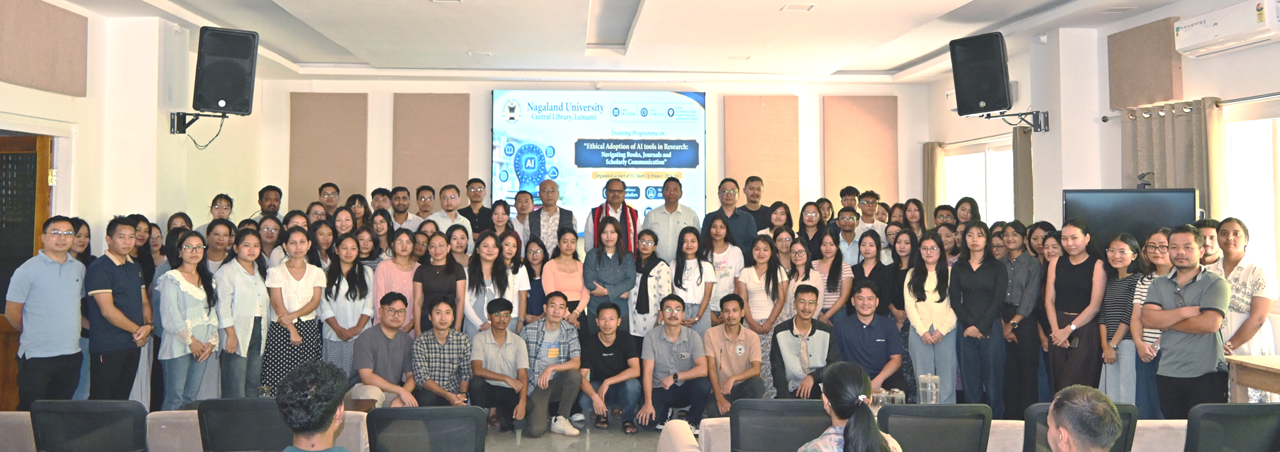
The Central Library of Nagaland University, Lumami, organised an offline training programme titled “Ethical Adoption of AI Tools in Research: Navigating Books, Journals and Scholarly Communication.” Held under the NU Start-Up Project (2024–26), led by Principal Investigator, Dr Chanlang Ki Bareh, the programme was attended by 120 PhD research scholars.
The inaugural session was moderated by Er Ochenstungba Ozukum, Information Scientist, and attended by the Chief Guest, Prof Jagadish K. Patnaik, Vice-Chancellor of Nagaland University; Prof Bendang Ao, Director, Research and Development Cell; Dr Kevezai Tureng, Director, College Development Council; faculty members and research scholars.
In his keynote address, Deputy Librarian Dr T Temjen encouraged scholars to use AI responsibly and cautioned them about inaccurate AI-generated responses and fabricated citations.
In his address, Prof Patnaik reflected on his research experience at Queen’s University in Kingston in the early 1990s, when researchers relied on a 40 MB computer and physical library catalogue cards to locate books and articles. He noted that today’s AI tools offer speed and convenience but also raise ethical questions, including how to interpret similarity reports and distinguish acceptable from unacceptable use.
He emphasised that research supervisors and PhD scholars alike should be equipped to use AI effectively, and urged faculty members to exercise sound judgement about when and for what purposes such tools should be used. The inaugural session concluded with a vote of thanks by Dr Gyati Yam, Assistant Professor, Department of Forestry.
Download Nagaland Tribune app on Google Play


The technical session, led by Dr Chanlang Ki Bareh, Assistant Librarian, featured demonstrations of research-support tools, large language models and other AI applications, including SciSpace, Elicit, Litmaps, Research Rabbit, Gemini, ChatGPT and QuillBot.
Er Ozukum also demonstrated registration for the QuillBot premium service provided by the University.
Dr Bareh discussed responsible AI use across the research process, from brainstorming and literature searches to data analysis and peer review. He outlined appropriate uses, disclosure requirements and prohibited practices, warning against fake citations, uploading sensitive or unpublished material to public AI tools, and relying on AI to analyse or interpret findings on behalf of researchers.
He also cautioned that excessive reliance on AI could weaken scholars’ critical thinking and analytical skills. The programme concluded with remarks by Jailei Konyak, Semi-Professional Assistant. Certificates were presented to all 120 participants, followed by an interactive discussion.