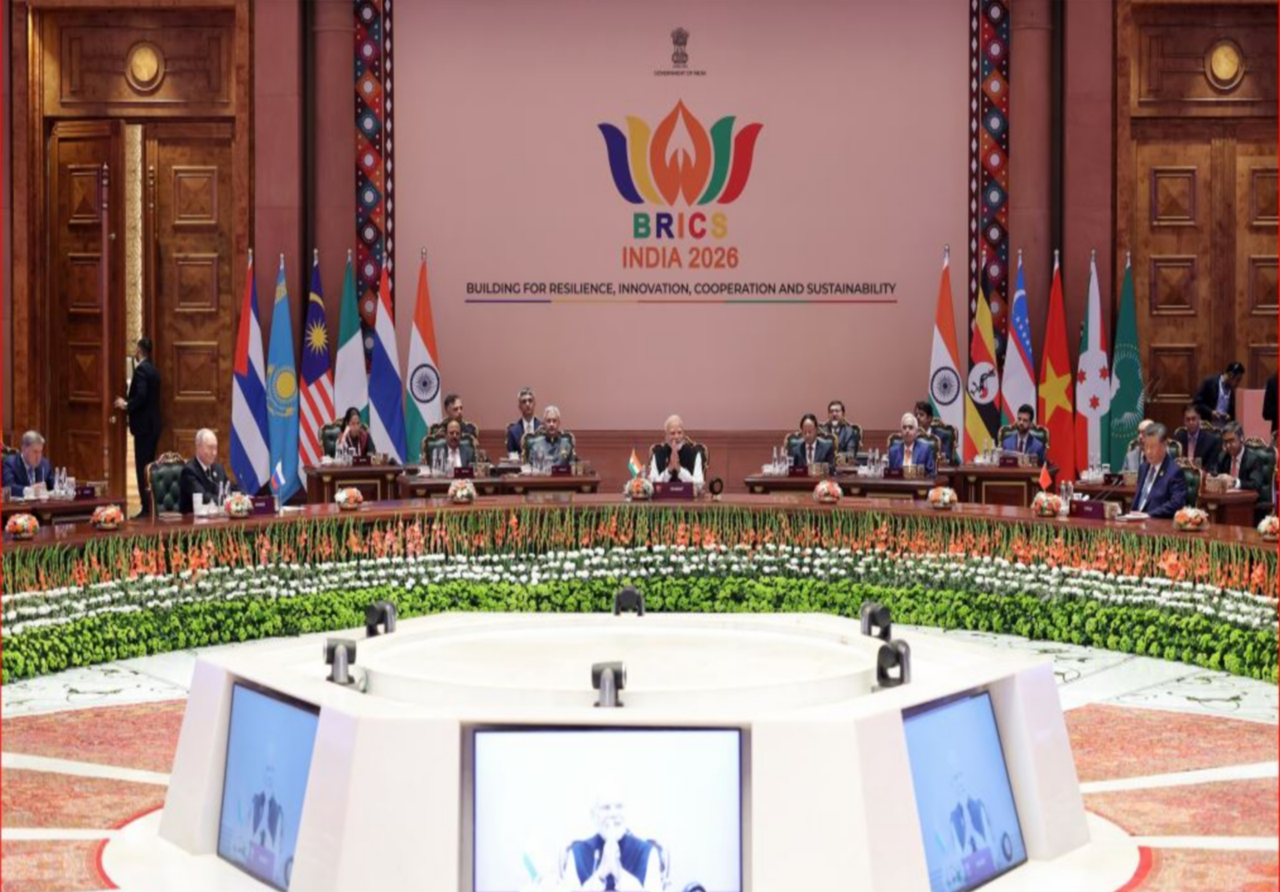
BRICS countries have expressed concern over growing risks of nuclear conflict and called for stronger international efforts towards disarmament, arms control and nuclear non-proliferation to promote global peace, stability and security.
The call was made in the New Delhi Declaration 2026, adopted by consensus at the 18th BRICS Summit in New Delhi, where India is hosting the grouping under the chairship theme “Building for Resilience, Innovation, Cooperation and Sustainability.”
The BRICS nations reaffirmed their support for nuclear-weapon-free zones and stressed the need to accelerate efforts towards establishing a zone free of nuclear weapons and other weapons of mass destruction in the Middle East, ANI reported
The grouping called on all invited parties to participate in the conference on establishing such a Middle East zone “in good faith” and to engage constructively in the process.
The declaration also took note of the adoption of United Nations General Assembly Resolution 79/241, titled “Comprehensive study of the question of nuclear-weapon-free zones in all its aspects,” and the successful conclusion of the study adopted by the group by consensus.
Women’s participation in peace and security
On the Women, Peace and Security agenda, BRICS reaffirmed its commitment to the full implementation of UN Security Council Resolution 1325 (2000) and subsequent resolutions.
The grouping stressed the importance of ensuring the “full, equal, safe, and meaningful participation of women” in decision-making at all levels of peace and security processes.
This, it said, should extend to conflict prevention and resolution, humanitarian relief, mediation, peace operations, peacebuilding, and post-conflict reconstruction and development.
BRICS condemns J&K terror attack
The BRICS countries condemned in the strongest terms the April 22, 2025 terrorist attack in Jammu and Kashmir, in which 26 people were killed and several others injured.
The declaration reaffirmed the grouping’s commitment to combating terrorism in all its forms and manifestations, including the cross-border movement of terrorists, terrorism financing and the existence of safe havens.
BRICS called for zero tolerance towards terrorism and rejected double standards in dealing with the menace.
It also called for the expeditious finalisation and adoption of the Comprehensive Convention on International Terrorism under the UN framework and urged concerted action against all UN-designated terrorists and terrorist organisations.
Download Nagaland Tribune app on Google Play


BRICS opposes unilateral sanctions, protectionism
In a separate economic thrust, BRICS called for an immediate end to unilateral economic sanctions and expressed concern over growing protectionist policies, warning that arbitrary tariff increases and trade barriers presented as environmental measures were disrupting global supply chains and disproportionately affecting developing countries.
The New Delhi Declaration said the global multilateral trading system had reached a critical crossroads, with countries increasingly adopting trade-restrictive measures that, according to the grouping, violate World Trade Organisation rules.
BRICS warned that rising customs duties, non-tariff barriers and protectionist restrictions disguised as environmental measures could disrupt international commerce, increase global economic uncertainty, deepen disparities among nations and hinder global economic growth.
The grouping agreed to work towards making the WTO more responsive to trade disruptions while ensuring that the economic and developmental interests of emerging markets and developing countries remain a priority.
Strong stand against economic coercion
BRICS strongly condemned unilateral and secondary sanctions imposed outside the mandate of the UN Security Council, maintaining that such measures violate international law and the UN Charter.
The declaration noted that unilateral restrictions can have far-reaching consequences for fundamental human rights in targeted countries, including access to food, healthcare and economic development.
The grouping also reaffirmed its commitment to strengthening global economic governance, noting the growing contribution of emerging markets and developing economies (EMDEs) to global output and growth.
It called for reforms of the Bretton Woods Institutions to make them more agile, effective, credible, inclusive, fit for purpose, unbiased and accountable, with governance structures reflecting the transformation of the global economy since their establishment.
BRICS said the voice and representation of EMDEs in the Bretton Woods Institutions should correspond to their growing position in the global economy.
It also called for greater regional diversity and representation of emerging and developing economies in the leadership of the International Monetary Fund and World Bank.
Push for WTO reform
The BRICS countries reaffirmed their support for reform of the World Trade Organisation and called for a stronger, open, equitable, transparent, fair, inclusive, predictable and rules-based multilateral trading system with the WTO at its core.
The grouping strongly advocated the immediate restoration of an accessible, effective and fully functioning two-tier binding WTO dispute settlement mechanism.
It also called for the appointment of new members to the WTO Appellate Body without further delay.
The wide-ranging New Delhi Declaration reflects the BRICS grouping’s positions on nuclear security, terrorism, women’s participation in peace processes, global trade, economic governance and the reform of multilateral institutions as India hosts the 18th BRICS Summit in New Delhi on September 12-13.
(with ANI inputs)