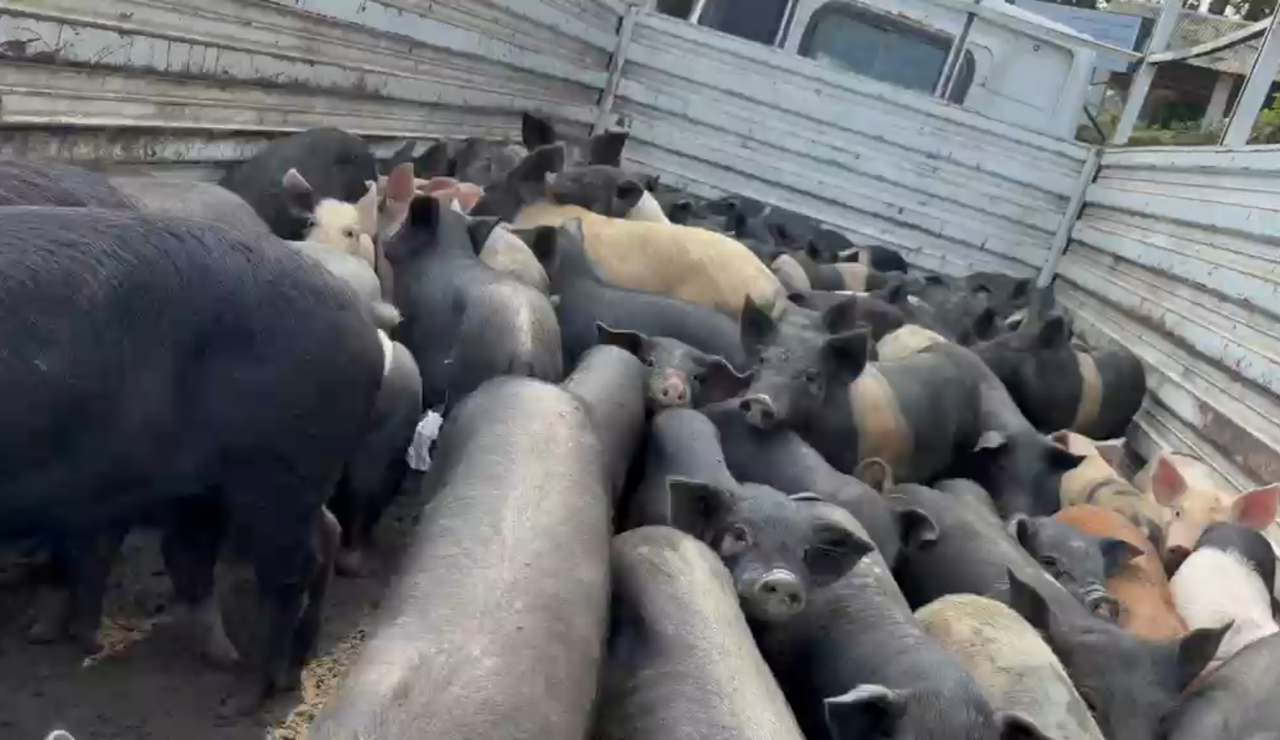
First-of-its-kind initiative under the Local Area Development Programme (LADP) in Nagaland, the 23 Impur (ST) Assembly Constituency Community Piggery Project was formally launched at Kubolong on April 29, with 169 piglets distributed to 105 beneficiaries across the Asetkong range under Mokokchung district. The project was organised by the Think Tank Committee, Asetkong under the patronage of TN Mannen, IAS (Retd.), MLA and Advisor for Law & Justice, Land Revenue, Government of Nagaland.
Addressing the gathering during the launch of the community piggery initiative under the District Plan funding for the Asetkong range, TN Mannen stated that the initiative was conceived as a ‘community participatory project’ aimed at promoting sustainable livelihood and strengthening the rural economy through piggery development in the Asetkong range.
He said that detailed guidelines had been prepared for beneficiaries to ensure proper implementation and long-term sustainability of the project. Many projects are initiated but often fail to achieve the intended outcome, but this project have guidelines formulated with inputs from the advisor, the Think Tank team in collaboration with the Department of Animal Husbandry & Veterinary Services (AH&VS).
According to the project guidelines, the initiative has been introduced as a pilot community participatory venture covering the Asetkong range under 23 Impur Constituency of Mokokchung district. The document noted that Nagaland continues to depend largely on agrarian activities and that nearly 70 percent of the population is still dependent on agro-forestry practices, including jhum cultivation. It stated that diversification into animal husbandry and allied activities such as piggery, poultry, goatery, cattle rearing and fisheries would provide more productive and sustainable economic opportunities.
The guidelines described the Asetkong range as the smallest range in Mokokchung district but possessing favourable agro-climatic conditions, abundant water resources and fertile basins suitable for agriculture and allied activities. It further stated that piggery has significant economic potential in the range due to increasing pork consumption and the gap between local demand and supply, which has resulted in pigs being imported from outside the state.
A total of 105 beneficiaries were distributed piglets sourced from outside the state, including from West Bengal, after being examined and cleared by the department. Altogether, 169 piglets, comprising 151 female boars and 18 male boars, were distributed covering all villages and blocks under the 23 Impur Constituency in the Asetkong range.
The document observed that traditional pig rearing practices often suffer from poor housing, nutrient-deficient feeding, irregular healthcare and inferior breeding management, thereby affecting economic returns. It added that the project seeks to improve breeding, feeding and management practices through scientific intervention and collective community participation.
The guidelines further stated that the piggery farming initiative in the Asetkong range is intended as a pioneering venture to collectively improve sustainable livelihood income for the area. It mentioned that if successful, the project could later evolve into a systematic pig breeding and marketing cooperative society along with feed compounding units using locally available raw materials such as maize, tapioca and vegetables to reduce production costs.
Under the project structure, a Project Medical Team (PMT) headed by a qualified and experienced veterinarian has been constituted to oversee animal healthcare, disease control and preventive measures. The team will also conduct regular inspections and provide practical education and instructions to growers regarding livestock care.
Download Nagaland Tribune app on Google Play


The project also provides for the constitution of a Governing Body-cum-Monitoring Committee comprising representatives from the Think Tank team, village councils, beneficiaries, expert management units and veterinary department officials for day-to-day supervision and management.
The intervention strategy includes backyard pig breeders and fattener units. According to the guidelines, for every ten breeder females there shall be two breeder boars maintained in a 1:10 ratio to avoid in-breeding. Genetic records of both male and female pigs are to be maintained through lineage recording books. It also specified that breeder sows should not be sold for slaughter before two to three years of breeding.
The project further provides for establishment of feed mill units within the Asetkong range, where locally produced crops and cereals will be used for feed compounding. In return, feed mill owners are expected to distribute feed to association units at subsidised rates.
A “Pig Bank” mechanism has also been incorporated under which each breeder unit will contribute one piglet from the second farrowing to the localised Pig Bank for redistribution to deserving households selected by village councils and management committees in the next phase of beneficiaries.
Regarding the role of village councils, the guidelines stated that councils will be responsible for selecting beneficiaries capable of successfully implementing the scheme. Village-level project management committees will also be constituted, including VDB secretaries designated to maintain records and correspondence related to the project.
Under the responsibilities laid down for beneficiaries, each beneficiary is required to construct pigsties according to specifications provided by the technical team and veterinary department before distribution of piglets. The project will provide five pieces of 10×3 CGI sheets for roofing support. Beneficiaries are also required to ensure proper feeding and management of the animals.
The continuation of the guidelines further stated that any health-related problem concerning the pigs must be promptly reported to the veterinary technical team for timely intervention and treatment. It further specified that no breeding pigs shall be sold before two to three years in order to continue breeding activities, and in cases where disposal becomes necessary, prior permission must be obtained from the PMT leader.
The document also stated that piglets are to be reserved for supply to future beneficiaries in the following year at reasonable rates fixed by the Think Tank team. As part of the sustainability mechanism, five percent of the proceeds from each pig sold in the market will be contributed to the Think Tank team to meet supervisory, veterinary and miscellaneous expenses related to the project.
Mannen maintained that the success of the pilot project would depend on “full hearted cooperation and sincere implementation” by beneficiaries, along with timely supervision and active involvement of village councils.
He stated that after assessing the strengths and weaknesses of the area and its people, the community piggery project was considered the most suitable venture to begin with, considering the increasing demand for pork and the economic prospects associated with pig rearing. He further stated that pig rearing, being both a traditional and modern economic activity, has the potential to enhance the economic well-being of the people while generating employment opportunities for both educated and uneducated youth.
The initiative, it added, has therefore been undertaken as a pioneering people’s participatory project through District Plan funding allotted for the 23 Impur Constituency, with the objective of eventually making the Asetkong range a pig surplus area depending on the success of the venture.
The National Livestock Mission (NLM) scheme was introduced under which livestock farmers were informed that they can avail insurance coverage for their animals by paying only 15 percent of the premium, while the remaining 85 percent is borne by the Central and State governments.
TN Mannen, announced that he would personally cover the 15 percent premium required from each beneficiary. He urged the beneficiaries to rear the pigs properly, adhere to the prescribed guidelines given, and make effective use of the initiative.
A word of encouragement was delivered by Akumjungba, Council Chairman, MCT, while technical inputs were presented by Dr N Yanger Kubzari, Farm Manager, State Cattle Breeding Farm. “Looking ahead and appreciation” was delivered by Aongsen Aier of the Think Tank team.
Wati Kichu, Pastor, Chami Baptist Arogo pronounced the invocation while greetings were delivered by T Imlitoshi Walling, President, Asetkong Mungdang. Benediction and dedicatory prayer for the project was pronounced by I Lanu Longkumer, Pastor, Kubolong Baptist Arogo.
Following the inaugural session, an orientation hour for piggery beneficiaries was conducted by resource persons Dr Simon Ao (retd) former Deputy Director and Joint Director, Department of Animal Husbandry & Veterinary Services (AH&VS), Nagaland and Dr Sarendi Walling, ACTO, Animal Science, KVK, Mokokchung.