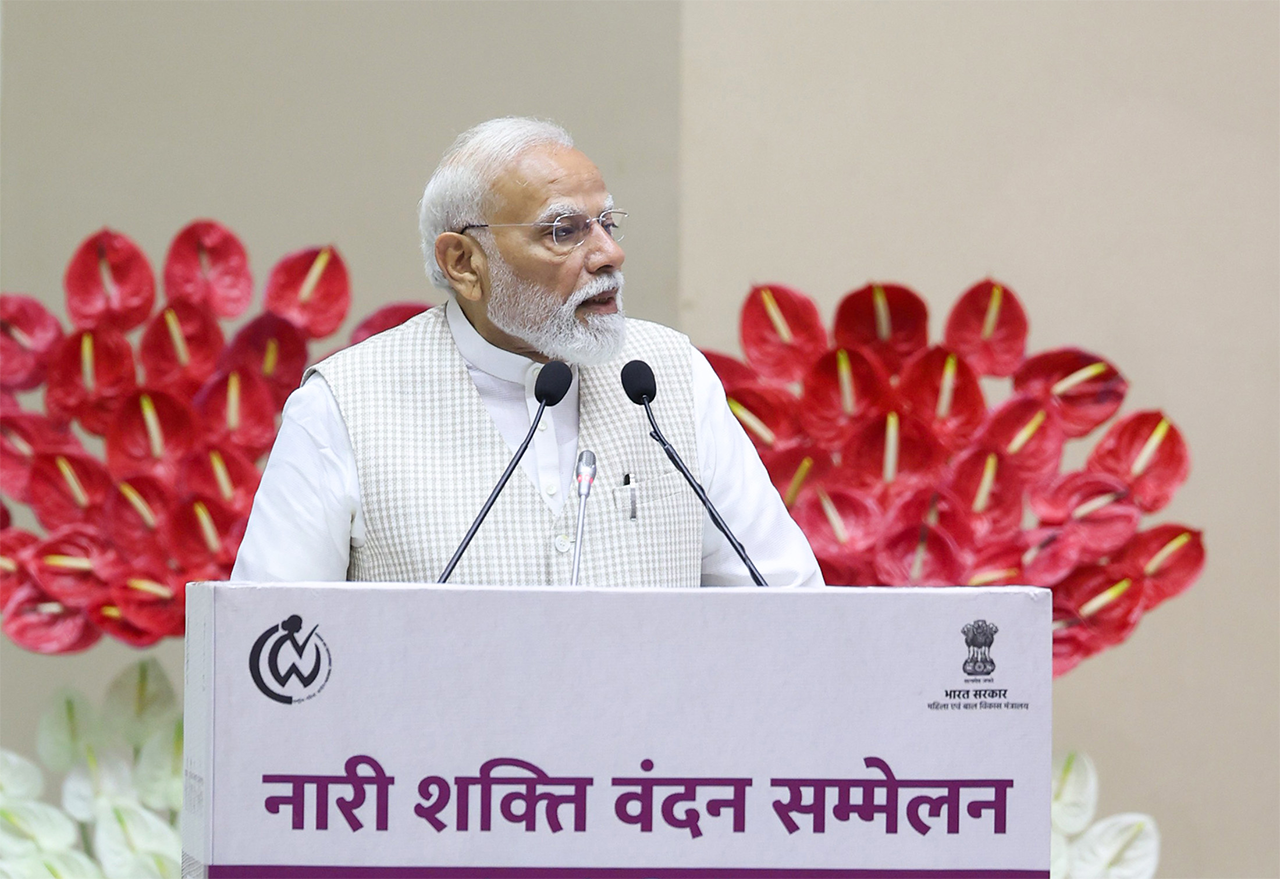
Prime Minister Narendra Modi on Monday described the proposed implementation of the Nari Shakti Vandan Act as one of the most significant decisions of the 21st century, asserting that it will play a transformative role in strengthening women’s participation in India’s democratic institutions.
Addressing the Nari Shakti Vandan programme at Vigyan Bhawan, the Prime Minister termed the moment historic and said the country is on the verge of creating a new chapter in its parliamentary journey—one that fulfills long-standing aspirations for gender equality and social justice.
Speaking on the occasion of Baisakhi and ahead of New Year celebrations in different parts of the country, Modi also paid tribute to the martyrs of the Jallianwala Bagh massacre, recalling their sacrifices and linking them to the broader ideals of justice and equality.
Highlighting the importance of inclusive governance, the Prime Minister said India envisions a society where social justice is not merely a slogan but an integral part of governance and public life. He remarked that the decades-long wait for enhanced political representation of women—from state assemblies to Parliament—is now nearing its conclusion.
Recalling the passage of the Nari Shakti Vandan Act in 2023, Modi noted that the legislation had received unanimous support across party lines, reflecting a shared national commitment. He stressed that the law must be implemented within the stipulated timeline so that women’s participation in legislative bodies can be significantly enhanced. In this regard, he informed that a special session of Parliament’s Budget Session is scheduled to begin on April 16, with efforts being made to take the process forward through dialogue, cooperation, and consensus.
According to a PIB release, the Prime Minister observed that the announcement has generated widespread enthusiasm among women across the country, many of whom are now expressing aspirations to contest elections and serve in legislative roles. He urged women to actively engage in the process by interacting with their Members of Parliament and sharing their expectations and perspectives.
Reflecting on history, Modi highlighted the crucial role played by women in India’s freedom struggle and in shaping the foundations of the nation. He said women have consistently demonstrated leadership and capability whenever given the opportunity. Noting that women today occupy key positions—from the highest constitutional offices to critical roles in governance—he said their contributions continue to strengthen the nation.
He cited Panchayati Raj institutions as a strong example of grassroots empowerment, stating that over 14 lakh women are currently serving in local governance bodies, with participation reaching nearly 50 percent in around 21 states. This, he said, has not only enhanced democratic participation but also improved the quality of governance at the local level.
The Prime Minister pointed out that increased representation of women in decision-making has brought greater sensitivity and focus to issues such as water supply, education, healthcare, and nutrition. He cited the success of initiatives like the Jal Jeevan Mission as evidence of the positive impact of women’s leadership at the grassroots level.
Emphasizing economic empowerment as a cornerstone of women’s progress, Modi highlighted a range of government initiatives introduced over the past decade. These include schemes such as Beti Bachao-Beti Padhao to promote the welfare of the girl child, Pradhan Mantri Matru Vandana Yojana for maternal health, and Sukanya Samriddhi Yojana for financial security and education of daughters.
He also underlined the impact of financial inclusion programmes, noting that more than 32 crore women have opened bank accounts under the Jan Dhan Yojana. Additionally, over 60 percent of loans under the Mudra Yojana have been availed by women entrepreneurs, enabling them to establish and expand businesses.
Highlighting property ownership as a key factor in economic empowerment, the Prime Minister said that under the Pradhan Mantri Awas Yojana, homes have been registered in the names of women on a priority basis, benefiting over three crore women and strengthening their financial independence.
Download Nagaland Tribune app on Google Play

He further pointed to the growing participation of women in emerging sectors, including startups and technology-driven fields. According to him, more than 45 percent of registered startups in India have at least one woman director, reflecting a shift in the entrepreneurial landscape.
Modi also spoke about the role of skill development initiatives, noting that programmes such as Skill India have empowered women with new opportunities, including the rise of “Drone Didis” who are contributing to modern agricultural practices through the use of technology.
On the social front, the Prime Minister highlighted the expansion of self-help groups, stating that nearly 10 crore women have been connected to such networks. He added that the government aims to create six crore “Lakhpati Didis,” with more than three crore women already achieving this milestone, thereby contributing to rural economic growth.
Addressing women’s safety, Modi acknowledged it as a critical societal issue and said the government has taken significant steps to strengthen legal and institutional mechanisms. He referred to reforms under the Bharatiya Nyaya Sanhita, which include provisions to simplify FIR registration, enable e-FIR and Zero-FIR, and ensure faster justice delivery through special courts.

Reaffirming the government’s commitment, the Prime Minister said that the aspirations of women are central to India’s development journey. He emphasized that empowering women is not only a matter of equality but also a prerequisite for building a strong and developed nation.
In his concluding remarks, Modi called upon citizens to spread awareness about the Nari Shakti Vandan initiative across the country. He urged women to take the message to every village and community, ensuring that they understand the opportunities ahead and actively participate in shaping the nation’s future.
Stating that women’s participation in decision-making is essential for a vibrant democracy, he said, “When women move forward, the nation moves forward,” and emphasized that ensuring their rightful place in governance will be a defining step towards a more inclusive and progressive India.
