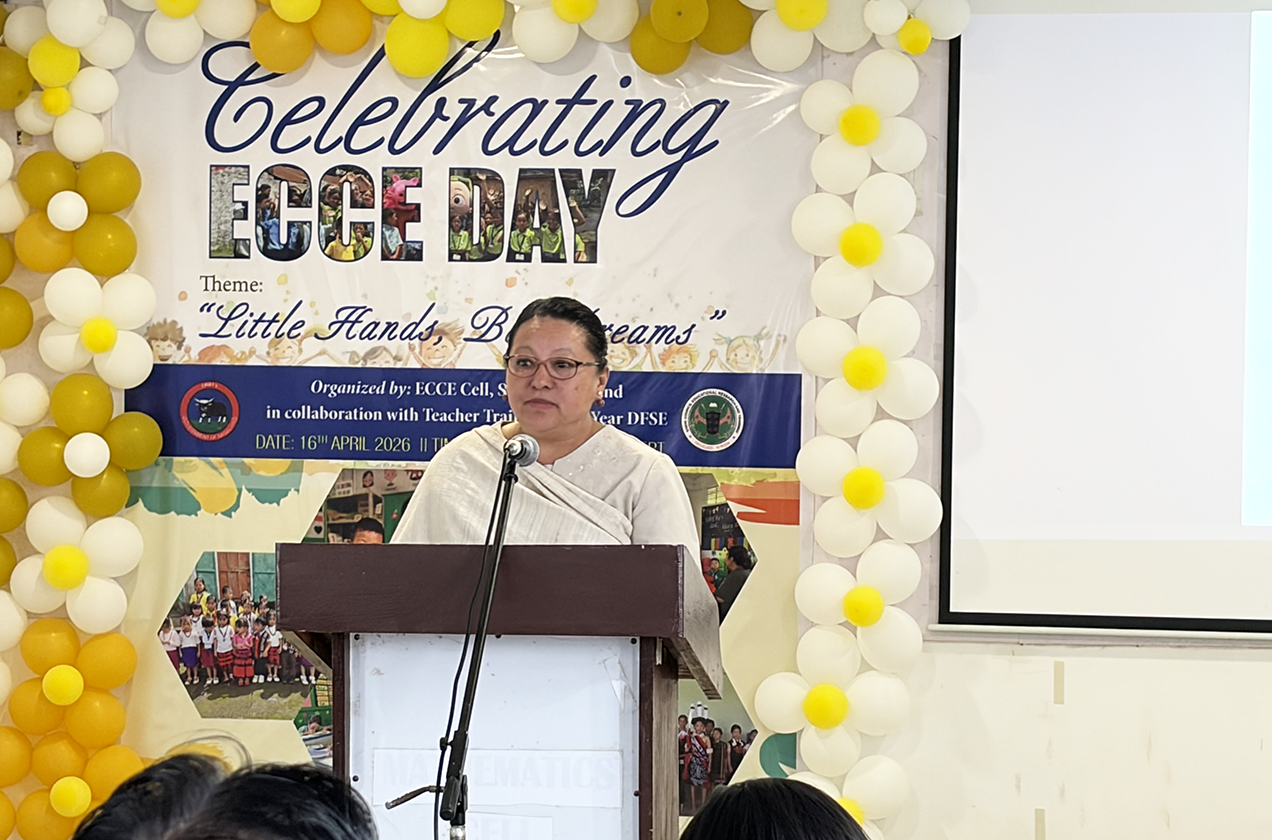
The State Council of Educational Research and Training (SCERT), Nagaland celebrated the 1st edition of ECCE Day on April 16 at Conference Hall 3, SCERT Kohima. The programme was organized by the ECCE Cell, SCERT, in collaboration with the in-service teacher trainees of the Two-Year Diploma in Foundational Stage Education (DFSE) as part of their course-based learning experience.
The event aimed to celebrate and promote the significance of Early Childhood Care and Education (ECCE), highlighting the crucial role of the foundational years—covering Classes A, B, 1 and 2—in shaping a child’s overall development.
Vikhweno Chale, Additional Secretary, Department of School Education, Government of Nagaland, graced the occasion as the Special Guest. In her address, she congratulated the in-service teachers for their enthusiasm and dedication, describing the programme as an opportunity to witness the sincere efforts being made by the department in strengthening early education.
She expressed appreciation for the well-developed training modules and commended the department and the ECCE team for equipping teachers with effective methodologies. Emphasizing that the early years are crucial for brain development, she said appropriate care and guidance at this stage are essential for nurturing young minds.
Reflecting on her perception of the word “teacher,” she shared that it once brought to mind images of books and classrooms. However, after observing the programme, she realized that foundational stage teachers are “special,” as they nurture children with kindness, empathy, patience, and love.
“They are the ones who hold the hands of children, make efforts to keep them happy, and shape their interest in learning,” she said, adding that teachers often transform a child’s attitude towards education and support parents who may struggle to guide their children academically.
Calling foundational teachers “heroes” and “future shapers of the next generation,” she urged them to instill the knowledge and skills gained through training into their classrooms. She expressed confidence that sincere implementation of these methodologies would increase enrolment in government schools.
Questioning why many parents hesitate to enroll their children in government schools, she stated that government institutions should be the first choice and asserted that they have the potential to be even better than private schools without the need for unhealthy comparison or competition.
She described teacher training as an investment in the future and encouraged educators to provide recommendations to the department to make the education system more progressive and responsive to challenges.
“Learning is a continuous process,” she remarked, urging all stakeholders to work together to ensure the holistic development of students and make schools vibrant centres of meaningful learning.
Earlier, Kerüüpfeü Rupreo, Director of SCERT Nagaland, delivered the keynote address, describing ECCE Day as not just another programme but a celebration of childhood itself—of curiosity, creativity, and the joy of learning. She highlighted that the event reflected the larger national vision under the National Education Policy 2020, which places strong emphasis on Early Childhood Care and Education.
Download Nagaland Tribune app on Google Play

She also referred to the National Curriculum Framework for Foundational Stage and the National Curriculum Framework for School Education, stating that these frameworks encourage joyful, play-based, activity-oriented and developmentally appropriate learning practices. She termed this as a significant shift from rote learning to experiential learning and from instruction-based teaching to facilitation.
Rupreo emphasized that the years between ages 3 to 8 are decisive in a child’s life, as language, cognitive abilities, and socio-emotional skills begin to take shape during this period. She noted that SCERT, through the Two-Year Diploma in Foundational Stage Education, has taken on the responsibility of preparing teachers to create inclusive, responsive, and joyful classrooms.
She, however, cautioned that training alone is not sufficient and stressed the importance of translating knowledge into classroom practice. The ECCE Day platform, she said, provided an opportunity to demonstrate innovation through live classroom practices, learning corners, project displays, cultural and skill-based demonstrations, food and nutrition corners, and assessment techniques aligned with national guidelines.
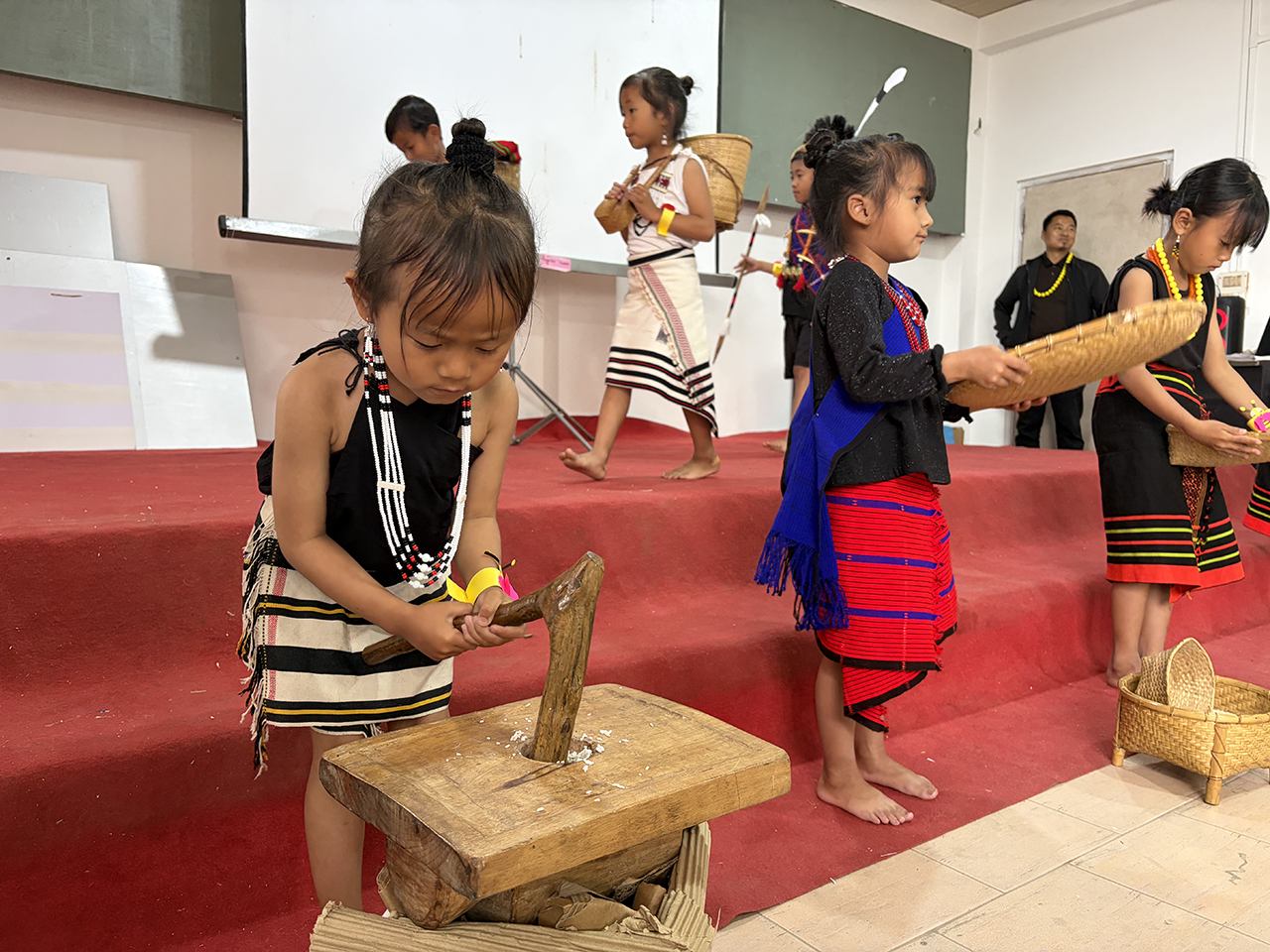
Highlighting the importance of contextual and culturally grounded practices, she encouraged educators in Nagaland to design learning experiences rooted in local culture and resources rather than copying external models. She called for ECCE Day to evolve into a sustained movement across DIETs, schools, and communities, strengthening partnerships between schools and parents.
The programme was chaired by Veketulu Veyie, Senior Lecturer, ECCE Cell, SCERT. Highlights included a Konyak lullaby presentation titled “Nao ü pu” by DFSE trainees, a speech on behalf of the trainees by Imtimongba of GPS Impang, Chuchuyimlang, and a presentation by Tughunaka T. Awomi of GPS Sahuboto. The event also featured a project work screening by the teacher trainees, showcasing innovative classroom practices and experiential learning models.
The event featured vibrant activities including project work screenings, cultural presentations such as the Konyak lullaby, and speeches by trainees Imtimongba and Tughunaka T Awomi. Demonstrations of learning corners, nutrition displays, and classroom practices reflected innovative, low-cost, and locally adaptable teaching approaches.