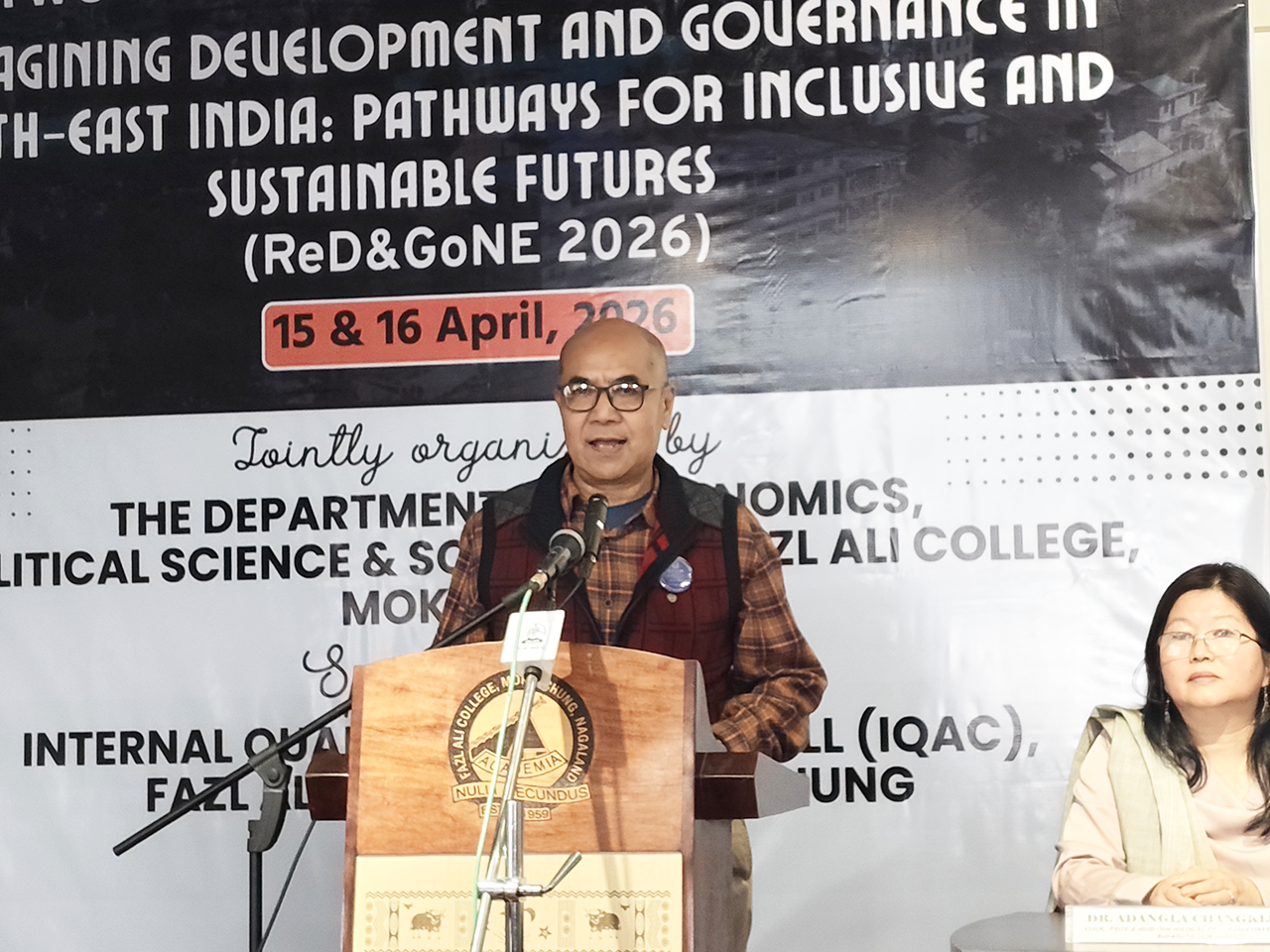
Two-Day National Conference ‘Reimagining Development and Governance in North-east India: Pathways for Inclusive and Sustainable Futures (ReD&GoNE 2026) commenced on April 15 at the Science Block lobby, Fazl Ali College, Mokokchung. The event is jointly organized by the departments of economics, political science & sociology of Fazl Ali College and is sponsored by the Internal Quality
Assurance Cell (IQAC), Fazl Ali College Mokokchung. Prof. Lanu Aier, retired professor from the Department of Sociology, NEHU, was the theme speaker, while Amba Jamir, Senior Policy Analyst and Development Strategist from Guwahati, Assam, served as the resource speaker.
The inaugural program included a formal programme along with technical deliberations, and parallel paper presentations.
While delivering the keynote address on the conference theme, Prof. Lanu Aier, retired Professor from the Department of Sociology, NEHU, dwelt extensively on the concept of “development,” describing it as a term present across all disciplines of arts, sciences, and beyond, yet one that carries multiple meanings and interpretations. He pointed out that the term has “thousands of definitions,” creating a dilemma in choosing a singular understanding.

To simplify, he defined development as any change brought about by action, whether good or bad, big or small. He emphasized that across disciplines such as sociology, anthropology, economics, political science, physics, chemistry, and mathematics, while definitions may differ, the common element is action. Without action, nothing happens; with action, change occurs, and such change constitutes development.
However, he raised a critical moral question: whether development is inherently good or bad. He illustrated this duality by citing the “development of cancer” as negative, while economic growth in Nagaland could be seen as desirable. Thus, he described development as “double-edged,” requiring careful and sensitive handling.
Prof. Aier further explained that development is often equated with progress, which he described as qualitative change. If such qualitative improvement is absent, development may instead result in regress. Similarly, development is also understood in terms of growth, referring to quantitative multiplication. In the absence of such growth, the outcome becomes decay. He noted that development inherently carries possibilities of progress and regress, growth and decay, and positive and negative outcomes.
He illustrated this with examples, stating that revolutionary changes leading to violence and loss of life cannot be considered positive, whereas changes promoting health and well-being could be constructive. He cautioned that development can be misleading, where something perceived as beneficial may ultimately turn harmful.
Download Nagaland Tribune app on Google Play

Highlighting the directional nature of development, he said it can move forward or backward, upward or downward. Using Nagaland as an example, he noted that industrialization and agricultural expansion generating income would indicate positive direction, while their decline would signify regression.
On the question of who drives development, Prof. Aier identified various dimensions of social, economic, political, urban, commercial, and religious stating that all are interconnected and collectively shape social development. He stressed that social development is a reflection of the cumulative impact of these processes.
He then raised questions regarding the state of development among Nagas, asking whether the people and the 14 tribes of Nagaland could claim to be more developed compared to others. He stressed the need to examine development within the specific geographical and social context of Nagaland.
Addressing the claims of Ao Nagas are the most advanced tribe by others, he expressed disagreement and questioned the basis of such claims whether economic, political, commercial, or religious superiority justifies such assertions. He noted that answers to these questions are often uncomfortable and highlight the dangers of uncritically following certain developmental paths.
Prof. Aier also examined the role of different groups in development. He questioned whether political parties, pressure groups, or interest groups are responsible for social development. While acknowledging that political parties contribute to some extent, he remarked that their involvement is often driven by their own objectives. He described pressure groups as professional entities capable of influencing outcomes, particularly during elections, and questioned the overall contribution of various interest groups.
On civil society, he stated that his sociological understanding differs from common perceptions in Naga society. He described civil society as entities that quietly provide ideas, suggest solutions, and address problems without seeking publicity. In contrast, he observed that many so-called civil societies in Nagaland are publicly visible but their actual contribution to social development remains questionable.
Throughout his address, he raised a series of reflective questions, including whether Nagas are developed, whether they are civilized, and what constitutes civilized behaviour. He questioned whether societal life promotes peace and tranquility.
He emphasized that social development cannot exist without economic development, political will, commercial capability, and moral or religious guidance. Without the ability to produce and sell goods, sustain economic activity, and maintain ethical values, social development would not be possible.
Referring to present realities, he pointed out that Nagaland largely depends on financial assistance from New Delhi. He questioned what would happen if such funding ceased, asking whether people would remain sustained. He stressed the importance of self-dependence.
Prof. Aier also highlighted the contradiction between claiming adherence to traditional values and the actual practice of those values in daily life. He questioned whether people truly embody the principles they attribute to their forefathers.
Drawing attention to dependency, he remarked that society risks becoming reliant to the extent of losing autonomy. He urged acceptance of this reality and the need to seek solutions.
He concluded by stating that Nagaland, like many other regions, remains a dependent society. He cautioned against avoiding problems and emphasized the need to confront them directly across social, economic, political, commercial, and religious dimensions.
The programme was chaired by Dr. Adangla Changkija, Associate Professor and Head of Department (Sociology), who also delivered the opening remarks as the programme convenor.
The welcome address was delivered by Dr. I. Wati Imchen, Principal and Patron of ReD&GoNE 2026. The session concluded with a summation and acknowledgement by Bendangsenla, Coordinator, IQAC, FAC.

Later the technical session–I was moderated by Dr. Lipokrenla Jamir, Associate Professor and Head of Department (Political Science). The session saw Amba Jamir, Senior Policy Analyst and Development Strategist from Guwahati, Assam, as the resource speaker. He spoke on the theme “From Frontier to Pivot: Reimagining Development and Governance in Peripheral Landscapes.”
The afternoon session comprised parallel paper presentations held at two venues: the Conference Hall and SB-31 Classroom. In the Conference Hall, under the theme “Rethinking Development and Economic Transformation,” the session was moderated by Kethosilhu Meyase, Assistant Professor and HoD (Economics), with Sentisola Tzudir, Assistant Professor (English), serving as recorder. Presentations were delivered by Dr. I. Koktiba on “Bridging Developmental Gap through Basic Livelihood,” Neito-ü Mero on “Institutional Convergence for Sustainable Horticulture Livelihoods: An SLF Perspective from Nagaland,” Dr. Levinu Sakhrie on “Governance Challenges in North-East India: Implications for Development and Democracy,” Sheriza Japhia Nonglait on “From Isolation to Gateways: Navigating the Kaladan Multi-Modal Transit Transport Project for Transformation in North East India,” Dr. P. Lalpekhlui on “Rethinking Development in Northeast India: An Exploration of Socio-Economic and Environmental Impacts of Mono-Crop Plantations,” and Rupali Boro on “Autonomy Dynamics in the Bodo Movement: Governance through Bodo Kachari Welfare Autonomous Council,” followed by a discussion and Q&A. Simultaneously, in SB-31 Classroom, the session on “Governance, Federalism, and Participatory Institutions” was moderated by Dr. Imnaznela Longkumer, Assistant Professor (Political Science), with Sentiwala T. Imchen, Assistant Professor (English), as recorder. The session featured presentations by Poushali Goswami on “Gender Role and Governance and Its Impact on Youths in Nagaland and Assam,” Yimyangner Ozukum on “A Study on Determinants of Participation in Vocational Education and Training in Nagaland, India,” Pievlohoutouu Zhale on “Job Reservation Policy in Nagaland: Assessing Inclusive Growth and Social Justice in a Frontier Region,” Zupenthung Shitiri on “Political Culture and Changing Perspective on Women’s Representation (Nagaland),” Kushemyimjong Chang on “Hybrid Governance and the Limits of Formal Authority: Community Policing in the Frontier Districts of Nagaland,” and Cheme S on “Rethinking Autonomy: Frontier Nagaland Territory Authority (FNTA) in Comparative Perspective,” and also concluded with a discussion and Q&A.