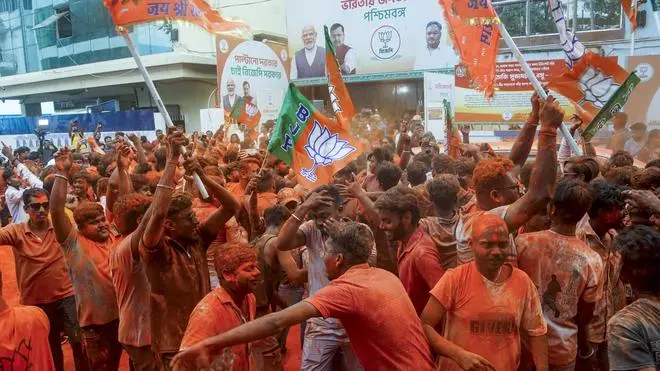
The 2026 Assembly election results in West Bengal have triggered a political earthquake, bringing an end to the long-standing dominance of Mamata Banerjee and propelling the Bharatiya Janata Party (BJP) to power with a commanding majority.
In a stunning reversal of fortunes, what was once considered an impregnable stronghold of the All India Trinamool Congress (TMC) has transformed into the BJP’s biggest breakthrough in eastern India, fundamentally reshaping the state’s political landscape.
As counting progressed across 293 constituencies, the BJP surged well past the majority mark of 147 seats, establishing a dominant position with 207 seats (wins and leads combined). In contrast, the TMC was reduced to just 80 seats, marking a dramatic decline from its previously unchallenged dominance.
Other political players remained largely marginal in the overall tally. The Indian National Congress and Aam Janata Unnayan Party secured two seats each, while the Communist Party of India (Marxist) and All India Secular Front managed just one seat apiece.
Although results for 254 constituencies had been formally declared at the time, with 39 still showing leads, the broader trend was unmistakable—West Bengal had decisively chosen a new political direction.
Interestingly, the vote share revealed a more competitive contest beneath the surface. The BJP secured 45.84% of the votes, while the TMC followed closely with 40.80%, indicating a tightly fought electoral battle at the grassroots level. The CPI(M) received 4.45% of the vote, while Congress garnered 2.97%, with smaller parties and independents collectively accounting for around 4.28%. The figures suggest that while the BJP converted its vote share into a sweeping seat advantage, the opposition continues to retain a significant support base.
The most symbolic moment of the election came from the high-profile Bhabanipur constituency, long regarded as a bastion of Mamata Banerjee. In a major upset, BJP leader Suvendu Adhikari defeated the Chief Minister by a margin of 15,105 votes. Adhikari secured 73,917 votes against Banerjee’s 58,812, while CPI(M) candidate Shrijeev Biswas finished a distant third. The defeat marked not only a personal setback for Banerjee but also symbolised the scale of the political shift sweeping the state.
Nagaland Tribune app on Google Play


However, the results have not been without controversy. Mamata Banerjee rejected the outcome, alleging large-scale irregularities and accusing the Election Commission of bias. She claimed that over 100 seats were “looted” and termed the BJP’s victory “immoral” and “illegal,” alleging misuse of central forces and administrative machinery, along with instances of violence and procedural violations during counting.
Tensions escalated at the Sakhawat Memorial Government Girls’ High School counting centre, where BJP representatives accused Banerjee of breaching Election Commission norms by entering without proper identification and carrying a mobile phone into a restricted zone. BJP agent Suryanil Das demanded a halt to counting, calling it a serious violation of security protocols.
Reports of violence further intensified the charged atmosphere, with clashes between BJP and TMC workers emerging from districts such as Cooch Behar and Barrackpore. In Howrah’s Dumurjala area, a TMC office was vandalised, with visuals showing extensive damage. While TMC leaders alleged targeted attacks, BJP leaders countered that the results reflected a public rejection of what they described as “politics of chaos.”
The 2026 verdict marks a watershed moment in West Bengal’s political history, signalling both a decisive shift in power and the beginning of a new and potentially volatile political chapter in the state.
(with inputs from ANI)
