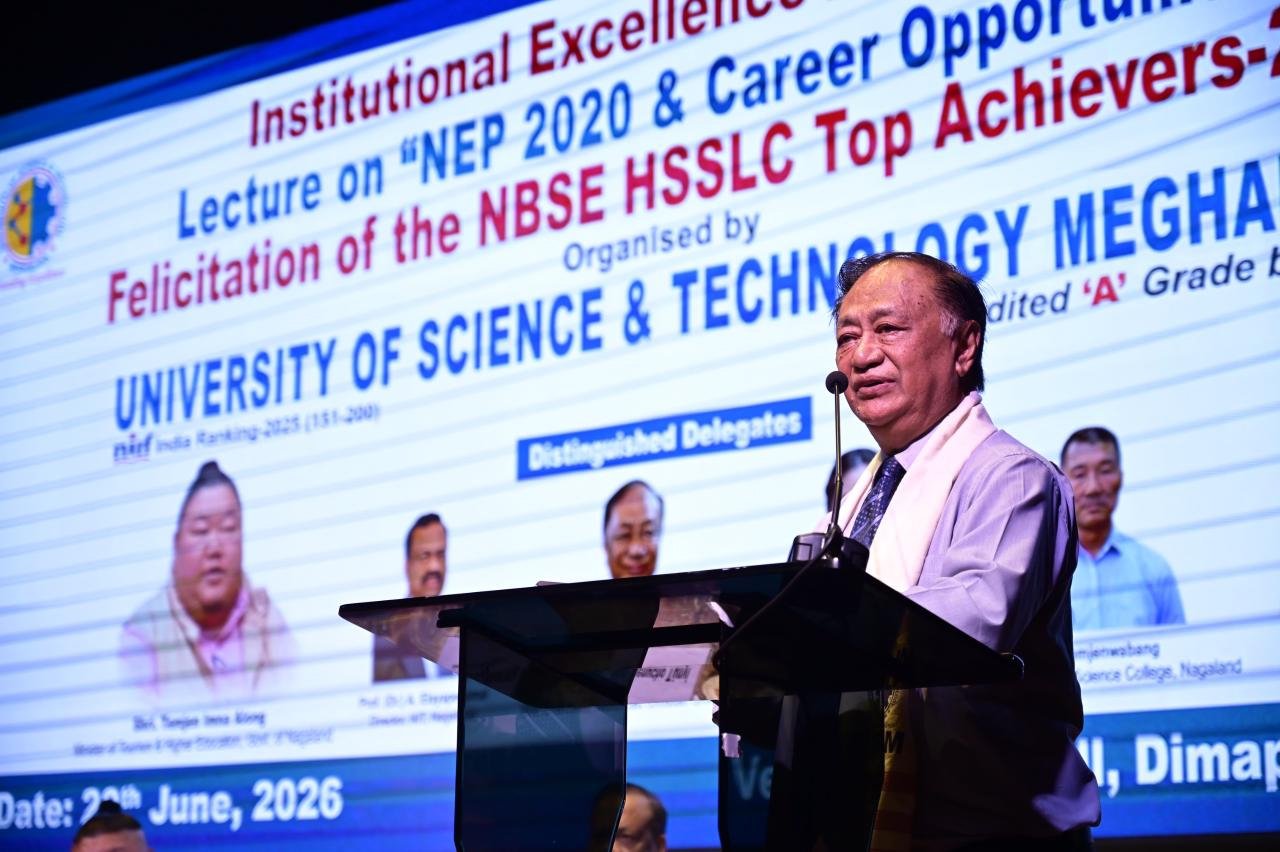
Emphasising that the future belongs to adaptable and skilled individuals rather than degree holders alone, Prof Darlong Khating, Vice Chancellor, North East Christian University highlighted the transformative opportunities offered by the National Education Policy (NEP) 2020 and urged students to prepare themselves for a rapidly evolving job market.
Delivering a lecture of NEP 2020 during the Felicitation programme of HSSLC Toppers organized by the University of Science and Technology Meghalaya (USTM), attended by outgoing school students and fresh graduates, Prof Khating said the traditional approach of choosing a degree solely for securing employment was no longer relevant. Instead, students should focus on developing capabilities and competencies that would keep them relevant over the next four decades.
He noted that technological advancements and changing economic realities are reshaping the nature of work globally. Citing projections of the World Economic Forum, he said nearly 40 per cent of existing jobs could disappear by 2030, while entirely new professions would emerge. In such a scenario, he stressed that students must cultivate the ability to learn continuously, adapt to change and create value.
Explaining the significance of NEP 2020, Prof Khating said the policy provides unprecedented flexibility in higher education by breaking the rigid barriers between academic streams. Unlike the earlier system where students were largely confined to science, commerce or arts disciplines, the new framework allows learners to pursue multidisciplinary education and combine subjects according to their interests and career goals.
He illustrated that a computer science student can study fashion design, an English graduate can pursue hospitality-related courses, and nursing students can venture into healthcare entrepreneurship. Such flexibility, he said, enables students to shape unique career pathways based on their talents and aspirations.
Khating also highlighted the apprenticeship and internship provisions under the policy, which allow students to gain practical work experience while pursuing their degrees. Instead of spending the entire duration of a course within classrooms, students can undertake industry placements for one or more semesters, with the experience counting towards academic credits.
“This ensures that by the time students graduate, they possess not only theoretical knowledge but also practical skills and work experience, qualities that employers increasingly seek,” he said.
Download Nagaland Tribune app on Google Play


Another major feature of NEP 2020, according to him, is the multiple-entry and multiple-exit system. Students facing financial, personal or other challenges can temporarily discontinue their studies without losing academic progress. Those completing one year of undergraduate study can receive a certificate, while two years can lead to a diploma, and three or four years to a degree.
He explained that the Academic Bank of Credits (ABC) system allows students to store academic credits digitally and retrieve them when they resume their studies. Credits earned at one institution can also be transferred to another institution, including, in some cases, international universities, thereby providing greater academic mobility and flexibility.
Khating said the policy encourages students to move beyond the mindset of merely seeking jobs and instead focus on solving real-world problems and creating opportunities. He observed that society faces numerous challenges in sectors such as water management, sanitation, education, waste management, tourism, energy and infrastructure, all of which offer avenues for innovation and entrepreneurship.
“There is no shortage of problems to solve. What is lacking are people who can create opportunities and develop solutions,” he remarked.
He further noted that employers today increasingly value skills, innovation and adaptability over academic qualifications alone. Students preparing exclusively for conventional jobs risk finding themselves equipped for careers that may become obsolete by the time they graduate.
Khating also pointed out that NEP 2020 itself has opened up new career opportunities, particularly in areas such as early childhood education, child development and foundational learning, as the policy places significant emphasis on children between the ages of three and eight years.
Encouraging students to make full use of the opportunities available under the policy, he urged them to remain open-minded, positive and committed to lifelong learning.
Congratulating the award recipients present at the programme, Khating expressed confidence that with perseverance, adaptability and a willingness to continuously acquire new skills, young people would be well positioned to succeed in an increasingly dynamic world. He wished them success in their future academic and professional pursuits.
