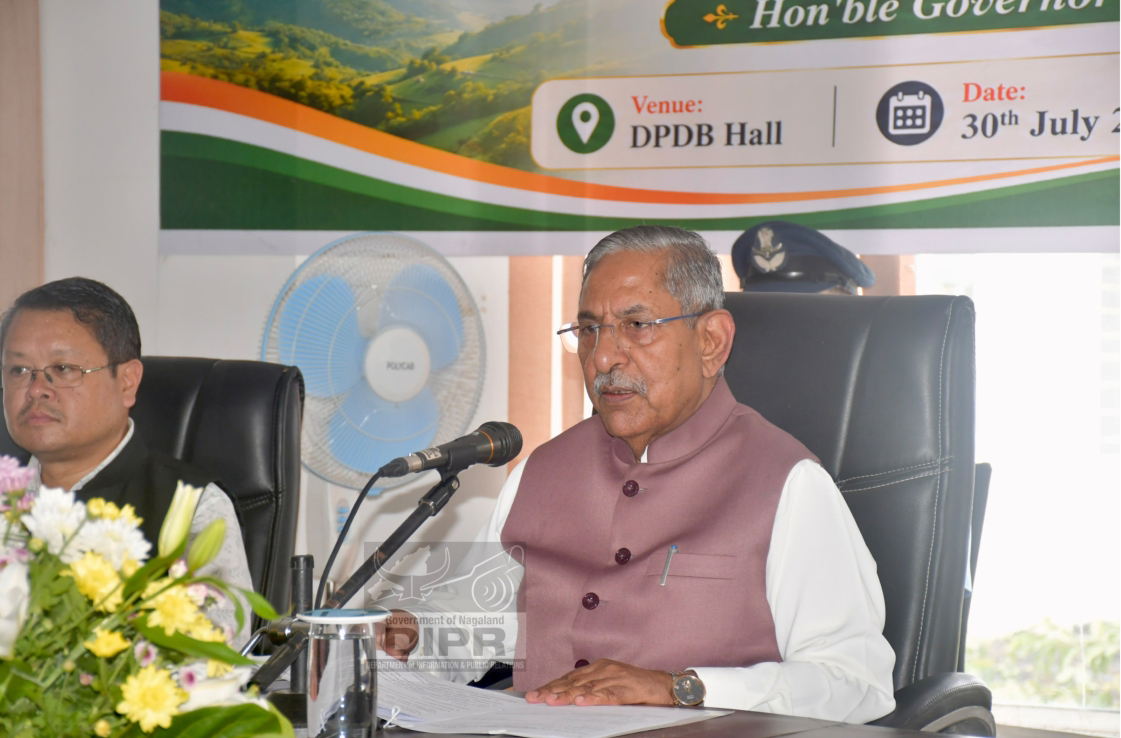
Nagaland Governor Nand Kishore Yadav on Thursday called for stronger collaboration between government departments and civil society organisations to ensure inclusive and sustainable development, describing Chümoukedima as the “Land of Opportunities” with the potential to emerge as a model district in the state.
The Governor was addressing a district review meeting at the DPDB Hall, DC Office Complex, during his visit to Chümoukedima district, where he interacted with civil society organisations, government departments and beneficiaries of various government welfare schemes. On his arrival, he was accorded a Guard of Honour, followed by the National Song and the National Anthem.
Addressing officials and civil society representatives, Yadav said Chümoukedima’s identity as the “Land of Opportunities” reflects not only its strategic location and economic potential but also the aspirations and dynamism of its people.
Emphasising the importance of cooperation between the government and civil society, he said development becomes more meaningful and sustainable when both work together with a shared sense of responsibility. He noted that the review meeting provided an opportunity to assess progress, identify challenges and explore practical solutions for the district’s development.
The Governor stressed that the success of development should not be measured merely by the number of schemes implemented but by the tangible improvements they bring to people’s lives. He urged all departments to ensure transparent and efficient implementation of government programmes so that every deserving beneficiary receives the intended benefits.
Highlighting the district’s rapid growth, Yadav said Chümoukedima has immense potential to become a centre for planned urban development, entrepreneurship, quality education, healthcare, tourism and employment generation. He called upon departments to work with a clear vision, maintain close coordination and remain responsive to public needs.
He also appealed to civil society organisations to continue promoting peace, unity and constructive public participation, expressing confidence that with commitment, integrity and teamwork, Chümoukedima would continue to grow as a vibrant district and truly live up to its identity as the “Land of Opportunities.”
Download Nagaland Tribune app on Google Play


Earlier, Deputy Commissioner Polan John, NCS, who chaired the first session, presented an overview of the district. He said Chümoukedima, created as Nagaland’s 15th district in December 2021, has emerged as a fast-growing district with significant potential in agriculture, tourism, logistics and infrastructure.
The Deputy Commissioner highlighted major assets, including the Agro-Food Processing Unit at Ganeshnagar, the Collection and Processing Centre at Rüzaphema, and the Bamboo Resource and Honey Bee Mission Centres.
He also noted that the district is home to four universities, several premier educational and research institutions, Nagaland’s only airport, and expanding rail and road connectivity.
Polan John said several major infrastructure projects, including gas pipeline works, national highways, healthcare facilities, tourism infrastructure, IT parks and sports facilities, are currently under development. He added that although Chümoukedima is a relatively new district and some institutional facilities are yet to be established, its strategic location and ongoing projects position it as a future hub for infrastructure development and socio-economic growth in Nagaland.
The programme also featured interactions with representatives of the Chakhroma Public Organisation (CPO), Western Sümi Hoho (WSH), NTUCT, and Hindu Samaj, who shared their views and concerns on issues relating to the district.
The second session, moderated by SDO (Civil) Chümoukedima Headquarters Shreyansee Jain, IAS, included presentations by the District Programme Officer (Social Welfare), District Agriculture Officer, Chümoukedima, and the Project Management Unit of NHIIDCL, Dimapur.
The Governor also interacted with beneficiaries of various government welfare schemes to understand their experiences and assess the impact of government initiatives at the grassroots level.