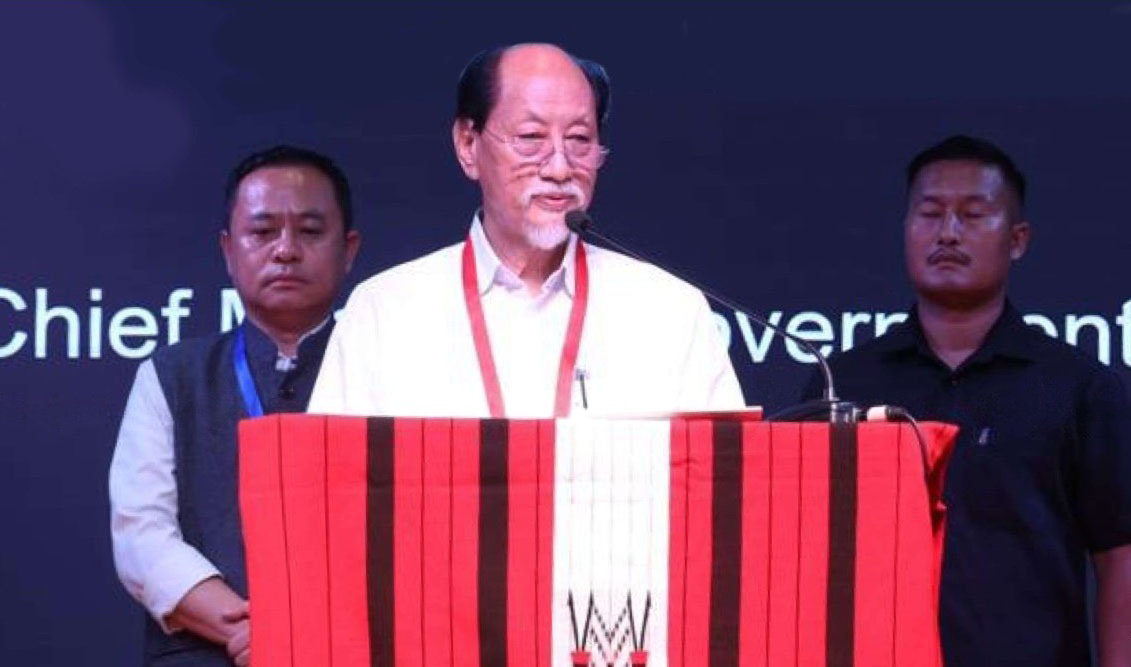
Nagaland Chief Minister, Neiphiu Rio has called for a balanced and effective implementation of the Bengal Eastern Frontier Regulation (BEFR), 1873, asserting that the Inner Line Permit (ILP) system remains necessary to protect the identity, land, culture and indigenous rights of the Naga people while ensuring that the state does not isolate itself from legitimate economic activities and development.
Addressing the National Seminar on the Bengal Eastern Frontier Regulation, 1873, organised by the Naga Students’ Federation (NSF), Rio said the seminar provided an important platform to examine the ILP system from historical, constitutional, legal and contemporary perspectives.
He recalled the history of British expeditions into the Naga Hills, noting that the BEFR was introduced in the context of regulating the movement of outsiders into protected areas and safeguarding indigenous communities from external economic and demographic pressures.
Rio said the provisions of the BEFR remain relevant for Nagaland, but stressed that they must be applied judiciously. “We have to be broad-minded. But we have to bring a system of using this BEFR 1873, a system which will protect the Indian citizens, also protect the indigenous Nagas, and mutual interest for development and economic developments,” he said.
Referring to the 16-Point Agreement that preceded Nagaland’s statehood, the Chief Minister said the continuation of the BEFR in Nagaland was specifically provided for and subsequently linked with the constitutional safeguards under Article 371A.
He cautioned, however, against misuse of the protective provisions. “And therefore we should not ignore, but protect, but not to misuse,” he said. He also informed that besides ILP, the Protected Area Permit has been re-imposed in Nagaland.
On the extension of ILP to Dimapur, Chümoukedima and Niuland, Rio said the State Government had to take into account the historical circumstances of these areas, particularly the settlement of people before Dimapur was formally declared a tribal belt in 1979.
He also said that the issues of Dimapur, Niuland and Chumoukedima have to be tackled separately as non-Nagas have established, some purchased land also and lived up to Chumoukedima. “We have given a cut-off year of 1963. But for Dimapur area, up to Chumoukedima, we may have to consider up to 1979, because Indian citizens cannot be harassed,” he said adding, “If there is any issue, as per notification, they will go to court. And they’ll get judgement.”
He said that the government’s primary concern was to identify and check illegal migrants while ensuring that legitimate residents were not subjected to unnecessary hardship.
Rio also welcomed the Gauhati High Court judgment of June 16, 2026, which upheld the State Government’s decision to extend the ILP regime to Dimapur, Chümoukedima and Niuland. He described the verdict as a significant development for Nagaland, particularly as the judgment highlighted the constitutional significance of Article 371A in protecting Naga identity, customary practices and institutions. “These are our traditions. And therefore, I think the validity of BEFR 1873 is upheld by the court, and that is significant,” he added.
The Chief Minister also stressed the need to curb benami businesses while encouraging genuine investors from outside the state. He said Nagaland should welcome outside investment but insisted that business activities must be conducted transparently.
“We welcome the investors from outside Nagaland, non-Nagas. But do transparency, transparently. We want to build our economy,” Rio said.
Calling for a broader development-oriented approach, Rio said Nagaland could not remain dependent solely on grants from the Centre when the state possesses substantial natural resources, including petroleum, natural gas and minerals.
Nagaland Tribune app on Google Play


He said unresolved issues and internal disagreements had prevented the state from fully exploiting its natural resources and urged all stakeholders to adopt a more open and constructive approach.
“We are rich, but we remain poor. Therefore, we should overcome all this,” he said, stressing the need for collective efforts by the government, tribal organisations, student bodies and other stakeholders.
Rio also highlighted the challenges posed by the proposed fencing of the India-Myanmar border, particularly for Naga communities whose traditional lands, families and villages straddle the international boundary.
Citing Longwa in Mon district as an example, he said the international boundary cuts through the village and even through the house of the Ang, with portions falling on both sides of the border. He maintained that rigid fencing would create serious difficulties for communities whose traditional social, cultural and economic activities have historically extended across the boundary.
The Chief Minister said Nagaland must simultaneously address migration, urbanisation, connectivity and economic development. He stressed that the state could not avoid urbanisation or economic integration and that greater attention must be given to strengthening the state’s economy.
“Society, our society mostly we talk about politics, politics, politics. But other societies, what they talk most is economy, economy, economy,” Rio said, arguing that economic strength was essential for achieving the vision of a developed India by 2047.
“We cannot ignore. If we go on talking economy, if we go on talking politics, and don’t discuss about economy, we cannot achieve our goal,” he stressed.
He also called for greater public cooperation in major infrastructure projects, including highways. Referring to discussions on a proposed foothill road, Rio said improved connectivity would be essential for unlocking Nagaland’s economic potential. “Without connectivity, road, there can be no development,” he said.
Rio said the seminar should ultimately produce practical and forward-looking recommendations, with the objective of creating an ILP framework that protects Naga identity, land, culture and indigenous rights while facilitating legitimate economic activity, investment and development.
“The inner line should remain not merely as a regulatory mechanism, but an effective instrument for protecting identity while enabling Nagaland to move forward, progress and prosperity to reach our goal,” he said.
Earlier, the presidential address was delivered by Mteisuding, President NSF.