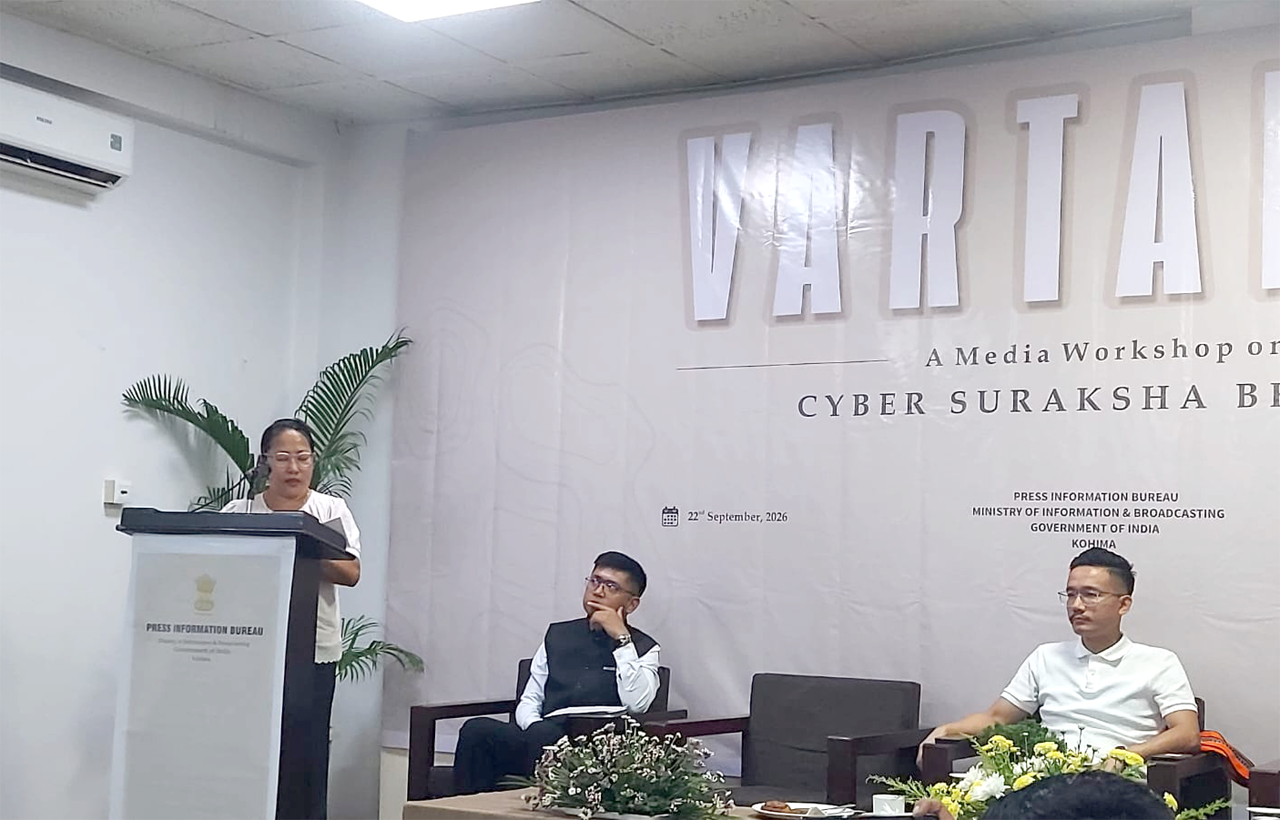
Dimapur Public Prosecutor, Temsunaro Jamir has urged journalists to uphold accuracy, fairness and accountability in their reporting, stressing that careful verification and responsible use of legal terminology are essential safeguards against defamation and other legal consequences.
Speaking on “A Legal Perspective on Defamation & Journalistic Responsibilities” during a media workshop on Cyber Suraksha Bharat, organized by Press Information Bureau Kohima, Jamir said journalists should verify information before publication and ensure that news is reported with accuracy, fairness and impartiality.
Explaining defamation under the Bharatiya Nyaya Sanhita (BNS), she said criminal defamation is now covered under Section 356, replacing Section 500 of the erstwhile Indian Penal Code. She explained that defamation can have both civil and criminal consequences, with civil proceedings generally seeking monetary compensation and criminal proceedings seeking punishment.
She said journalists facing defamation proceedings could rely on important defences where the published material is true and made for the public good, or where an opinion is honestly expressed on a matter of public interest. However, she stressed that journalists must be able to substantiate the basis of their reporting.
‘Accuracy is strongest protection’
Jamir said investigative journalism and opinion pieces could carry greater legal risks and urged media organisations to distinguish clearly between fact, allegation, analysis and opinion.
“Absolute truth published for the public good is your strongest defence against defamation,” she said, while cautioning journalists against sensational headlines, thumbnails, captions and social media posts that exaggerate or distort the substance of a report.
She also advised journalists to give persons against whom serious allegations are made a fair opportunity to respond and to preserve evidence of their efforts to seek a response.
Raw interview recordings, field notes, documents and records of communication with sources and subjects should be retained, she said, as such material could demonstrate due diligence if a legal notice or defamation case arises.
Cautions against ‘media trials’
Jamir particularly cautioned journalists against conducting what she described as “parallel trials” in the media while a case is pending before a court.
She stressed the importance of the presumption of innocence, saying an accused person remains legally innocent until guilt is established by a competent court.
“Reporting must never frame an accused or charge as a final verdict of guilt,” she said, urging journalists to avoid prematurely describing an arrested person as a “criminal” or “scammer”.
She also advised journalists covering police and court cases to familiarise themselves with terms such as police remand, judicial custody, confessional statements, framing of charges, discharge, acquittal and conviction.
Using an example, she said an accused being remanded to judicial custody does not mean that the person has been found guilty, as the trial and determination of guilt come later.
Warns against errors in legal terminology
Jamir said precision in terminology was particularly important in crime reporting, as inaccurate descriptions could damage the reputation of an accused person and potentially expose publications to legal action.
She also urged journalists to help the public understand the difference between an allegation, an arrest, investigation, remand and conviction.
Referring to cases registered under the Arms Act and drug laws, she observed that reports often prominently cover arrests but less frequently follow up on the eventual outcome of trials. She said journalists should also report acquittals and other final court outcomes where relevant.
Download Nagaland Tribune app on Google Play


Strict caution on POCSO reporting
Jamir stressed that journalists must observe statutory restrictions while reporting cases involving children, particularly under the Protection of Children from Sexual Offences (POCSO) Act.
She said absolute anonymity must be maintained for minors, whether they are victims or accused persons. The media should not disclose details that could indirectly identify a child, including the name, address, school, locality, neighbourhood or family information.
She warned that merely withholding the child’s name would not be sufficient if other details published could lead to identification.
She also referred to restrictions relating to in-camera proceedings and urged journalists to exercise particular care when reporting sensitive cases involving minors and sexual offences.
Journalists urged to maintain independence
Jamir said journalists, like members of other professions, must work independently and avoid political, financial or personal conflicts of interest.
She described the journalist’s primary obligation as being towards the public rather than commercial or political interests and said mistakes should be acknowledged and corrected through appropriate means.
She also encouraged journalists who receive information about criminal activity to consider sharing relevant information with law enforcement authorities where appropriate, while continuing to perform their role as reporters.
At the same time, she emphasised the need to protect sources and exercise professional judgment when handling sensitive information.
Calls for responsible digital journalism
With digital and social media becoming an increasingly important source of news, Jamir urged journalists to apply the same standards of accuracy and responsibility to online reporting as to print journalism.
She cautioned that speed should not come at the cost of verification, particularly in breaking news and crime reporting, where an inaccurate or premature report can have serious consequences for individuals and investigations.
Concluding her presentation, Jamir urged media practitioners to verify information in good faith, avoid sensationalism, distinguish fact from allegation and opinion, provide a fair opportunity to respond, and preserve records demonstrating due diligence.
She said responsible journalism was not merely about being the first to report a story but also about ensuring that what is reported is accurate, fair and legally sound.