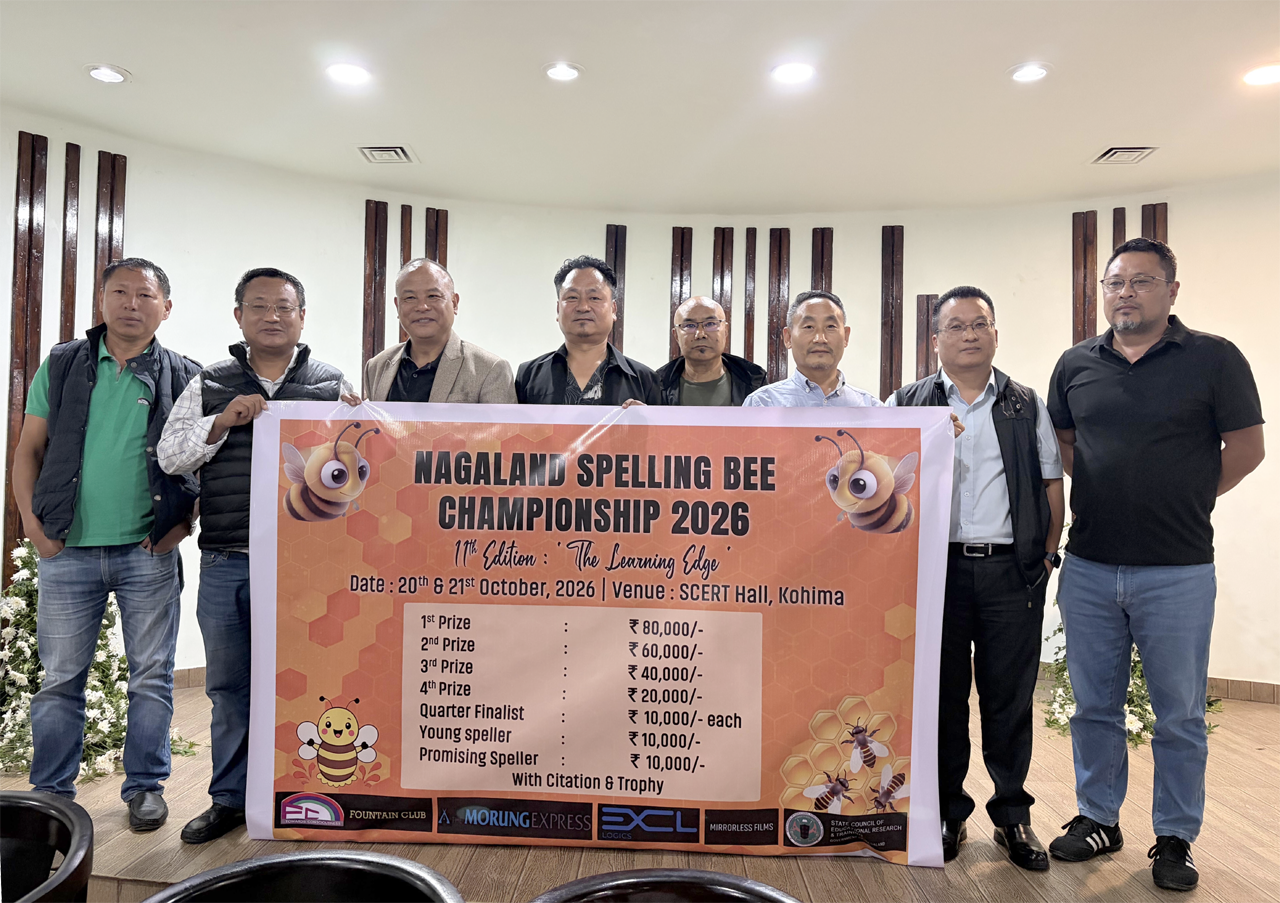
The 11th edition of the Nagaland Spelling Bee Championship 2026, themed “The Learning Edge,” would be held on October 20 and 21 at the State Council of Educational Research and Training (SCERT) halls in Kohima.
The announcement was made during a press conference held at Hotel Japfü, Kohima, on Sunday where convenor, Neizokhotuo Belho highlighted the upcoming competition and its focus on encouraging students to develop their spelling skills and strengthen their command of the English language.
The championship is being organised by The Fountain Club, Kohima, in collaboration with SCERT and its partners, The Morung Express, Excellogics and Mirrorless Films.
The Fountain Club, Kohima has extended the registration deadline for the 11th edition of the Nagaland Spelling Bee Championship 2026 to the morning of October 20, following requests from parents, teachers and educational institutions.
The competition is open to students from Classes 6 to 9, with each educational institution permitted to nominate two spellers.
The championship offers cash prizes across several categories, with the winner receiving Rs. 80,000, the second-place winner Rs. 60,000, the third-place winner Rs. 40,000 and the fourth-place winner Rs. 20,000. Quarter-finalists will receive Rs. 10,000 each, while the Young Speller and Promising Speller categories will carry prizes of Rs. 10,000 each.
Detailed competition rules, regulations and entry forms are available for download on the official websites of The Fountain Club, The Morung Express and Excellogics.
The forms can also be obtained from SCERT and District Institutes of Education and Training (DIET) centres in Chiechama, Mokokchung, Wokha, Pfutsero, Mon, Tuensang, Zunheboto and Dimapur.
Completed forms may be emailed to fountainclubkma@gmail.com or submitted in person at Super Travels, Hotel Japfü, Kohima; Equipments & Sports near Razhü Point, Kohima; and the NSTCB Ltd. High School Junction branch in Kohima.
Speaking during a press conference at Hotel Japfü, Kohima, convenor, Neizokhotuo Belho said the spelling bee initiative began in 2012 with the intention of making it an annual event. However, the competition could not be held in 2021 due to the Covid-19 pandemic and was also not conducted in 2024 and 2025 owing to other reasons.
He said these interruptions had resulted in the upcoming competition being the 11th edition, despite the initiative having begun more than a decade ago.
Belho said the organisers had initially fixed October 15 as the last date for submission of entry forms. However, they received requests from parents, teachers and educational institutions seeking permission for students to submit their forms upon arrival at the venue.
In response to these requests, the organisers have relaxed the deadline and will accept completed entry forms from 8 a.m. to 9 a.m. on October 20, before the commencement of the inaugural programme.
He clarified that no forms would be accepted after the inaugural programme begins, urging interested students to ensure that all required documents are submitted within the stipulated time.
The convenor also informed that the organisers had made arrangements for accommodation, food and refreshments free of cost for participating students coming from other districts of Nagaland.
He said the arrangements were intended to facilitate students travelling from different parts of the state to take part in the competition without having to bear additional expenses for these essential facilities.
However, parents and teachers accompanying the participating students would be charged nominal rates for accommodation and other facilities, which Belho said would be lower than prevailing market rates.
Focus on Language Skills and Competitive Learning
Explaining the objectives of the championship, Belho said the competition was designed not merely to test students’ ability to spell words correctly but also to help them develop a deeper understanding of language.
He said the spelling bee aimed to strengthen students’ communication skills and encourage them to understand the meaning, origin, definition and alternative pronunciations of words.
Belho said the competition was intended to provide students with an opportunity to master words beyond their spelling, enabling them to understand the different aspects of vocabulary and use language more effectively.
He added that the initiative was focused on supporting students’ overall development by building their confidence and communication abilities through an academic platform that encourages learning and healthy competition.
The organisers have also put in place arrangements for pronouncers and judges with expertise in phonetics to ensure that the competition is conducted appropriately.
Belho said teachers with expertise in phonetics would be involved in the pronunciation process, while the latest edition of the Oxford Dictionary would continue to serve as the reference for the competition, as it has since the championship began.
He urged the participating teams and concerned committees to refer to the Oxford Dictionary while preparing for and conducting the competition.
Download Nagaland Tribune app on Google Play


Participation expected to increase this year
The convenor said previous editions of the Nagaland Spelling Bee Championship had generally attracted between 100 and 150 participants, with a significant number coming from Kohima, Dimapur and Mokokchung.
For the 2026 edition, the organisers are anticipating increased participation, particularly following efforts to encourage students from government schools to take part.
Belho said the concerned departments, including SCERT and the School Education Department under Samagra Shiksha, had been encouraging participation from all 49 government schools adopted under the PM SHRI scheme, with at least one student from each school expected to participate.
He said the initiative was expected to widen the reach of the competition and provide more students from government schools with an opportunity to demonstrate their abilities.
However, he pointed out that school-level selection competitions had not been completed in several institutions, while some schools that had conducted their internal competitions were yet to finalise their representatives.
He said these circumstances had prompted schools and parents to request an extension of the registration deadline so that students could complete the selection process and participate in the state-level championship.
Belho expressed the expectation that the competition would draw participants from across the districts, with at least 100 students anticipated for this year’s edition.
He said the organisers were hopeful that the encouragement extended by educational institutions and the concerned departments would help increase participation and make the championship more inclusive.
Eligibility revised to Classes 6–9
Belho explained that the eligibility criteria had undergone changes over the years to ensure a more balanced and competitive environment for participants.
In the earlier editions, students from Classes 8 to 12 were eligible to participate. However, the organisers subsequently reduced the upper limit from Class 12 to Class 10 and have now revised the eligibility to Classes 6 to 9.
He said the changes were introduced after the organisers observed differences in age and academic standards among students in the higher classes, which affected the competitiveness of the event.
According to Belho, the difference in educational levels between students in Classes 8 and 9 and those in Classes 10, 11 and 12 had made it difficult to maintain a sufficiently competitive environment.
The revised eligibility criteria are intended to create a more appropriate platform for students at similar stages of learning and provide them with an opportunity to compete on a more balanced footing.
Belho said the organisers also hoped that the championship would help prepare successful participants for future competitions at the zonal, regional and national levels.
However, he acknowledged that financial constraints remained a major concern, particularly in supporting students who qualify or express an interest in participating in competitions beyond the state level.
He said The Fountain Club might be able to organise the Nagaland Spelling Bee Championship but could face difficulties in meeting the expenses associated with sending interested students to zonal, regional or national competitions.
Despite these limitations, Belho assured that the Club would make efforts to support students as far as possible if the resources were available.
He said the organisers recognised the importance of providing opportunities for talented students to advance to higher-level competitions and would explore ways to assist them whenever feasible.
Students can participate without school recommendation
The convenor also clarified that students interested in participating would not necessarily be excluded if their schools were unwilling to recommend them.
According to Belho, the entry process consists of two forms, designated Forms A and B. One form contains the student’s profile, while the other requires an endorsement from the respective educational institution to establish the school’s support and recommendation for the participant.
However, he said the institutional endorsement requirement would not be treated as an absolute barrier for students who independently wished to take part in the championship.
Belho explained that if a school was not interested in sending students or was unwilling to recommend a participant, the organisers would still support an interested student who wished to compete.
He said the primary objective of the spelling bee was to encourage students to improve their skills and expand their knowledge, and that opportunities should be made available to those who were genuinely interested in learning and participating.
The Club, he added, was committed to supporting students who demonstrated enthusiasm for the competition, irrespective of whether their institutions actively encouraged their participation.