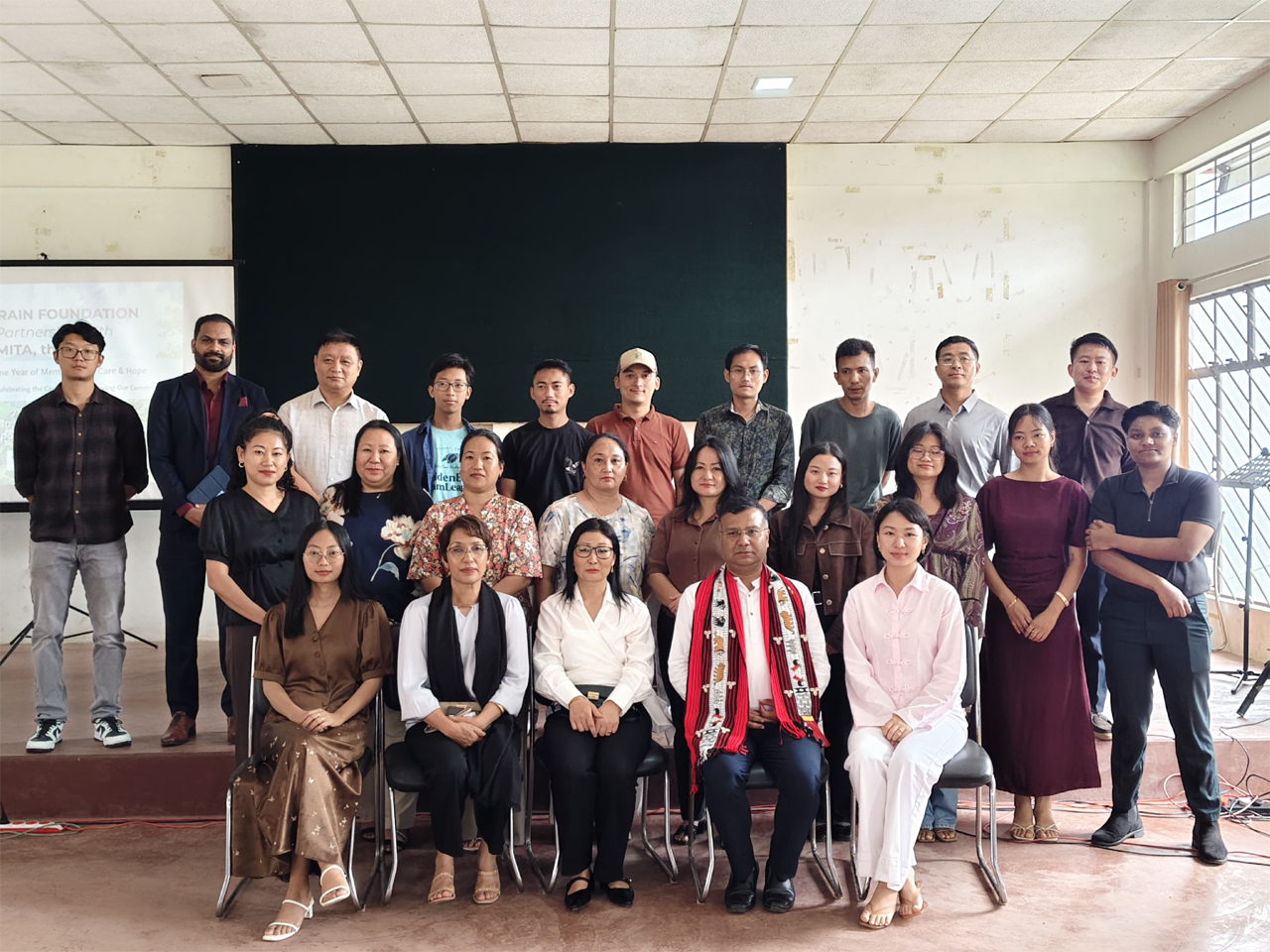
The First Rain Foundation, in partnership with MITA, the ant, marked the first anniversary of its mental health camps in Mokokchung on August 7 at Sangtemla Ward Multipurpose Hall, with speakers highlighting the importance of community-based mental healthcare, early intervention and creating an environment where people can seek help without fear or stigma.
The anniversary programme brought together mental health professionals, counsellors, volunteers, community members and beneficiaries of the camps to reflect on the first year of the initiative and its wider significance for mental health awareness in the community.
In her keynote address, Lanusenla Jamir said every community has “two stories”- the story that is visible through its hills, churches, schools, markets, institutions and development, and another story carried privately by people, which often remains hidden behind everyday achievements and routines.
Reflecting on the first year of the mental health camps, she said the greatest achievement was not simply conducting 12 camps, but that the community had “given us permission to listen.”
She said First Rain had conducted a youth mental health baseline survey in 2025 involving approximately 600 respondents and a community needs assessment in 2026 involving 141 respondents. The youth survey found that more than half of respondents experienced stress or anxiety, nearly one in three reported symptoms of depression, and more than half had no mental health support. Most concerning, she said, 17.3 percent reported having personally attempted self-harm or suicide.
The 2026 community assessment similarly identified unemployment, emotional distress and substance abuse as major challenges, while 56 percent of respondents felt that life in the community had become worse over the previous five years.
Jamir said the findings had changed her understanding of mental health, arguing that mental well-being is not shaped only inside hospitals and counselling rooms but by what she described as “psychological infrastructure”- the environments created in homes, schools, churches and workplaces.
“Long before someone enters a counselling room, they have already been shaped by these environments,” she said, adding that psychological infrastructure is built “conversation by conversation, relationship by relationship and choice by choice.”
According to Jamir, when such infrastructure is strong, people seek help earlier, families recognise illness sooner and teachers are more likely to notice when students begin withdrawing. However, when it is weak, shame and silence increase, treatment is delayed and people may suffer alone.
She said 78 individuals between the ages of 16 and 85 had sought help through the camps during the past year, while more than 20 young volunteers had contributed their time consistently.
Jamir also acknowledged the challenges faced during the early stages of the programme, including financial difficulties, slow growth in participation and the absence of a resident psychologist. She credited reduced consultation and medicine costs, awareness broadcasts by All India Radio, Puducherry, and faith-based support for helping make mental healthcare more accessible.
She said the camps had gradually helped challenge stigma, with people who had received treatment and experienced improvement subsequently encouraging their families, friends and neighbours to seek help. “The greatest advertisement for compassionate care is compassionate care itself,” she said.
Speaking on behalf of MITA, the ant, Dr Mintu Moni Sarma said he felt privileged to be part of the anniversary programme in Mokokchung, which he described as an intellectual centre of Nagaland. He expressed gratitude to First Rain Foundation for conceptualising and leading the initiative and for allowing MITA to work alongside it during the past year.
Dr Sarma traced the evolution of community mental healthcare initiatives in the Northeast, saying the organisation he represented had its roots in community-based mental healthcare in Assam, where people in remote and conflict-affected areas previously had to travel 200–300 kilometres to access mental health services.
Nagaland Tribune app on Google Play


He said the community mental health camp model began as a monthly initiative in 2007 and later developed into the Mental Illness Treatment Alliance (MITA) from 2017. The model has since expanded to 33 sites across Northeast India and Bihar, he said.
Dr Sarma stressed that mental healthcare cannot remain the responsibility of psychiatrists and medical professionals alone. He said community members, families, civil society organisations and other stakeholders must all be part of the care-giving and care-seeking process.
He said research increasingly emphasises the effectiveness and cost-efficiency of community-based interventions, particularly after treatment, as hospitals can sometimes remain disconnected from the social and family environments in which patients live.
Describing the mental health situation as increasingly serious globally, Dr Sarma said the COVID-19 pandemic had further exposed the scale of mental health challenges. He also pointed to rapid changes in technology, including artificial intelligence, as factors likely to transform healthcare, care-giving and care-seeking in the coming years.
Recalling the early days of community mental health work in Assam, he said stigma was so strong that some camps initially had no patients, while others saw only two or three patients after several months. However, the model gradually gained acceptance and has now registered more than 15,500 patients, with around 6,000 patients served per month across its different sites, according to their electronic health management information system.
Dr Sarma particularly appreciated First Rain’s efforts to generate local evidence through surveys and assessments, saying evidence generation was essential for strengthening community mental healthcare systems.
He said treatment should go beyond medicines and consultation rooms and encompass families, communities and the wider social environment. He called for building resilient communities capable of coping with future stresses and distresses.
A beneficiary of the camp also shared his personal journey with the gathering. He said he had been living with schizophrenia for 13 years and, at the time of his diagnosis, was also struggling with alcohol and cannabis use. He said he had since stopped using both substances and was happy to be living a sober life.
He began attending the First Rain mental health camp in February this year. Recalling his experience, he said his illness caused him to hear voices and sometimes see people or figures in the corner of his eyes. At first, he did not understand that these experiences were hallucinations associated with his condition.
He said the medication provided through the camp had helped him significantly, but equally important was the time he spent with the First Rain team, who helped him understand his illness and what he was experiencing.
Although he still occasionally hears voices, he said he now sleeps peacefully and has learned to recognise that such experiences are symptoms of his illness rather than reality.
Expressing gratitude to the First Rain team, he said, “Recovery takes time, but it is possible.” He encouraged others living with mental health conditions not to be afraid of social judgement, but to have the courage to seek help, believe that things can improve and take recovery “one step at a time.”
He also presented an original song titled “Escaping Shackles,” which he composed with the support of the First Rain team and which reflects his struggles and the peace he found through his recovery journey.
Zulurenla who shared her journey with anxiety, spoke about experiencing panic attacks, physical symptoms, agoraphobia and prolonged fear that significantly affected her daily life. After years of struggling and seeking answers, she joined the mental health camp in September 2025, where she said she found empathy, acceptance and professional guidance.
She expressed gratitude to the doctors, counsellors and team for their continued support, including regular follow-up calls and home visits, which she said made her feel cared for as a person rather than merely a patient.
While acknowledging that recovery remains ongoing, she said she has learned to manage and accept anxiety without allowing it to control her life. She encouraged others to seek help without shame, stressing that mental health struggles are real and seeking help is a courageous step towards healing.
Lanuakum Aier, Counsellor at Eden Academy, stressed the importance of creating a community where children feel heard, seen and supported. Sharing his experience as a counsellor, he said even a child simply seeking someone to listen can have a lasting impact on their emotional well-being.
He highlighted concerns over child neglect, children with special needs and unequal access to mental healthcare, particularly among underprivileged families. Aier called for stronger collaboration among schools, families, mental health workers and the community, and suggested the need for dedicated support systems for children’s mental health.
He also appreciated First Rain Foundation for addressing mental health needs in a community with limited resources and expressed hope that its work would continue to expand.
Anungla Kichu, a counsellor with First Rain, shared her personal journey into counselling, recalling how being bullied as a child profoundly affected her and eventually led her towards psychology and the beginning of her healing journey. She stressed that healing is a process and that counselling is not about “fixing” people but listening without judgement, understanding their wounds and helping them recognise that they are not defeated.
She clarified that counselling is a structured and scientific process, involving understanding behavioural patterns and an individual’s worldview, rather than merely listening, encouraging or praying for someone. Kichu called on church leaders, doctors, educators and community organisations to collectively advocate for mental healthcare in families, workplaces and the wider community, stressing that while mental illness is real, there is also hope and recovery is possible.
The programme was chaired by MaonglemIa Jamir, with an invocation by Akangtemsu Yaden, Youth Director, MTBA. Temshier Longkumer delivered the vote of thanks, while Ps Jerald Saju, Associate Pastor Youth, NCRC, offered the benediction.