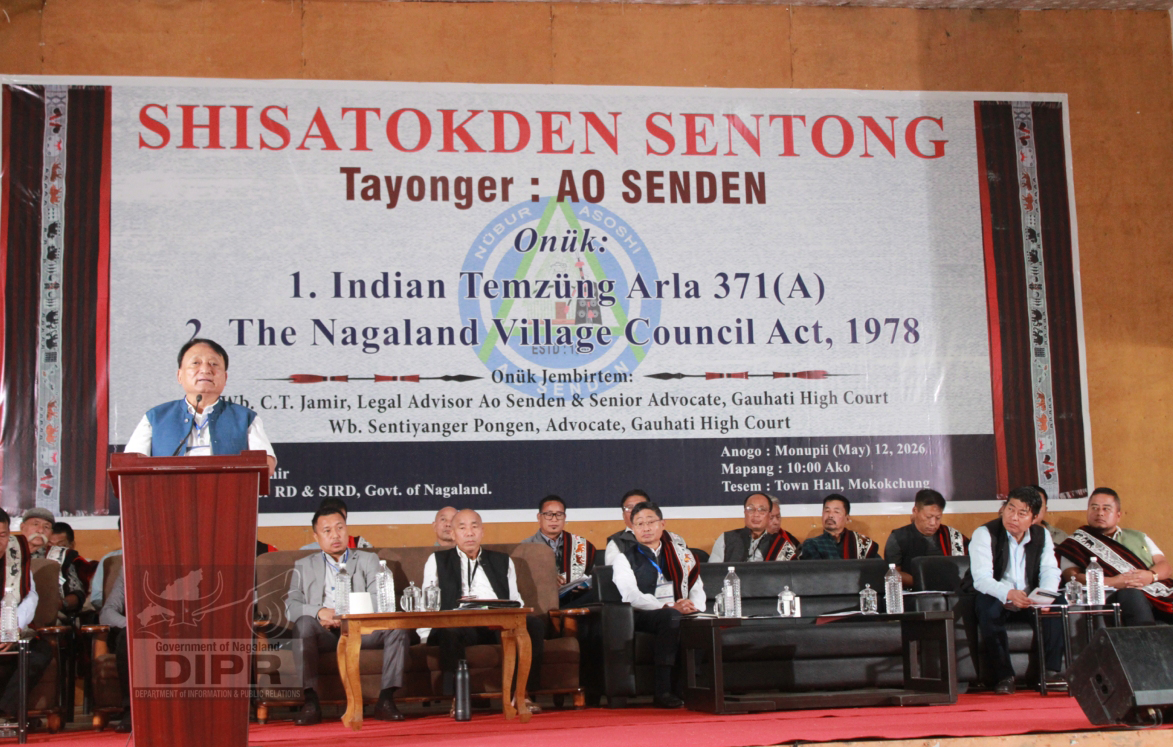
Seminar on ‘Article 371 (A) of the Indian Constitution’ and ‘The Nagaland Council Act 1978’ was organised by Ao Senden (So Apex body) at the Town Hall, Mokokchung on May 12. The speakers for the topics were CT Jamir, Legal Advisor Ao Senden & Senior Advocate, Gauhati High Court and Sentiyanger Pongen, Advocate, Gauhati High Court. The seminar was graced by the presence of Metsubo Jamir, Minister Nagaland, Sentiyanger Imchen, IAS Chief Secretary, Government of Nagaland and Daochier I Imchen, MLA.
Metsübo Jamir, in his brief exhortation, expressed concern that many Nagas do not fully realise the significance of Nagaland attaining statehood on December 1, 1963. He said that before statehood, the Nagas were under Assam and identified as “Naga Assam,” and that statehood gave the Nagas their own political identity and constitutional protections.
He stated that Article 371(A), the Bengal Eastern Frontier Regulation, and income tax exemptions were provided to safeguard the Naga people, their land, traditions, customs, and resources at a time when the Naga population was only in a few lakhs. He said these rights were secured through the sacrifices and vision of the forefathers and were meant to preserve the identity and future of the Nagas.
Jamir also said that Article 371(A) was framed for the protection of all Nagas, while the Nagaland Village Council Act, 1978, empowered village authorities to function within their respective jurisdictions. Referring to restrictions on oil extraction, he said the constitutional safeguards were intended to protect the land and interests of the indigenous people.
At the same time, he expressed concern over what he described as the growing reluctance to part with land for developmental activities. Stating that no project can come without land, he remarked that Nagas often complain about lack of development while resisting efforts to make land available for roads and other infrastructure projects. Referring to the Foothills Road project, he appealed for support and unity among the people.
He further urged the Ao community to move away from a culture of dependency and work towards self-reliance and self-sustenance, saying that “nobody will give free money forever.” He lamented that people continue “asking to give” without making efforts to build and develop collectively.
Jamir also cautioned that if the Nagas fail to value and safeguard the constitutional protections granted to them, there could come a time when such provisions may be repealed by the centre and he warned, could threaten indigenous control over land and resources. He said the need of the hour is for Nagas to remain united, preserve their heritage and traditions, and work together for development and the future of coming generations.
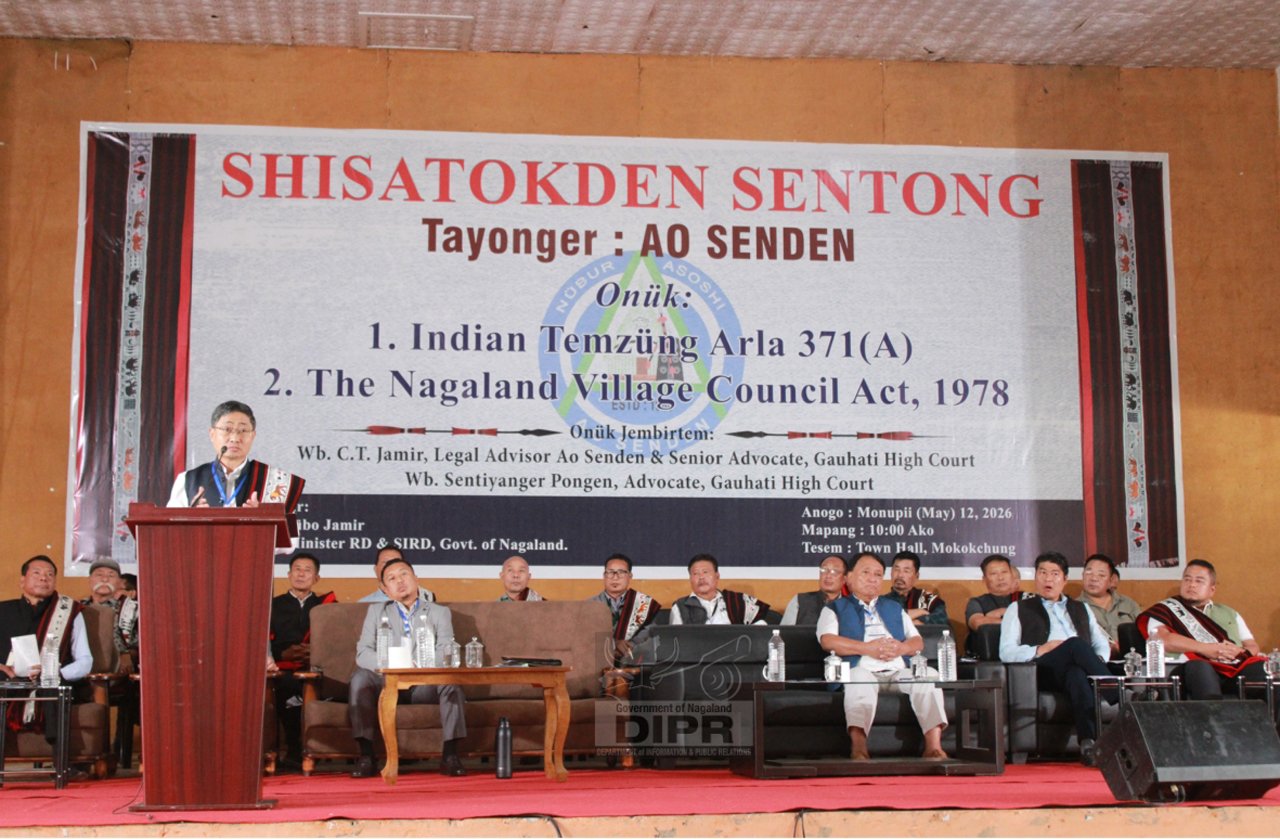
Chief Secretary of Nagaland, Sentiyanger Imchen, said Article 371(A) was incorporated to safeguard the traditional and customary identity of the Naga people, but regretted that many continue to misunderstand and misinterpret the constitutional provision. He stressed that laws are essential for maintaining peace and order in society and said confusion would prevail in the absence of laws governing the people.
Describing laws as instruments of social change, Imchen said good governance depends not only on having good laws but also on their fair and proper implementation by leaders. “Even the best law in the world is only effective when leaders implement it in an unbiased manner,” he said, while underscoring the responsibility of both the government and village institutions in framing progressive rules for the welfare of society.
Referring to the Ao community, he said the Aos have traditionally followed customary laws passed down orally from one generation to another as part of a tribal system rooted in tradition and belief. He noted that unlike many others, the Ao community lacked written records of its customary practices and stressed the importance of documenting laws, customs and regulations for future generations.
Imchen further observed that laws and rules are not static and must evolve with changing times and societal needs. While acknowledging that Article 371(A) was conceived as a temporary and transitional provision, he said the community must also reflect on whether certain old practices remain suitable in the present day.
Stating that the Aos are known as pioneers, he said the pace of change within the community has often been slow because of a strong attachment to old traditions and practices. He urged the people to adapt progressively and said the future and destiny of the Ao community lies in the hands of its own people.
Later in the program, topics outlined for the seminar was delivered by each resource person respectively.
Advocate Sentiyanger, while speaking on the “Nagaland Village and Area Councils Act, 1978,” explained that the Act empowers village councils to function within their respective jurisdictions in accordance with the customary laws and practices followed by each village, including the manner in which council members are elected and responsibilities are carried out.
Download Nagaland Tribune app on Google Play


He said the Act laid down provisions regarding qualifications for membership, including that members should be indigenous inhabitants and permanent residents of the village, while government employees were initially not eligible to become members. He also highlighted that the Act specifies the tenure and functioning of village councils and has undergone amendments on five occasions over the years.
Referring to the powers vested in village councils, he said the authority granted under the Act is extensive, but cautioned that no provision permits village councils to misuse or infringe upon the fundamental rights guaranteed under the Indian Constitution. Citing instances such as excommunication or banishment imposed by certain villages, he stated that although such practices may exist within customary traditions, they could conflict with fundamental rights, particularly the Right to Life, and therefore require serious consideration by legislators.
He further raised questions regarding the status and powers of “Putu Menden” and whether it should be considered synonymous with the village council under the Act. Pointing out that while the State Government has the authority to dissolve a village council, the Act remains silent on whether similar powers extend to “Putu Menden,” he said certain areas within the legislation require further clarity and inclusion.
Using the strength and powers already available under the Act, he urged village council leaders to adopt progressive and practical rules that would help take the community forward.
Speaking on Article 371(A), CT Jamir said that while the provision is widely known among Nagas, many do not fully understand its historical and constitutional significance. He said understanding the origin and purpose of Article 371(A) was important for Nagas to protect and exercise their rights effectively.
Jamir traced the historical developments that led to the inclusion of Article 371(A) in the Indian Constitution. He referred to the British administration’s “no interference policy” in the Naga Hills, the Scheduled District Act of 1874, the declaration of Naga Hills as an “excluded area” under the Government of India Act 1935, and the introduction of the Inner Line Permit in 1937.
He also highlighted the memorandum submitted by the Naga Club to the Simon Commission in 1929, where Nagas expressed their distinct identity and appealed to be “left alone.”
Jamir said the provisions of Article 371(A) originated from the 9-Point Agreement of 1947 and later the 16-Point Agreement signed between the Government of India and the Naga People’s Convention in 1960. He noted that the 13th Amendment Bill introduced during the tenure of Jawaharlal Nehru granted Nagaland statehood and incorporated Article 371(A) into the Constitution.
He said Nagaland became a state under “peculiar circumstances” through a political agreement, unlike other Indian states formed on the recommendation of state reorganisation committees.
Explaining the provision, Jamir said Article 371(A) contains a “non-obstante clause,” under which parliamentary laws on matters relating to Naga religious and social practices, customary laws, administration of civil and criminal justice, and ownership of land and resources would not apply to Nagaland unless approved by the State Legislative Assembly.
He described Article 371(A) as both a “restrictive” and “enabling” provision, as it restricts Parliament from imposing laws on protected matters while empowering the Nagaland Legislative Assembly to frame its own laws. He also referred to laws enacted by the state, including the Nagaland Land and its Resources Act, 1990.
Jamir stressed that Nagas should not take Article 371(A) for granted, adding that although it was enacted by Parliament, it was meant for the benefit and protection of the Naga people.
The speeches were followed by an interactive discussion session during which participants raised questions and shared suggestions to gain a better understanding of the issues surrounding Article 371(A) and customary laws. The resource persons responded to the queries and also offered views on possible measures that could be undertaken, including amendments and progressive reforms in certain laws and regulations in keeping with the changing needs of society.
During the discussion, it was also acknowledged that several areas and interpretations still remained unclear and misunderstood among the people, while participants expressed the need for further discussions and deliberations in the future to gain better clarity on such matters.
Meanwhile, Ao Senden president Marsanen Ao, in his keynote address, said the seminar was organised to help participants gain a deeper understanding of Article 371(A) and customary laws so that the rights and identity of the Naga people could be better protected and preserved. Stressing that it is not enough to merely know one’s rights, he said people must also understand them thoroughly in order to safeguard them effectively.
Highlighting the historical recognition accorded to Naga customs and traditions, Ao said that after the British entered the Naga Hills in 1832 and brought the area under their administrative control, they did not interfere with Naga customary laws, practices, traditions, and identity. Instead, he said, interpreters were appointed to better understand the uniqueness of Naga culture and traditions. In the same manner, he added, the Government of India acknowledged and respected the distinct identity of the Nagas by incorporating Article 371(A) following the attainment of Nagaland statehood.
He further informed that no formal resolutions would be adopted during the seminar. However, a detailed report prepared by the general secretary would later be placed before the Ao Senden Executive Council and the General Conference for further deliberation and necessary action, if required.
Molu Jamir Advocate & President Mokokchung District Bar Association chaired the programme, the program was attended by representatives from the all six ranges of Ao region, town unit, Mokokchung Municipal Council Councillors, Mangkolemba/ Changtongya/ Tuli Town Council Councillors, Mokokchung/ Mangkolemba/ Changtongya/ Tuli Town Ward, Watsü Mungdang, Ao Kaketshir Mungdang, Ao students body of all six ranges, Ao Lanur Telungjem, Ao Officers’ Union, Mokokchung Distict DBs and Mokokchung District GBs.