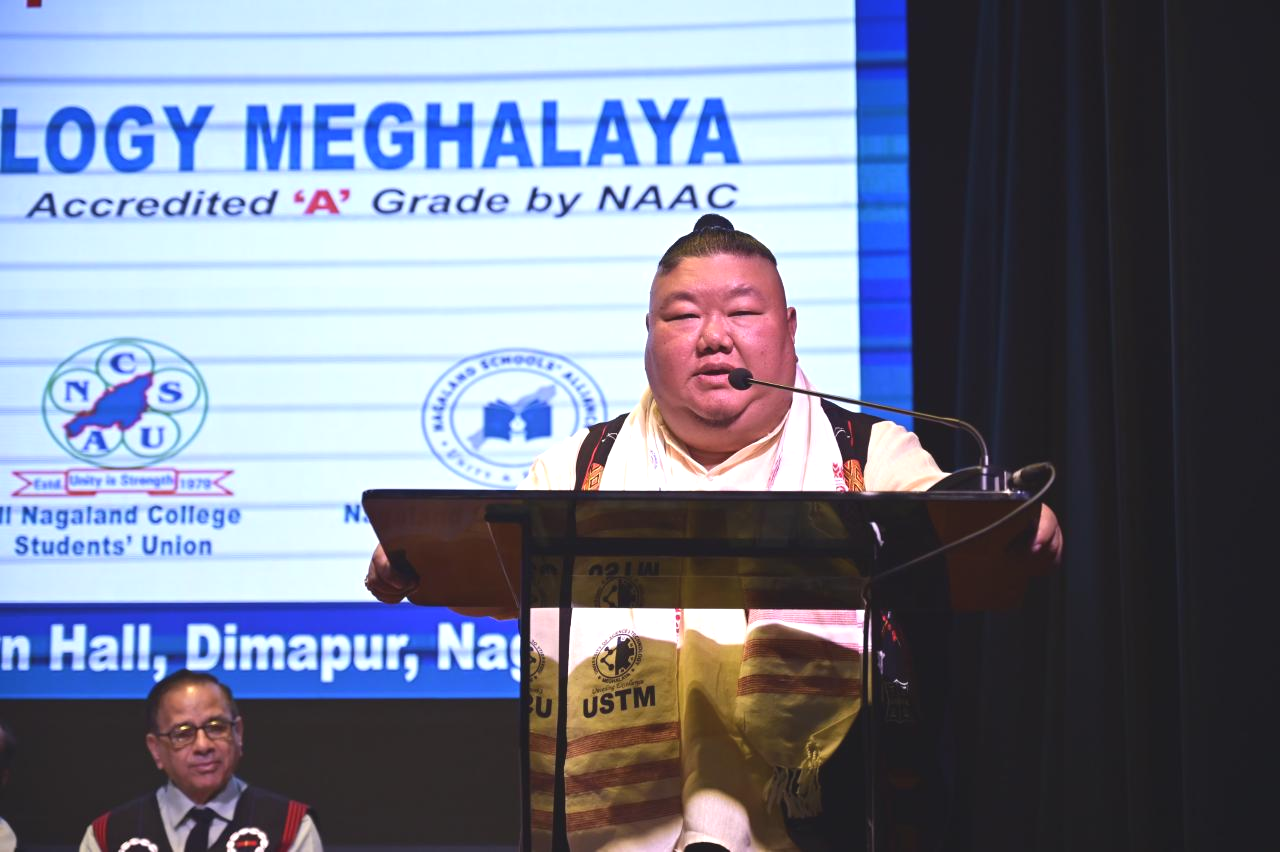
Nagaland’s Minister for Tourism and Higher Education, Temjen Imna Along, on Saturday stressed the need for transformative education, scientific temper, skill development and a strong work ethic among students and educators, asserting that Nagaland cannot achieve its vision of becoming a developed state by 2047 without investing in quality human resources and embracing technological change.
Addressing a Felicitation Programme of HSSLC Toppers and Institutional Excellence Award programme organised by the University of Science and Technology Meghalaya (USTM), Along described education as a transformative force that equips individuals to face life’s challenges and contribute meaningfully to society, the state and the nation.
“Education is not reformative; education is transformative. And education makes the person well-equipped to face the various challenges of life, not only for himself but also for the community, the society, the state, and the nation,” he stated.
Praising USTM’s leadership, he lauded Vice-Chancellor GD Sharma and Chancellor Mahbubul Hoque for their contributions to higher education in the Northeast. He said institutions such as USTM play a crucial role in creating educated and skilled human resources capable of driving sustainable development.
The Minister expressed concern over what he termed a growing culture of complacency and dependency, particularly among educated youth. While noting that Nagaland remains one of the most literate states in the country, he observed that academic certificates alone do not guarantee success unless accompanied by hard work, practical skills and a willingness to apply knowledge for the benefit of society.
“You think your certificate will give you food. If you are not willing to move, if you are not willing to use what you have learned, and that impact on the ground. If you are not willing to work for it, then believe me, that is not what we are going to be able to do,” he said.
Along highlighted the rapid transformation of the global economy driven by technology, artificial intelligence, robotics and automation and warned that many conventional jobs may disappear in the coming decades and stressed that students and teachers alike must adapt to changing realities.
“Nearly 80 percent of the jobs that exist today may no longer exist in the next twenty years,” he remarked.
Referring to the implementation of the National Education Policy (NEP) 2020, he said educational institutions must focus on creating real-world impact rather than limiting learning to classrooms.
He called upon educators, researchers and scholars to engage directly with communities by sharing their expertise with farmers, villagers and local entrepreneurs. According to him, knowledge must not remain confined to books and academic institutions but should be translated into practical solutions that improve livelihoods and strengthen local economies.
The Minister also underscored the importance of agriculture and vocational skills, lamenting that many young people are increasingly detached from farming despite coming from agrarian backgrounds. He urged schools and colleges to expose students to practical learning experiences, including agriculture and entrepreneurship, alongside formal education.
Expressing concern over the large number of students leaving Nagaland for higher studies, Along said many pursue courses without proper career planning or guidance.
According to him, many parents spend significant amounts of money sending their children to institutions outside the state without clearly understanding the quality of education being received.
He also expressed concern over the declining interest in science education among Naga students. He said many students continue to believe that subjects such as mathematics and science are beyond their capabilities.
Download Nagaland Tribune app on Google Play


He, therefore, stressed the need to strengthen science and mathematics education in the state, noting that relatively few students pursue careers in medicine, engineering, research and civil services. He called for early identification and nurturing of talented students and encouraged young people to aspire towards national-level competitive examinations and professional careers.
The Minister questioned why Nagaland could not produce hundreds of medical aspirants annually or secure larger numbers of successful candidates in prestigious national examinations such as the UPSC.
“There are years when not even a single candidate from Nagaland qualifies for UPSC,” he observed.
Speaking on the vision of a developed Nagaland by 2047, Along said progress would require collective effort from students, teachers, civil society organisations, community leaders and government institutions. He emphasized that unity, discipline, skill development and personal responsibility would be key to achieving that goal.
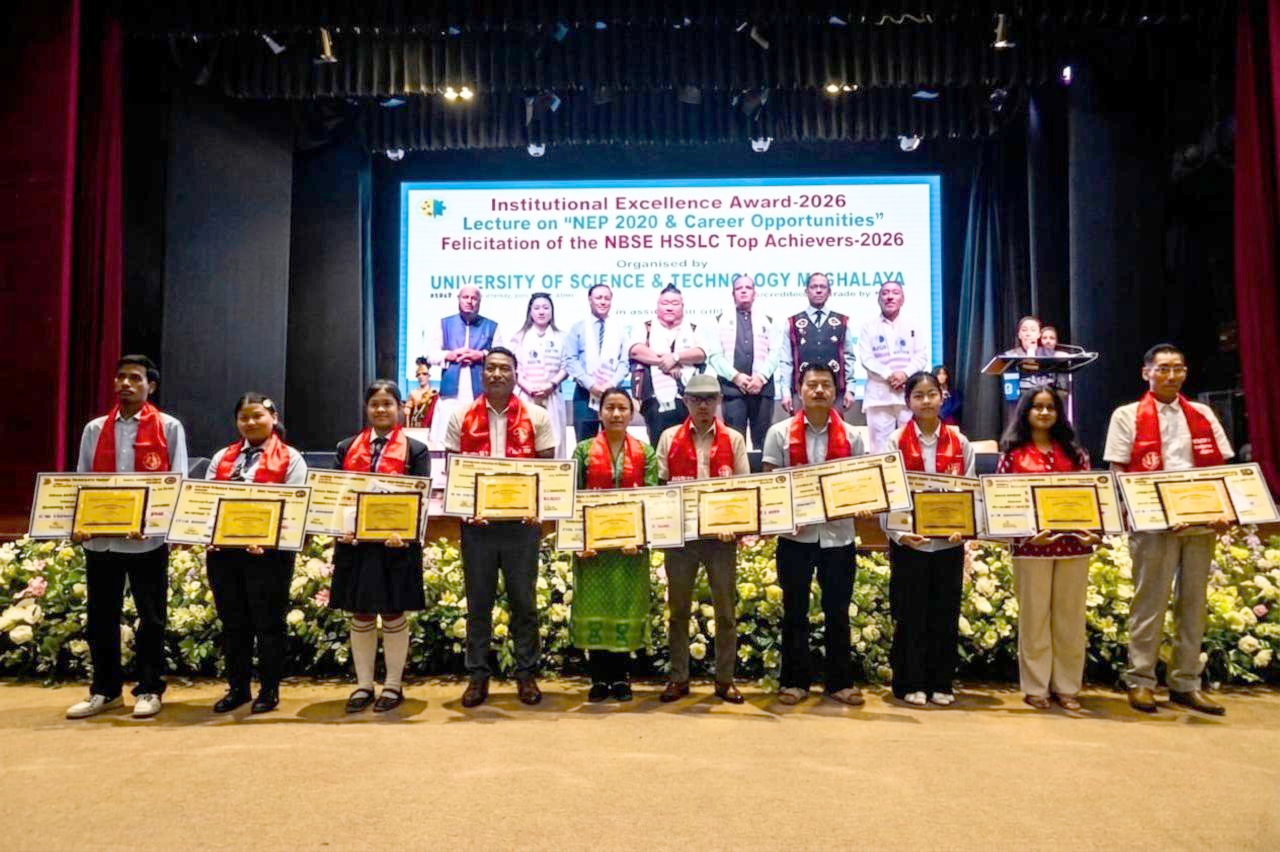
Congratulating students receiving awards and recognition at the programme, the Minister reminded them that accolades are only the beginning of a larger journey and urged them to focus on creating lasting impact rather than seeking recognition alone.
“There will be a time when nobody felicitates you, but your contribution will create impact. That is what truly matters,” he said.
Responding to concerns raised by student leaders regarding a hostel project at Kohima Science College, Along clarified that the project was being implemented through Corporate Social Responsibility (CSR) funding and not directly by the state government. Nevertheless, he assured that the Higher Education Department would continue engaging with the concerned agencies to facilitate its completion in the interest of students.
In his welcome address, Chancellor USTM, Mahbubul Hoque said USTM’s visit to Nagaland aimed to strengthen academic ties and increase student enrolment from the state. He highlighted the university’s growing reputation in research, innovation and medical education, noting that it has over 200 patents and researchers receiving international recognition.
He informed that USTM offers programmes ranging from medical sciences and engineering to humanities, law and social sciences, and is also developing a 1,000-bedded super-speciality hospital.
A key highlight of the event was the announcement of 50 scholarships, including 10 dedicated to talented students preparing for civil services through the university’s IAS Academy.
Hoque said the academy has engaged experienced mentors from Delhi to guide UPSC aspirants from the Northeast.
Stating that financial constraints should not prevent deserving students from accessing quality education, he said the university provides free or subsidised education to a significant number of students. He also invited students and educational institutions from Nagaland to visit the USTM campus and explore academic opportunities available at the university.
A talk on “NEP 2020 & Career opportunities” was delivered by Prof Darlong Khating, Vice Chancellor, North East Christian University. Others who also spoke on the occasion include Prof A Elayaperunal, Director, NIT Nagaland; Ani Yepthomi, Director, Livingstone Foundation International, Dimapur; and Kivika Yeptho, President, ANCSU.
On the occasion Awards were presented to toppers of HSSLC 2026 in Arts, Commerce and Science Streams.
The institutional excellence awards were conferred to St. John College, Dimapur, Unity College, Dimapur, Modern College, Piphema; Holy Cross Higher Secondary School, Dimapur; and St. John Higher Secondary Residential School, Dimapur.
