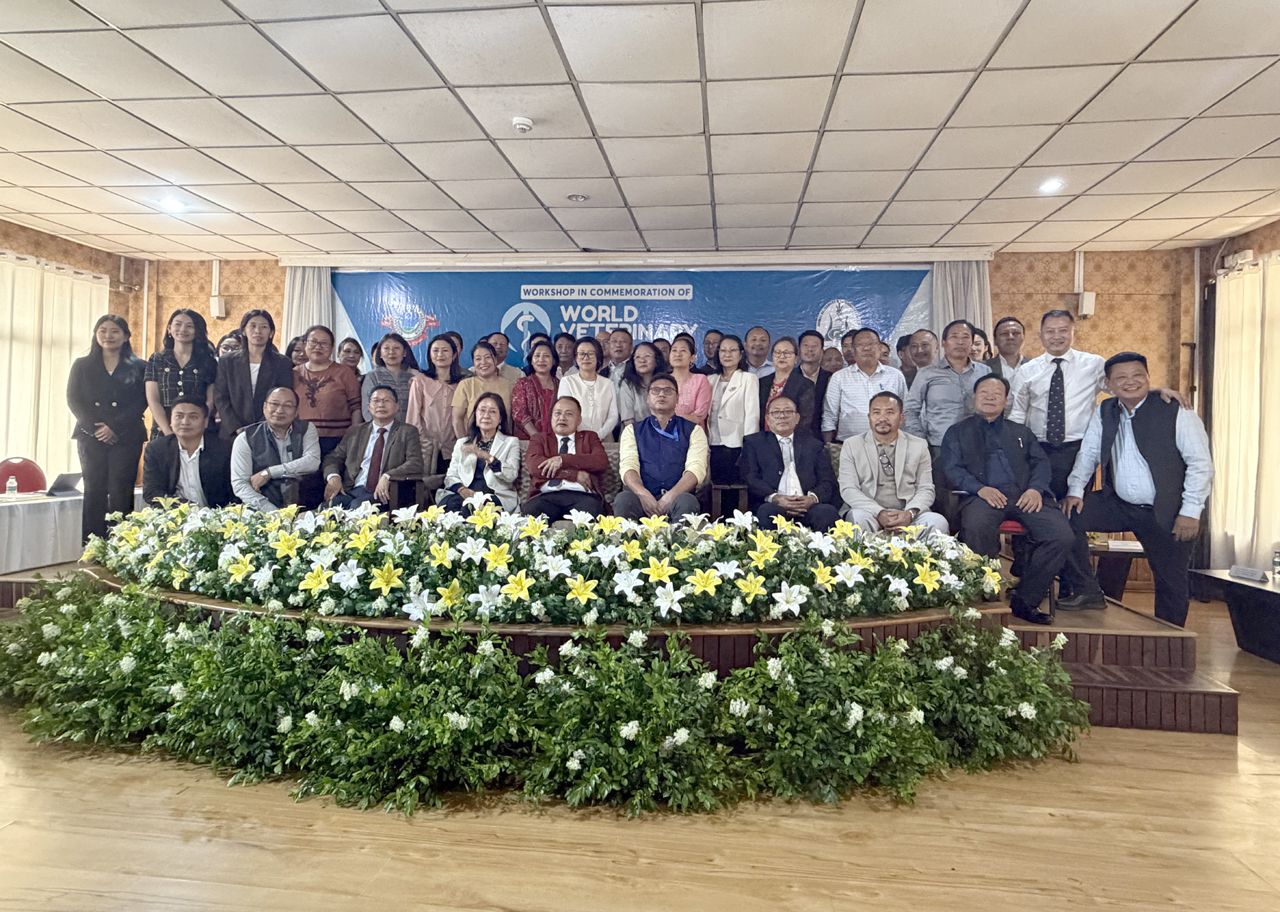
The Nagaland Veterinarians’ Association (NVA) commemorated World Veterinary Day 2026 with a workshop held at the Conference Hall of De Oriental Grand, Kohima on the theme “Veterinarians: Guardians of Food and Health.” The event brought together veterinary professionals, officials and stakeholders to deliberate on strengthening animal health, public health and food safety in the state.
Addressing the gathering as special guest, Secretary to the Government of Nagaland, Animal Husbandry & Veterinary Services and Tribal Affairs, Angelina Tajen, IAS emphasized the critical and often unseen role played by veterinarians. She described veterinarians as true “guardians” who anticipate and prevent crises rather than merely responding to them.
Highlighting the deep connection between food and culture in Nagaland, Tajen noted that staples such as mithun, pork, poultry and eggs rely heavily on veterinary oversight to ensure safety. She underscored that disease control efforts against African Swine Fever (ASF) and avian influenza, along with meat certification processes, are vital in protecting the food chain from contamination.
Drawing lessons from the COVID-19 pandemic, she stressed the interconnectedness of human and animal health, pointing to zoonotic diseases such as rabies, Nipah, Ebola and antimicrobial resistance (AMR) as major public health concerns.
“When you vaccinate a dog or test a pig, you are protecting a family,” she said, urging veterinarians to continue adopting the One Health approach.
Tajen also highlighted the economic importance of veterinary services, particularly in rural livelihoods where livestock serve as financial security for families. She noted that veterinary interventions such as deworming, artificial insemination services and farmer training directly contribute to poverty alleviation and support women-led self-help groups and livestock entrepreneurs.
She further outlined three key priorities for the sector—recognition, reinforcement and responsibility. Calling for greater visibility of veterinary contributions, she stressed the need for improved infrastructure, mobile veterinary units, better vaccine cold chains, digital disease reporting systems and adequate staffing. She also urged young veterinarians to uphold their professional responsibility with dedication and compassion.
Dr Zasekuolie Chusi, Commissioner and Secretary to the Government of Nagaland called on veterinary professionals to introspect and rise to the growing challenges facing the sector, while addressing the World Veterinary Day programme in Kohima.
Describing veterinary practice as a demanding and complex profession, Chusi said veterinarians shoulder the unique responsibility of diagnosing and treating animals that cannot express their suffering.
“It is the veterinarian who must understand what the animal needs and identify the ailment,” he remarked, urging professionals to reflect on their role and responsibilities.
Nagaland Tribune app on Google Play


Highlighting gaps in food production and availability in the state, he cited data indicating that per capita consumption of dairy products in Nagaland stands at around 67 grams against a requirement of 150 grams. Similarly, egg availability remains low at approximately 34 to 40 per capita compared to the recommended 110. He said such disparities underscore the need for the veterinary sector to strengthen its contribution to food security.
Drawing a comparison with national figures, Chusi noted that India’s total meat exports during 2024–25 were valued at around ₹42,000 crore, with buffalo meat alone contributing about 1.25 to 1.3 million tonnes annually to markets such as Vietnam, Malaysia, Egypt and the Middle East. In contrast, Nagaland continues to face a significant shortfall in local production.
Referring to departmental reports, he pointed out that the state has a deficit of ₹263.56 crore in meat imports and currently meets only about 44.5 percent of its own demand, leaving a gap of over 55 percent. “This wide gap between demand and supply is a serious challenge for the profession,” he said, calling for collective efforts to address the issue.
Chusi also highlighted the high consumption of pork in Nagaland, noting that the state’s demand remains disproportionately large compared to its production capacity. He said disease outbreaks affecting livestock further contribute to economic losses, despite ongoing preventive and control measures by veterinary professionals.
While acknowledging that veterinarians are among the better-paid professionals in the country, he stressed the need for greater commitment and service delivery. “We need to go the extra mile and ask ourselves whether we are doing justice to our profession,” he said.
Emphasizing the sector’s role in the rural economy, Chusi stated that animal husbandry remains a key pillar of livelihood in Nagaland. He urged veterinarians to actively contribute to income generation and support farmers through improved services, innovation and outreach.
He also welcomed the growth of private veterinary practices across the state and pointed to opportunities arising from government initiatives such as microfinance schemes, where a significant number of applications are linked to livestock and farming activities.
Calling for renewed dedication, Chusi said the profession must evolve to meet emerging demands not only in animal healthcare and food safety but also in strengthening the broader rural economy. “It is time to pull up our socks and deliver more for our people,” he said.
He concluded by urging veterinarians to remain committed to their role, noting that communities across Nagaland depend heavily on their services for both livelihood and well-being.
Earlier in the programme, an invocation was delivered by Dr Hiabe Zeliang, while Dr KN Zubemo Humtsoe, President of NVA, delivered the presidential address. Dr Kuokehebi Gwirie, Director of Animal Husbandry & Veterinary Services, gave the inaugural address, and Dr Simon Ao, President of NSVC, extended greetings. The programme also featured a special song by Azi Rudy and concluded with a vote of thanks by Dr Vikuolie Mezhatsu.
The workshop session included a theme presentation by Dr Raghubir Singh, Assistant Professor of Veterinary Public Health and Epidemiology at the College of Veterinary Science & Animal Husbandry, Jalukie. The event concluded with a reaffirmation of the Veterinarian’s Oat kuh led by the NVA President.