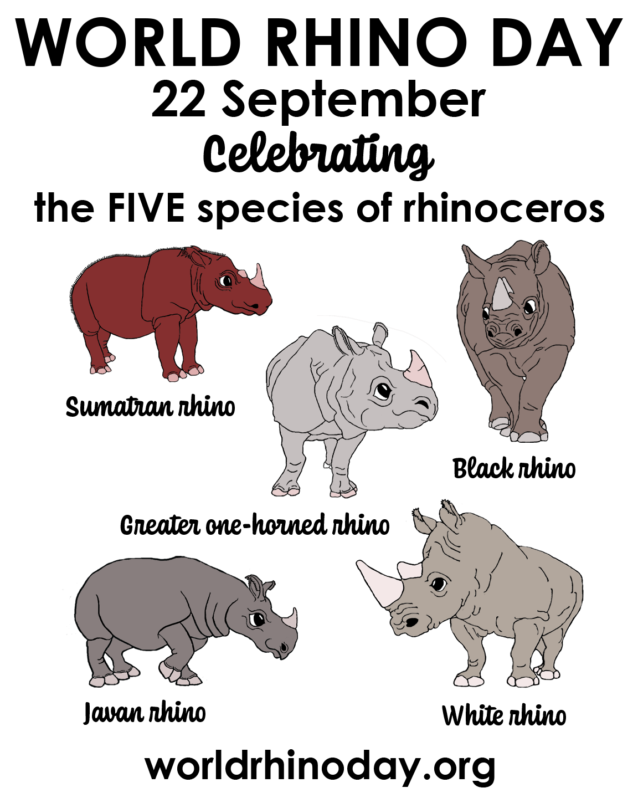
World Rhino Day was first announced by WWF-South Africa in 2010 but the international success it received in 2011 is credited to two rhino-loving women.
Lisa Jane Campbell and Rhishja connected over an e-mail in mid-2011 and in the months that followed, they worked together to make World Rhino Day 2011 an international success, both online and offline.
World Rhino Day has since become a global phenomenon, uniting NGOs, zoos, cause-related organizations, businesses, and concerned individuals from nearly every corner of the world. This day is all about spreading awareness about the amazing animal and its vulnerabilities and learning what we can do to protect them. But above of all, World Rhino Day is a day to celebrate rhinos.
The theme chosen for 2022 World Rhino Day is ‘Five Rhino Species Forever’. So, here are some information on all the five species of rhino.
- Black rhino (Diceros bicornis): They live in Namibia, Coastal East Africa. A fully grown black rhino is 5.2 feet tall and weighs from 1,760 -3,080 pounds. They are the smaller of the two rhino species found in African. They have two horns, and occasionally a third, small posterior horn.
Populations of black rhino declined dramatically in the 20th century at the hands of European hunters and settlers. Between 1970 and 1993, the population of black rhinos decreased by 96% from approximately 65,000 to only 2,300 surviving in the wild. But intensive anti-poaching efforts have had encouraging results since 1993. The population now numbers around 5,630 in the wild. Poaching still looms as the greatest threat.
- Greater one-horned rhino (Rhinoceros unicornis): They are found in Eastern Himalayas in India and Nepal. An adult one-horned rhino grows 5.75 – 6.5 feet tall, 10- 12.5 feet long and weighs between 4,000-6,000 pounds. The Indian rhino, as it is also called, is the largest of the rhino species.
Being hunted for sport or killed as agricultural pests, this species got very close to extinction and by the start of the 20th century, around 200 wild greater one-horned rhinos remained.
But thanks to strict protection by government authorities in India and Nepal, the greater one-horned, or Indian, rhino has rebounded to more than 3,700 today.
- Javan rhino (Rhinoceros sondaicus): The Javan Rhino is the rarest of the rhino species with only around 60 animals currently surviving only in Indonesia. Javan rhinos are now found only in Indonesia’s Ujung Kulon National Park, where the population appears to have stabilized, largely because they are guarded by Rhino Protection Units. Javan rhinos once lived throughout northeast India and Southeast Asia. Vietnam’s last Javan rhino was poached in 2010.
An adult Javan rhino grows 4.6–5.8 feet high, 10–10.5 feet long and weighs 1,984 – 5,071 pounds.
- Sumatran Rhino (Dicerorhinus sumatrensis): Sumatran rhinos are the smallest of the living rhinoceroses and the only Asian rhino with two horns. They are covered with long hair and are more closely related to the extinct woolly rhinos than any of the other rhino species alive today. An adult Sumatran rhino grows 3.3-5 feet in height, 6.5-13 feet in length and weighs between 1,320 -2,090 pounds.
While surviving in possibly greater numbers than the Javan rhino, Sumatran rhinos are more threatened due to habitat loss and fragmentation. The remaining animals survive in small, fragmented non-viable populations, and with limited possibilities to find each other to breed, its population decline continues. Just two captive females have reproduced in the last 15 years.
The Sumatran rhino once roamed as far away as the foothills of the Eastern Himalayas in Bhutan and eastern India, through Myanmar, Thailand, possibly to Vietnam and China, and south through the Malay Peninsula. Today, the species only survives on the Indonesian islands of Sumatra and Borneo. Experts believe the third subspecies is probably extinct.
- White rhino (Ceratotherium simum): White rhinos are the second-largest land mammal, and their name comes from the Afrikaan’s, a West Germanic language, word “weit” which means wide and refers to the animal’s mouth. They grow 5-6 feet tall and weigh from 3,080-7,920 pounds.
Two genetically different subspecies exist the northern and southern white rhino and are found in two different regions in Africa. As of March 2018, there are only two rhinos of the northern white rhino left, both of which are female. They live in the Ol Pejeta Conservancy in Kenya and are protected round-the-clock by armed guards. Their near extinction is due to decades of rampant poaching for rhino horn.
he majority (98.8%) of the southern white rhinos occur in just four countries: South Africa, Namibia, Zimbabwe, and Kenya. Southern white rhinos were thought to be extinct in the late 19th century, but in 1895 a small population of fewer than 100 individuals was discovered in Kwazulu-Natal, South Africa. After more than a century of protection and management, they are now classified as Near Threatened and around 18,000 animals exist in protected areas and private game reserves. They are the only of the five rhino species that are not endangered though that population has declined over the past 3 years because of poaching.
On #WorldRhinoDay 2022 and the first anniversary of consigning a record number of Rhino horns to flame, we reaffirm our commitment to protect the largest population of Rhino in the world.
A warm Greetings to all on World Rhino Day. #FiveRhinoSpeciesForever pic.twitter.com/AgJGMmloIr— Kaziranga National Park & Tiger Reserve (@kaziranga_) September 22, 2022