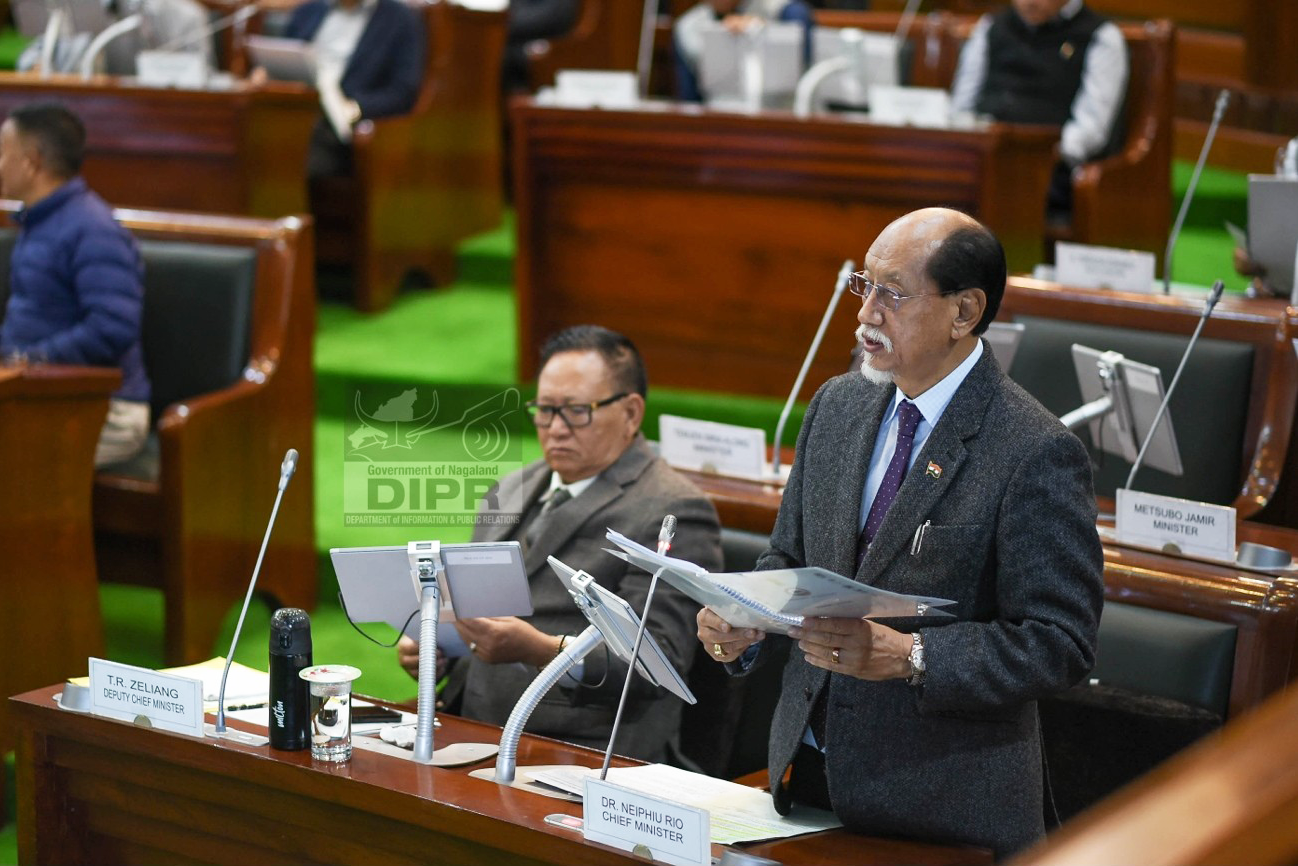
Acknowledging fiscal pressures even as he outlined an expansive development agenda, Chief Minister Neiphiu Rio on Thursday presented the Nagaland Budget for 2026–27, describing it as a surplus framework built on structural reforms, resource mobilisation and targeted sectoral investments.
Addressing the Assembly, Rio reported that the State’s gross receipts were projected at ₹22,507.10 crore against an expenditure of ₹22,127.33 crore. He stated that while the Budget yielded a surplus of ₹74.77 crore in net current transactions, the overall balance would remain negative at ₹337.04 crore due to the carried-forward deficit. He also pointed to improved fiscal management, noting that the 2025–26 deficit had been significantly reduced in the revised estimates.
Rather than projecting the Budget purely as a spending plan, Rio positioned it as a calibrated policy instrument aimed at navigating resource constraints while laying the foundation for long-term growth under the State’s “Developed Nagaland 2047” vision.
Opening his address, Rio referred to the agreement on the Frontier Nagaland Territorial Authority (FNTA), stating that it marked a critical step towards decentralised governance and inclusive development in the eastern districts. He informed the House that the State was expediting the formation of the interim body and had placed the relevant legislation during the session, with ₹100.57 crore earmarked as proportional allocation.
On the Naga political issue, the Chief Minister maintained that sustained engagement remained a priority. He stated that the Political Affairs Committee continued to serve as a consultative platform cutting across political and tribal representation, while a sub-committee under his leadership had been tasked with advancing discussions.
Referring to recent deliberations with the Centre, he indicated that a structured mechanism was being put in place at the Union level to monitor progress in the talks.
Rio, however, drew attention to emerging fiscal constraints. He noted that the State’s share in central taxes had been reduced to 0.481% following the latest Finance Commission recommendations, resulting in a projected receipt of ₹7,341 crore. He also flagged the discontinuation of revenue deficit grants as a matter of concern and said the issue had been formally raised with Union Finance Minister, Nirmala Sitharaman, while expressing confidence of continued support.
Against this backdrop, the Budget places strong emphasis on tightening expenditure and strengthening revenue streams. Rio stressed that high revenue expenditure, particularly on salaries, remained a structural challenge and reiterated the government’s intent to rationalize spending while enhancing State revenues through improved systems and compliance.
Significantly, the Budget introduces a shift in fiscal governance architecture. Rio announced the adoption of an SDG-linked budgeting framework, alongside a Gender Budget Statement and Outcome Budgeting model, aimed at linking allocations with measurable outcomes. He said the approach would integrate departmental efforts and community participation to achieve broader development goals.
The Budget also foregrounds gender-focused interventions, with the chief minister highlighting Nagaland’s top ranking in SDG-5 indicators. He announced the setting up of creches in government offices to improve workplace participation of women and introduced a ₹22 crore Innovation Seed Fund to support women-led nano enterprises. In addition, a pilot rollout of 50 “Pink Scooty Taxis” was proposed to expand livelihood opportunities for women in the transport sector.
In the infrastructure and sustainability segment, Rio outlined a ₹24 crore Water Resilience Initiative aimed at strengthening water security through storage, harvesting and recharge systems across district headquarters. He also launched a ₹211 crore Community Solar Partnership Initiative to install rooftop solar units in village council buildings, with the dual objective of reducing dependence on external power supply and generating community-level revenue.
Environmental sustainability measures include ₹21 crore for green economy initiatives focusing on bamboo-based industries and eco-friendly livelihoods. Rio noted that Nagaland’s community-led conservation model had already resulted in over 200 notified community reserves, reflecting local participation in environmental protection.
Download Nagaland Tribune app on Google Play

On employment and human capital, the Chief Minister announced an expansion of the Nagaland Skill and Entrepreneurship Development Mission with a ₹25 crore allocation, alongside the introduction of the Nagaland Apprenticeship and Placement Exchange (NAPEx) to bridge the gap between skill development and employment. The platform is expected to serve as a workforce registry and facilitate job matching, including tracking of Naga workers outside the State.
Education and youth development feature prominently, with allocations for faculty upskilling, STEM incentives, and alternative learning pathways for out-of-school youth. Rio stated that these interventions were aimed at strengthening the State’s long-term human resource base.
At the same time, the Budget incorporates social and behavioural initiatives, including a community wellbeing programme and performance-based incentives for sanitation and cleanliness among local bodies.
In a notable push towards revenue reforms, Rio announced the creation of Revenue and Development Fund Mobilization Cell and a committee on expenditure rationalization. He also detailed plans for land revenue reforms, digital payment systems such as e-GRAS, and the rollout of e-stamps to plug leakages and improve transparency.
Economic measures include a Gross Value Addition Promotion Initiative to support enterprises, an ₹85 crore logistics scheme to improve market access for agricultural produce, and a dedicated programme for weavers aimed at formalizing and expanding traditional industries.
Sectoral allocations reflect a broad-based approach, covering agriculture, rural development, infrastructure, power, industries, tourism, education and health. The chief minister also highlighted progress on key infrastructure projects, including the Trans-Nagaland Highway, while noting that land-related issues were being addressed through stakeholder consultations.
He further informed that Nagaland had secured ₹2,100 crore under a central scheme for the proposed Nagaki City, which is expected to emerge as a major urban and economic hub.

Concluding his address, Rio underscored the need for fiscal responsibility across all levels, cautioning that non-payment of utility dues and inefficiencies in revenue collection were placing increasing pressure on the State’s finances. He called for greater accountability among departments and citizens alike to ensure sustainable growth.
He then placed the Budget before the House for consideration, reiterating that the government’s objective was to translate public expenditure into tangible economic and social outcomes while steering Nagaland towards a stable and growth-oriented future.
Fiscal Performance and Budget Estimates
The State’s fiscal health has improved significantly, with the closing deficit for 2025-26 now estimated at ₹411.81 crore, down from the earlier projection of ₹843.21 crore.
For 2026-27, the Budget estimates gross receipts at ₹22,507.10 crore and gross expenditure at ₹22,127.33 crore. The breakdown is as follows:
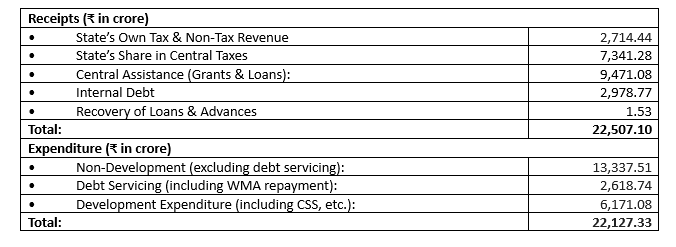
The Budget projects a net surplus of ₹74.77 crore, but accounting for the negative opening balance of ₹411.81 crore, the year is expected to close with a net deficit of ₹337.04 crore.