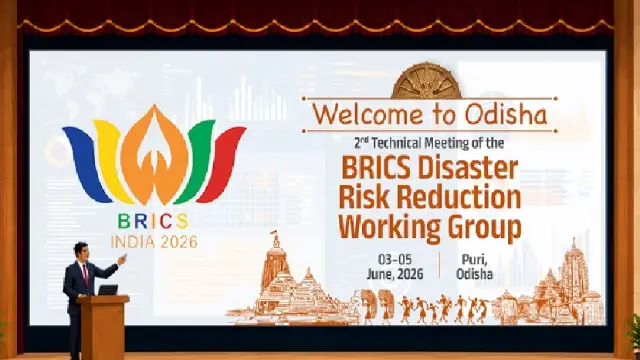
The State of Nagaland, through the Nagaland State Disaster Management Authority (NSDMA), Home Department, Government of Nagaland, successfully presented a series of pioneering disaster risk reduction and resilience-building initiatives during the 2nd BRICS Technical Meeting on Disaster Risk Reduction (DRR), at Puri, Orissa, from June 3 to 5, highlighting the state’s innovative and technology-driven approach towards disaster management.
Representing India at the prestigious international forum, Nagaland showcased several flagship initiatives that have emerged as national and global best practices in disaster risk governance, digital transformation, climate resilience, and anticipatory disaster financing.
Nagaland presented its innovative Disaster Risk Transfer and Protection Scheme (DRTPS), a pioneering parametric disaster risk financing mechanism designed to provide rapid financial support during extreme rainfall events and climate-induced disasters.
The initiative demonstrates how governments can leverage data-driven insurance and risk transfer instruments to strengthen disaster preparedness, reduce recovery time, and enhance financial resilience against climate shocks.
The meeting highlighted ELIONA, the advanced supercomputing and artificial intelligence platform developed by NSDMA for high-resolution weather forecasting, climate modelling, hazard simulations, risk analytics, and decision support systems.
ELIONA integrates Artificial Intelligence, Machine Learning, Geographic Information Systems (GIS), and advanced computing capabilities to generate actionable forecasts and risk assessments for disaster managers, planners, and policymakers.
The platform represents Nagaland’s vision of utilizing cutting-edge technology for climate adaptation and disaster resilience in mountainous and vulnerable regions.
Download Nagaland Tribune app on Google Play


Nagaland also showcased the NSDMIS, a comprehensive digital disaster management ecosystem that integrates real-time data collection, incident reporting, resource tracking, damage assessment, relief monitoring, and emergency response coordination.
The system enables seamless information sharing among state, district, and village-level authorities, significantly improving situational awareness and decision-making during emergencies.
The Decentralized Relief Payment System (DRPS) was presented as a transformative governance innovation that facilitates transparent, efficient, and timely disbursement of disaster relief assistance directly to affected beneficiaries.
By leveraging digital technologies and streamlined administrative processes, DRPS enhances accountability, reduces delays, and ensures that disaster-affected communities receive support when they need it most.
Delegates from BRICS member countries appreciated Nagaland’s integrated approach that combines technology, governance innovation, community participation, and climate resilience financing.
The presentation demonstrated how a geographically challenging and disaster-prone state can transform vulnerabilities into opportunities through innovation, partnerships, and strategic investments in disaster risk reduction.
The participation of Nagaland at the BRICS platform reflects India’s commitment to the objectives of the Sendai Framework for Disaster Risk Reduction and underscores the importance of international collaboration in addressing emerging disaster and climate risks.
The state reiterated its commitment to sharing knowledge, best practices, and technological innovations with national and international partners to build safer, more resilient, and sustainable communities.