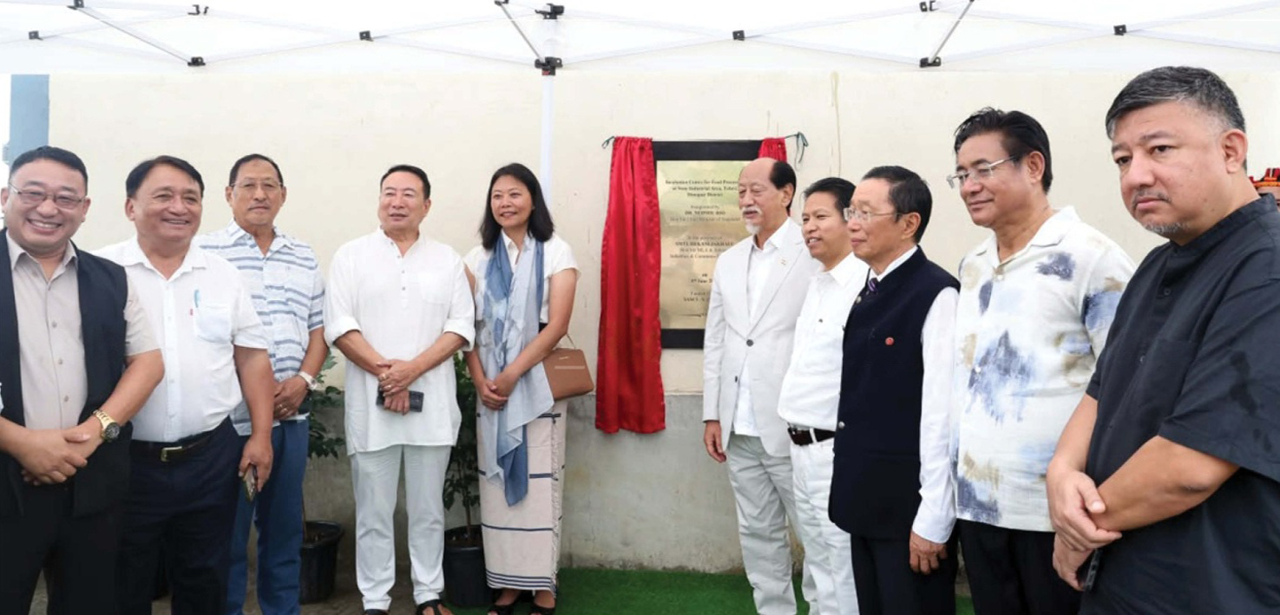
Nagaland Chief Minister, Neiphiu Rio on Monday emphasized the need for a paradigm shift from a consumer-driven economy to a production-oriented and entrepreneurship-led economy, while inaugurating Incubation Centre for Food Processing at State Industrial Area, Toluvi and launching three pilot food processing projects virtually at Chumoukedima, Tuensang and Mokokchung.
Addressing the inaugural programme at Toluvi, Rio described the initiative as a significant step towards strengthening the state’s agricultural and industrial sectors and creating sustainable livelihood opportunities for farmers and entrepreneurs. He congratulated Advisor for Industries and Commerce Hekani Jakhalu and the department for conceptualizing and establishing the infrastructure, while also bringing together farmers, entrepreneurs and market linkages.
Stating that nearly 70 percent of Nagaland’s population is engaged in farming, Rio said agriculture and allied activities remain the state’s greatest economic strength. He noted that Nagaland is not ideally positioned for large-scale heavy industries due to high transportation and production costs arising from dependence on imported raw materials.
“We have to emphasize agricultural products. This is where our potential lies, because we cannot easily set up big, heavy industries,” Rio said adding, “Therefore, the most viable path for us is small-scale industries, and food processing in particular.”
Rio said the incubation centres align with the vision of Prime Minister Narendra Modi’s “Viksit Bharat” mission and would help create a stronger local economy through food processing and entrepreneurship.
The Chief Minister observed that Nagaland has long functioned as a consumer state with an economy largely dependent on salaries and imported goods. However, he said the emergence of locally packaged products such as mustard oil and processed agricultural commodities demonstrated that the state was gradually transitioning towards production and value addition.
Highlighting the importance of farmers, the Chief Minister said food processing infrastructure would be meaningless without ensuring active participation and benefits for farmers. He stressed the need to establish incubation centres and processing units in every district so that region-specific crops could be efficiently processed and marketed.
He pointed out that fruits such as kiwi, peach, plum, dragon fruit and pineapple require proper processing facilities for juice production, drying and packaging, enabling farmers to utilize their entire harvest, including smaller or overripe fruits that may not be suitable for direct sale.
Rio also called for the development of a sustainable ecosystem where farmers receive direct benefits rather than middlemen capturing the largest share of profits.
Referring to various government support mechanisms, he highlighted the Chief Minister’s Micro-Finance Initiative under which beneficiaries receive a 30 percent government subsidy, contribute 10 percent themselves and avail 60 percent as loan assistance, with the government bearing the interest burden during the five-year moratorium period.
The Chief Minister urged youth to take advantage of entrepreneurship and self-employment opportunities instead of depending solely on government jobs. He noted that Nagaland’s employment register currently contains over 72,000 unemployed youth, while government vacancies continue to attract thousands of applicants for even lower-grade positions.
Citing findings from a recent job fair organized by the Nagaland Skill and Entrepreneurship Development Mission and the National Institute of Electronics and Information Technology (NIELIT), Rio said only 1,918 candidates registered out of the 72,000 unemployed youth despite participation by 33 multinational companies. Of those, only 954 attended interviews and just 89 ultimately received offer letters.
“This shows that our youth are being too selective. Even if there is a delay in securing a specific job, you must be willing to undergo skill training and capacity building. We must change our mindset and attitude,” he said.
The Chief Minister also highlighted employment opportunities abroad, including placements in Japan under a Memorandum of Understanding signed with Kochi Prefecture in 2025. He encouraged parents to support their children in pursuing career opportunities outside the state and country.
Rio further stressed the importance of contract farming and organic agriculture, saying every district should identify crops best suited to its soil conditions and produce them systematically under quality-controlled arrangements.
“We must strictly maintain organic farming standards. Contract farming will help us monitor quality and restrict the improper use of chemical pesticides and fertilizers,” he added.
Download Nagaland Tribune app on Google Play


The Chief Minister expressed confidence in the capabilities of Naga youth and urged them to utilize the incubation centres and other government initiatives to become successful entrepreneurs, farmers and innovators.
He also acknowledged the support of the Government of India through the Special Assistance to States for Capital Investment (SASCI) scheme, under which infrastructure projects are being funded with strict timelines and accountability mechanisms.
Hoping that the pilot model would encourage farmers, the Chief Minister said the Government intends to expand these centres to all the districts.
Achumbemo unveils ‘Six Ps’ vision to transform Nagaland’s Food Processing Sector
Speaking on the occasion, Advisor for SCERT and Food Processing, Achumbemo Kikon outlined an ambitious roadmap for the growth of Nagaland’s food processing sector, unveiling a vision centred around the “Six Ps” — Production, Processing, Preservation, Packaging, Pricing and Patenting — which he described as the guiding principles for the newly created department.
Expressing gratitude to the Chief Minister for entrusting him with the responsibility of leading the department, he also commended Advisor for Industries & Commerce, Hekani Jakhalu for her efforts in spearheading the initiative and acknowledged the support extended by the State Government in establishing what he described as a long-awaited and world-class facility for the food processing sector.
Highlighting his vision for the department, Kikon said the newly established Food Processing Department, which was carved out from the Department of Industries and Commerce, would focus on strengthening the entire value chain of agricultural production and marketing.
“I have already coined six words — the Six Ps: Production, Processing, Preservation, Packaging, Pricing and Patenting. These Six Ps will be the guiding star of the Department of Food Processing,” he said.
According to Kikon, the department would work in a mission mode to ensure that agricultural produce from Nagaland receives better value through modern processing techniques, improved preservation methods, attractive packaging, fair pricing mechanisms and protection of indigenous products through patenting and intellectual property rights.
He observed that food processing has always been part of Naga society and culture, pointing out that every household kitchen traditionally functioned as a small food processing unit.
“In our villages, every kitchen is a food processing industry. What was once known as a cottage industry already exists in our homes. Our objective is to scale it up and transform it into a sustainable economic activity,” he said.
He encouraged farmers to continue cultivating traditional cash crops such as ginger and turmeric, noting that Nagaland possesses ideal agro-climatic conditions for a wide variety of crops.
The Advisor said the State Government’s focus on food processing is aimed at generating employment, enhancing farmers’ incomes, reducing post-harvest losses and promoting value-added products from Nagaland.
Hekani highlights vision for Value Addition
Presenting the department’s vision through a detailed powerpoint presentation, Advisor for Industies & Commerce, Hekani Jakhalu said Nagaland’s new food processing centres are designed to create a complete value chain linking farmers, factories and markets, while reducing wastage and generating livelihoods.
She said food processing is not merely about installing machines but about converting agricultural produce into higher-value products that can generate income, employment and entrepreneurship opportunities.
Jakhalu noted that nearly 70 per cent of Nagaland’s population depends on agriculture and allied activities, while a large portion of produce is lost due to lack of processing and storage facilities. She identified inconsistent raw material supply, shortage of skilled manpower, lack of working capital, weak branding, poor roads and unreliable power supply as major challenges that had hindered earlier initiatives.
She said the four newly launched centres are pilot projects developed after studying local production patterns and will focus on products such as ginger, turmeric, mustard, chillies, potatoes and oilseeds. According to projected estimates, the Toluvi mustard oil and ginger dehydration units are expected to procure produce worth several crores from farmers annually while generating significant local employment and revenue.
Jakhalu said the department’s long-term goal is to establish processing centres in every district before 2028 so that farmers can access assured markets and value addition facilities closer to home. She credited Chief Minister Neiphiu Rio for supporting the pilot initiative through the Special Assistance to States for Capital Investment (SASCI) programme.
It may be mentioned that the Chief Minister virtually inaugurated Incubation Centre for Entrepreneurs and infrastructure development at Industrial Growth Centre, Ganeshnagar, Chumoukedima; Incubation Centre for Food Processing at Tuensang; and Modern aggregation Centre, Longnak, Mokokchung.