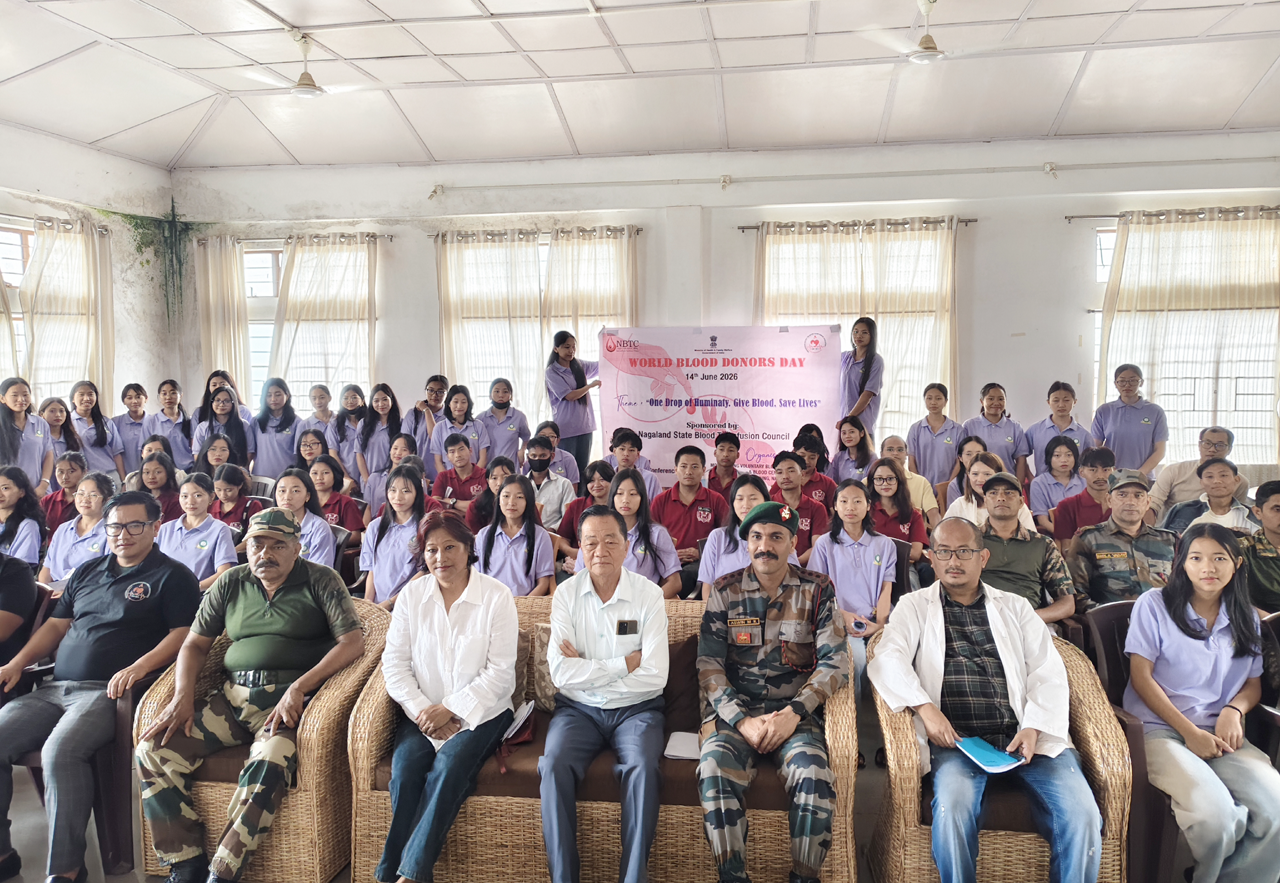
Imkongliba Memorial District Hospital (IMDH), Mokokchung observed World Blood Donors Day under the theme “One Drop One Humanity: Give Blood, Save Life” on June 14 at the IMDH conference hall.
The programme was attended by doctors, nurses and staff of IMDH, students from the College of Nursing IMDH, People’s College, Mokokchung College of Teachers Education (MCTE), Red Cross Society members, Mokokchung Voluntary Blood Donors Association (MVBDA) members and personnel from Assam Rifles.
Speaking on the significance of the day, Dr H Tsipongchem Sangtam shared about blood donation, the functioning of the IMDH Blood Centre and the present reality of blood availability in Mokokchung.
Dr Sangtam stated that while blood donation programmes are observed every year, an important question remains whether the blood centre is self-sufficient and completely dependent on voluntary donors. He said “currently the answer is no.”
He informed that only around 30 to 40 percent of the donations received at the blood centre are voluntary donations, while the remaining donations are replacement donations or family donors.
According to him, as per the Government of India policy, blood banks are not supposed to ask for replacement donations. People are expected to donate blood voluntarily, and if blood is available in the blood bank, patients requiring blood should receive it without arranging replacement donors.
However, he said the present situation requires the blood centre to depend on replacement donations because voluntary donations alone are not enough to maintain the blood supply.
Dr Sangtam said the blood centre continues to function because of regular voluntary donors, who respond whenever blood is required. He mentioned that some regular donors have donated blood 20 to 30 times, including donors from Mokokchung itself. He also acknowledged the support of Assam Rifles personnel, who respond whenever the blood centre requires donors.
He further stated that blood donation camps conducted in different places also contribute to the voluntary donation percentage. However, he pointed out that this is still not the level of voluntary donation expected by the Government of India, which aims for blood banks to be self-sufficient through voluntary donations.
Download Nagaland Tribune app on Google Play


Sharing the demand and supply situation, Dr Sangtam said that last year the requirement of blood was more than 1,500 units, but the blood centre could supply only around 1,200 units due to limited availability. He explained that blood cannot be manufactured in labs and can only be collected from people willing to donate.
Questioning the participation of youths, he said the age group eligible for blood donation forms a large section of the population. He stated that while youths do come forward, many donations happen only under replacement or family donor categories, while voluntary donors are fewer.
He also highlighted the role of civil society organisations in promoting blood donation camps. He said that although Nagaland has many organisations, only a few come forward to organise such camps. He mentioned that the Marepkong Youth Association in Mokokchung had invited the blood centre for a donation camp last year, which was successfully conducted stating “it was the only civil society organisation who invited for the blood donation camp.”
Dr Sangtam encouraged people not to donate blood only when someone requests them or when there is an emergency, but to come forward whenever they are healthy and eligible to donate.
Speaking about humanity and blood donation, he said that the colour of blood is the same beneath the differences in skin colour and that blood donation does not distinguish between people. He described blood donation as an act of empathy that connects people, regardless of background or social differences.
He stated that blood is essential for good health and many patients coming to hospitals require blood as part of their treatment. Since blood cannot be produced in laboratories, it depends entirely on willing and generous donors.
Dr Sangtam also said that blood donation takes only around 10 to 15 minutes, and while there may be temporary discomfort during the process, the donated blood can help another person survive.
He expressed gratitude to regular voluntary donors and encouraged those who have never donated blood to come forward if they are eligible.
“Not only a doctor or nurse can save a person’s life, but even you can save a person’s life by donating your blood,” he said.
The programme was chaired by Molo Jamir, President of Mokokchung Voluntary Blood Donors Association (MVBDA), who also delivered the vote of thanks. Wapang Longchar, IMDH Chaplain, pronounced the invocation.