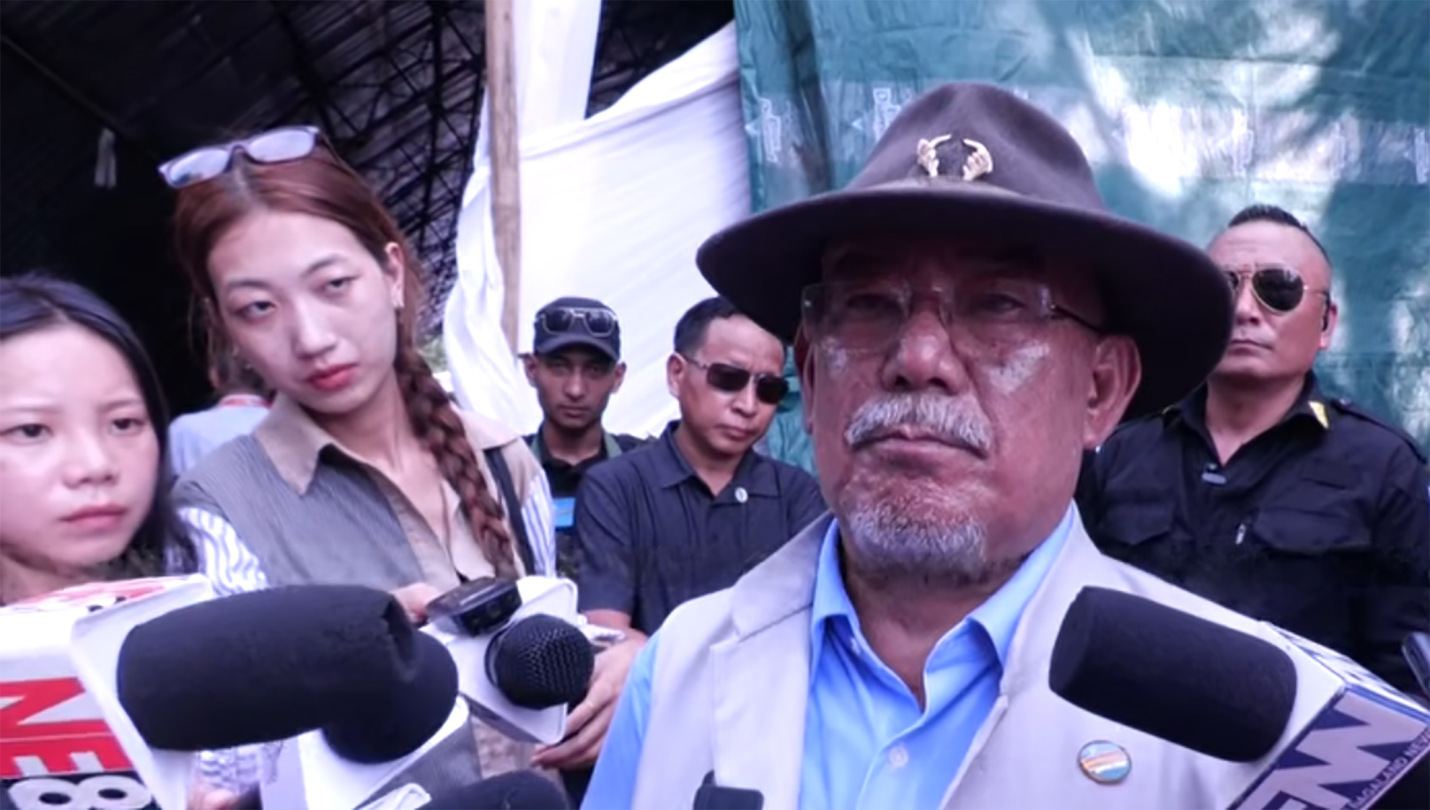
Convenor of Working Committee of NNPGs, N Kitovi Zhimomi on Saturday strongly criticised the proposed oil exploration and extraction following the signing of an MoU involving the Governments of Assam, Nagaland and the Centre.
Rejecting suggestions that delaying extraction would result in financial losses, he argued that proceeding without resolving ownership issues would itself amount to a far greater loss for the Naga people.
“There will definitely be a huge loss for the Nagas,” he said.
Interacting with media persons on the sidelines of a public rally, organized by “Fed Up Nagas,” he questioned who had authorised the signing of the agreement, maintaining that under the Agreed Position signed between the Government of India and the Working Committee NNPGs, ownership of land and natural resources belongs to the Nagas and that legislative authority over such matters would rest with the proposed Nagaland Tatar Hoho.
Kitovi cautioned against repeating what he described as the mistakes made during the signing of the 16-Point Agreement, alleging that decisions had then been taken without consulting the underground leadership, resulting in deep divisions.
Describing the current move as “broad daylight robbery,” he declared that oil exploration and extraction should not be permitted until the Assam-Nagaland inter-state boundary is clearly demarcated.
“If this proceeds, those responsible will have to answer for the consequences. I do not think Naga patriots will remain silent spectators,” he warned.
Responding to questions from the media, Kitovi said the large turnout at the public rally reflected the people’s determination to secure a political solution.
He said many of those participating were married individuals concerned about the future of their children, adding that they had voluntarily come despite the scorching heat because they had lost confidence in the future.
According to him, the gathering was driven by “willpower” and represented a positive sign of people’s commitment to securing a better future.
On NSCN (IM)’s absence
Asked about the absence of the NSCN (IM) and one faction of the Working Committee NNPGs led by Niki Sumi, Kitovi said only the respective organisations could explain their decisions.
He disclosed that Niki Sumi’s group had informed them through a letter that they were unable to attend due to unavoidable circumstances.
Stating that the number of Naga political groups was not the issue, Kitovi maintained that all groups desired a political solution. He said the emergence of the youth-led movement marked a new phase in the peace process.
“The youths are the real stakeholders. They are the future. Civil society organisations have been making appeals for years, but implementation has not happened. Now the youths themselves have taken the responsibility because they know they will inherit the consequences if the political issue remains unresolved,” he said.
Kitovi said the movement resonated with him because the youths had expressed a simple aspiration—to live in peace, progress, and have certainty about their future.
Download Nagaland Tribune app on Google Play


Rejects sponsorship allegations
Responding to allegations that he was sponsoring the “Fed Up Nagas” movement, Kitovi categorically denied the claim.
He admitted that he had initially been skeptical of the movement because of past experiences where youth initiatives had faded away after receiving recognition.
However, after interacting with the organisers, he said he became convinced of their sincerity and commitment.
“There is no sponsorship. We simply met at the crossroads. I was moving in one direction and they were moving from another, but our destination was the same. We decided to walk together. Calling me a sponsor is completely false,” he asserted.
Asked whether the NSCN (IM) had stayed away because veteran politician Dr SC Jamir was expected to attend the programme, Kitovi said he could not confirm the speculation.
However, he recalled an incident from 1997 when Dr Jamir, then Chief Minister, voluntarily withdrew from a delegation travelling to Atlanta after the NSCN (IM) reportedly objected to his participation.
If a similar situation had arisen this time, Kitovi said, the reasons could only be explained by the NSCN (IM) itself, while questioning why anyone would hesitate to face Dr Jamir directly.
Calls for identifying those delaying implementation
On who should be held responsible for the continued delay in implementing the Naga political agreements, Kitovi said both the Government of India and the signatories to the agreements had repeatedly expressed their readiness for a solution.
He argued that the focus should now be on identifying who was actually obstructing implementation.
“We have to do a post-mortem. Who is blocking it? Is it those who signed the agreement, the Government of India, or some third party? That is what must be established,” he said.
Expressing support for the aspirations of the “Fed Up Nagas,” Kitovi said their demands were fundamentally about peace, development, dignity and securing a stable future.
“If they say they are hungry, nobody has the right to tell them they should not be hungry. They have every right to demand a better future, and there is no reason for anyone to oppose their aspirations,” he added.