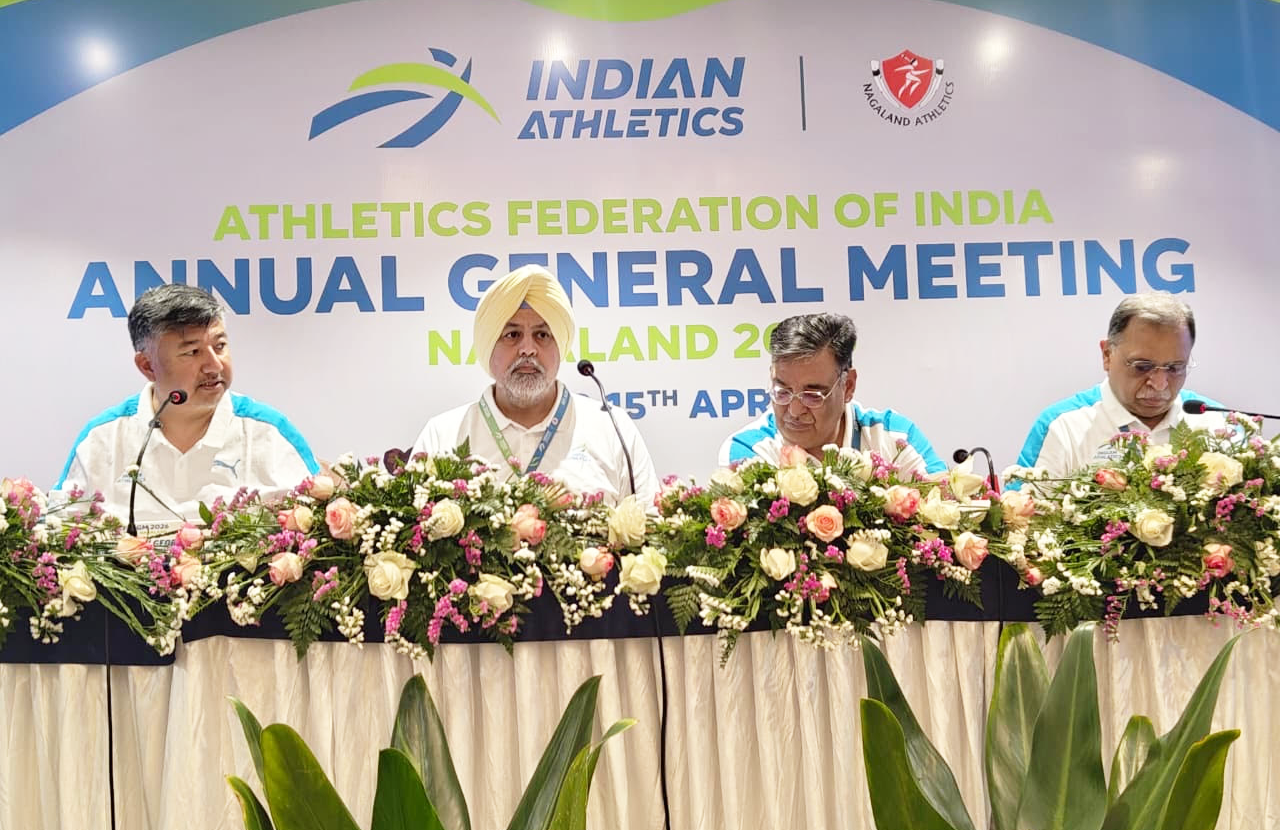
The Annual General Meeting (AGM) of the Athletics Federation of India (AFI), held over two days in Kohima, concluded on a historic note with the adoption of the “Kohima Declaration” and a series of far-reaching decisions aimed at transforming the athletics landscape in the country.
Summing up the deliberations, South Asian Athletics Federation president Lalit K Bhanot said the meeting witnessed extensive and detailed discussions, with participants expressing satisfaction over both the conduct and outcomes of the AGM. He credited the successful organisation to AFI vice president Abu Metha and his team, while acknowledging the support of the Nagaland government.
Among the key decisions, Bhanot announced that AFI has made it mandatory for athletes to undergo the SRY gene test, a sex-determination test, to participate in all national-level competitions. He said the federation would bear the cost of the test in coordination with the government, considering its high expense.
In another major initiative, AFI will begin DNA testing of athletes for research and developmental purposes. The programme will start with around 100 athletes in the first phase this year and will be expanded gradually to build a scientific database to better understand performance traits and guide training strategies.
The AGM also resolved to restructure district-level bodies to strengthen grassroots participation. Bhanot stated that each district executive committee would comprise 15 members, with broader representation from villages, blocks, and mandals to ensure deeper outreach beyond headquarters.
As part of efforts to popularise athletics nationwide, AFI announced an annual two-kilometre race to be conducted across 700 districts on August 30, commemorating India’s first bronze medal at the World Championships and encouraging mass participation in track and field.
The highlight of the AGM was the adoption of the Kohima Declaration, which Metha described as a commitment to nation-building through sports, promotion of athletics, and fostering national unity. The declaration was signed by Bhanot, World Athletics vice president Adille Sumariwalla, AFI president Bahadur Singh Sagoo, and Metha.

Metha said the declaration envisions expanding athletics to every corner of the country, creating opportunities for youth to participate and excel, and building a strong ecosystem for talent development. It also emphasises enhanced collaboration between AFI, state governments, associations, and stakeholders.
He underscored that the declaration carries a special focus on Nagaland and the Northeast, with commitments to targeted interventions, infrastructure development, capacity building, and high-performance pathways. It also aims to position the region as a hub for athletics by hosting more national and international competitions.
Describing the occasion as historic, Metha noted that it was the first time a national sports federation had held its AGM in Nagaland, adding that Kohima’s legacy, particularly its association with the Battle of Kohima, lent deeper significance to the gathering.
Download Nagaland Tribune app on Google Play

Elaborating on organisational matters, Sumariwalla said AFI would intensify decentralisation efforts and expand activities at the grassroots level with greater involvement of state associations. He informed that the executive committees of Chhattisgarh and Arunachal Pradesh had been suspended due to non-performance, while Tripura and Manipur have been placed on a watch list and downgraded to associate members without voting rights.
He also announced the appointment of two high-performance directors—Karl-Gunther Lange for senior athletes and Michael Kamel for junior athletes—to strengthen elite training programmes.
On athlete welfare, Sumariwalla said discussions on sponsorship agreements were ongoing and had been kept on hold for further consultation, stressing that the federation remains committed to protecting athletes from unfair contractual practices while balancing sponsors’ interests.
Responding to queries on Nagaland’s prospects, Bhanot said AFI would extend technical guidance, coaching support, and assistance in identifying suitable events based on athletes’ strengths, while clarifying that infrastructure development remains the responsibility of the state government.

He added that Nagaland shows promise in middle- and long-distance running as well as race walking, and assured that more competitions could be hosted in the region depending on available facilities.
Earlier, Sagoo said the AGM saw comprehensive discussions on all agenda points with participation from representatives across states, expressing satisfaction over the successful conduct of the meeting.
The AGM concluded with AFI officials placing on record their appreciation for the Nagaland Athletics Association, the state government, and the media, while reaffirming their commitment to advancing athletics across India.