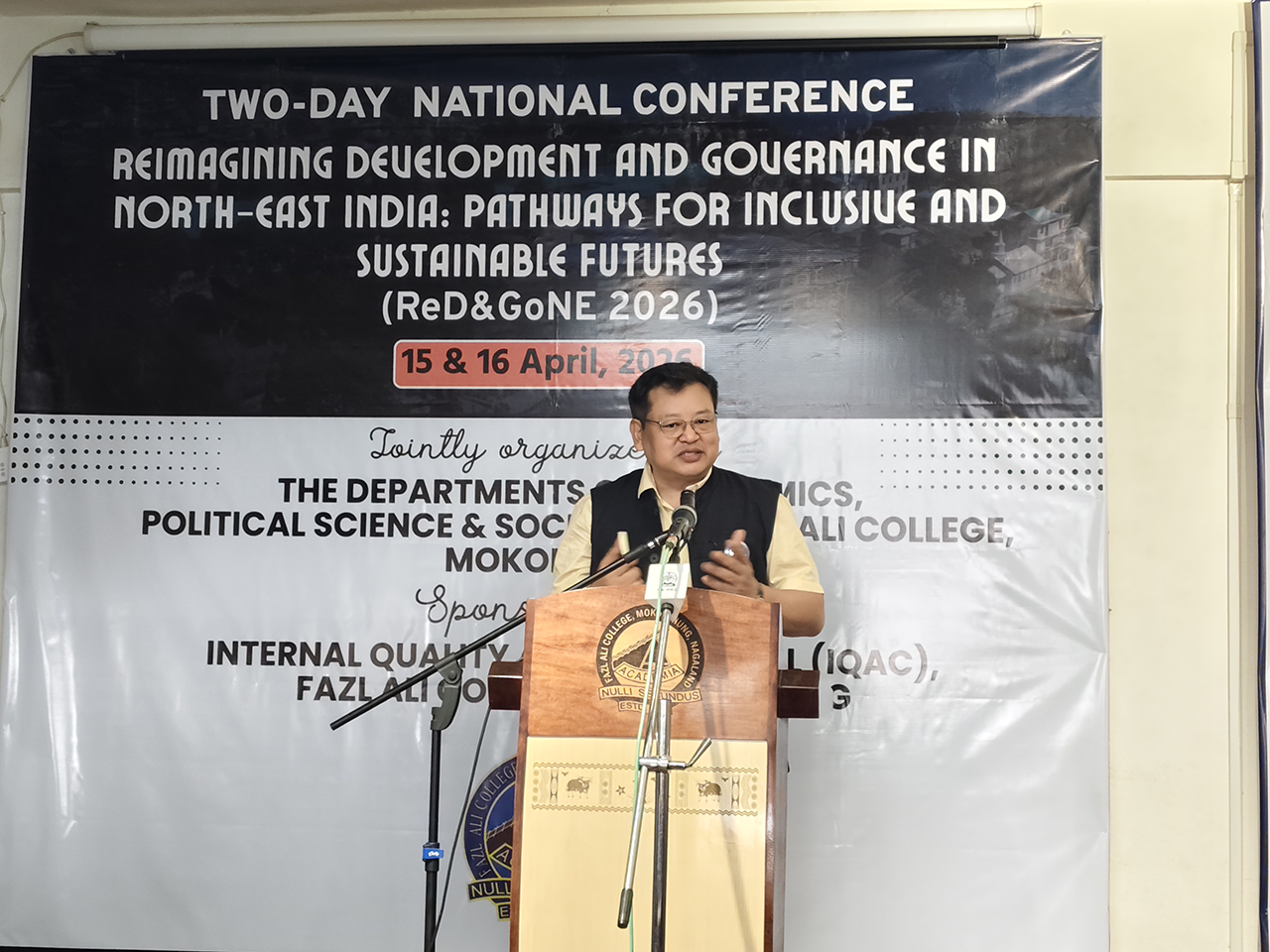
While speaking as the resource person on the topic “From Frontier to Pivot: Reimagining Development and Governance in Peripheral Landscapes,” Amba Jamir, Senior Policy Analyst and Development Strategist from Guwahati, Assam, raised critical concerns on the existing development narrative in Northeast India, particularly Nagaland, questioning both its direction and underlying assumptions.
He was speaking at the two-day National Conference ‘Reimagining Development and Governance in North-east India: Pathways for Inclusive and Sustainable Futures (ReD&GoNE 2026),’ which commenced on April 15 at the Science Block lobby, Fazl Ali College, Mokokchung.
He stated that academic disciplines possess the knowledge systems, institutional mechanisms, and intellectual capacity to contribute meaningfully to development. However, he observed that governments and planners often lack a clear vision and have become increasingly dependent on external consultants, with planning frequently carried out by individuals from outside the region, particularly from Delhi. This, he noted, has led to a situation where local capacity for planning has weakened over time.
Referring to constitutional provisions such as Article 371A in Nagaland and similar provisions across the Northeast, along with the Sixth Schedule, he pointed out that while these exist as safeguards, they are not effectively utilized as instruments of governance. He remarked that Article 371A remains more of a “shield” than a functional tool, as the state has not translated its provisions into actionable laws and policies.
Raising fundamental questions, he asked what development means and why the region continues to perceive itself as a “periphery.” He challenged the notion that the Northeast is merely a distant, underdeveloped region dependent on external support, stating that such a mindset has shaped policies, planning frameworks, and economic understanding in ways that have been detrimental. He stressed that this perception of marginality has been internalized and has influenced how development is approached.
He highlighted that the region possesses diverse governance systems and institutions. Citing the example of Nagaland’s rejection of the Panchayati Raj system following the 73rd Constitutional Amendment, he said the state had asserted the existence of its own traditional governance mechanisms, such as village councils and customary institutions. However, he clarified that village councils are statutory bodies created by the state and not traditional institutions, functioning largely as extensions of the Deputy Commissioner’s office for administration and development.
Jamir emphasized the presence of indigenous knowledge systems, particularly ecological intelligence developed over generations. He pointed out that local communities, especially farmers, possess deep understanding of environmental patterns, such as predicting rainfall and agricultural cycles. Despite this, such knowledge is increasingly ignored, even by the communities themselves, in favour of external systems.
He also drew attention to the role of social institutions, including kinship systems and clan-based structures, which continue to govern land, resources, and social responsibilities. He cited his own clan as an example of a functioning institution that manages land and responds to community needs, yet noted that such systems are largely unrecognized in formal governance and planning frameworks.
Addressing development challenges in the region, he attributed many issues to structural misalignment between development design and institutional realities. He stated that externally designed frameworks are often imposed without considering local contexts, resulting in overburdened institutions such as village councils, which are tasked with implementation without adequate capacity or alignment with traditional systems.
Download Nagaland Tribune app on Google Play

He further explained that development models often fail because they are based on assumptions that do not reflect local realities such as individual land ownership, transactional economic behaviour, and standardized governance systems whereas in Nagaland, land is communally owned and social relations play a central role in economic interactions.
Using the example of cooperative movements, he noted that while such models have succeeded elsewhere, including well-known cases like dairy cooperatives, they have struggled in Nagaland due to lack of contextual adaptation. He emphasized that external frameworks are not inherently flawed but must be adapted and co-created with local communities rather than imposed.
Jamir warned of the growing marginalization of local knowledge systems and described it as part of a deeper “epistemic imbalance,” where knowledge produced within the region is undervalued in favour of external expertise. He also pointed to the education system as contributing to this disconnect, as it often distances individuals from their cultural roots and traditional knowledge.
On governance, he highlighted a structural duality in Nagaland, where traditional institutions, statutory bodies, and informal systems coexist without clear coordination or recognition. He noted that while clans and customary systems govern land and social relations, statutory bodies like village councils handle development funds and administrative functions, leading to confusion, lack of accountability, and inefficiencies.

He stressed that Article 371A’s limitations are not constitutional but institutional, arising from the state’s failure to enact laws that operationalize its provisions. He cited examples such as resource governance and financial opportunities lost due to absence of state legislation, despite constitutional protections.
Discussing development outcomes, he pointed out that land ownership remains fragmented among clans and families, while decision-making often lies with bodies that do not directly own land. This disconnect he said, affects implementation of development initiatives and impacts ecological balance, social cohesion, and economic transformation.
Jamir argued that the articulation of development pathways must emerge from within the region, grounded in local realities and informed by interdisciplinary engagement. He called for a shift from externally driven, program-based approaches to deliberate institutional design rooted in community participation.
He proposed three key shifts: moving from program delivery to institutional design, integrating traditional institutions with statutory frameworks, and aligning modernization with cultural and ecological identities. He emphasized that traditional institutions must be formally recognized and coordinated with state systems, as they carry social legitimacy and play a crucial role in governance.
He also cautioned against “romanticizing traditional systems,” stating that while recognition is necessary, integration must be practical and structured. He underscored the need for policies that respect both modernization and cultural identity, noting that development should not come at the cost of ecological sustainability or social values.
Referring to shifting cultivation, he stated that it has been widely stigmatized as unproductive and destructive, despite its resilience and ecological significance. He observed that such narratives have affected the confidence of farmers and contributed to the erosion of traditional practices, even as global perspectives begin to re-evaluate such systems.
In conclusion, Jamir stated that the Northeast should not be viewed merely as a frontier but as a region with significant ecological, cultural, and institutional strengths. He emphasized that these characteristics must be reframed as strategic assets. He reiterated the need to shift from constitutional protection to active institutional building, from passive acceptance of external frameworks to generation of indigenous development logic, and from reactive, scheme-driven planning to a coherent, locally grounded vision. He stressed that autonomy must translate into capability, and that development must be embedded in local realities, institutions, and knowledge systems.