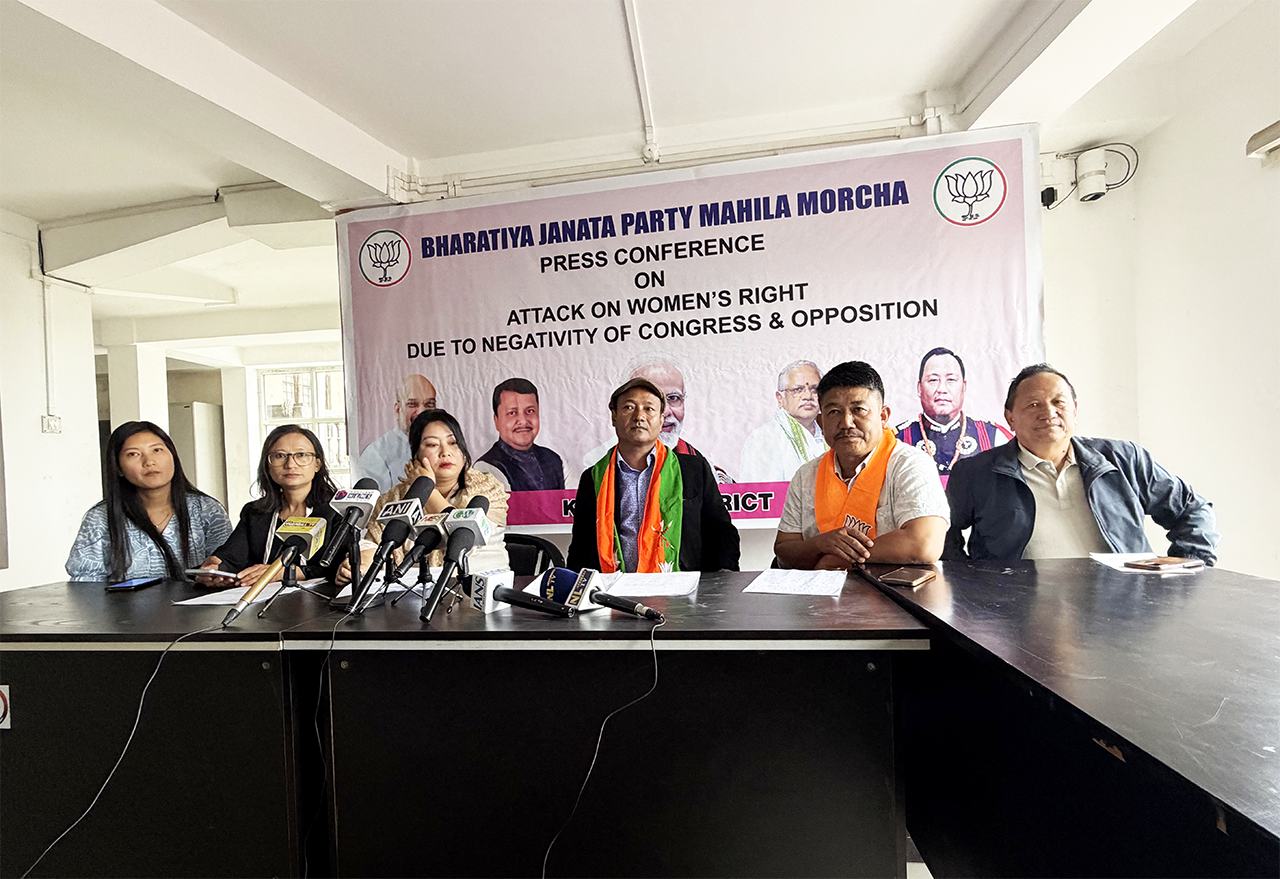
The Bharatiya Janata Party (BJP) Kohima unit on Wednesday strongly criticized the Opposition parties over the defeat of the Constitution (131st Amendment) Bill, 2026 in the Lok Sabha.
Addressing the media, Vineizo Tsürho, State Executive Member said that the discussions held in Parliament on April 16 and 17 regarding the Constitution (131st Amendment) Bill, the Delimitation Bill, 2026, and the Union Territories Laws (Amendment) Bill, 2026, were historic and directly connected to the democratic future of the country and women’s participation in governance.
However, he stated that the proposed constitutional amendment failed to secure the required two-thirds majority in the Lok Sabha, despite receiving 298 votes in favour and 230 against.
He explained that the Women’s Reservation Act, passed in 2023, provides 33 percent reservation for women in the Lok Sabha and State Assemblies but links its implementation to delimitation following the post-2026 Census.
According to him, if the government had waited for the Census and subsequent delimitation process, women might not have benefited from the reservation even in the 2029 general elections due to the time required to complete these procedures.
Tsürho said the 131st Amendment Bill was introduced to delink the implementation of women’s reservation from the Census-related condition to ensure timely benefits for women. If passed, he said, the amendment would have paved the way for 33 percent reservation in the Lok Sabha as early as 2029.
On delimitation, he clarified that it refers to the process of redrawing constituency boundaries and is essential for implementing women’s reservation. He pointed out that the current cap of 550 Lok Sabha seats was fixed in 1976, when India’s population was around 54 crore. With the population now exceeding 140 crore, he argued that increasing the number of seats to 850 would ensure fair and proportional representation.
He further maintained that no changes were proposed to the Delimitation Commission Act and that the existing legal framework would remain intact. Any recommendations made by the Commission, he said, would require parliamentary approval and Presidential assent. He also assured that ongoing and upcoming elections up to 2029, including those in states such as Tamil Nadu and West Bengal, would not be affected.
Launching a sharp attack on the Opposition, Tsürho alleged that parties such as the Congress, Samajwadi Party, TMC and DMK had obstructed the Bills and displayed an “anti-women mindset.” He accused them of delaying women’s political empowerment for decades through procedural and political excuses.
Download Nagaland Tribune app on Google Play


He said Prime Minister Narendra Modi had appealed in Parliament to rise above party lines and support the legislation in the national interest, stressing that equal participation of women in policymaking is their right, not a favour. He added that the BJP remains committed to strengthening democracy through balanced and inclusive representation.
Leanne Kiewhuo, who is the Mahila Morcha Kohima District president in her address, said that implementing reservation requires a comprehensive delimitation process, which is consultative and can take up to two years to complete. She reiterated that the Constitution of India does not permit reservation based on religion and that reservation policies are grounded in social and economic backwardness as defined by constitutional provisions.
She clarified that the Women’s Reservation Act enacted in 2023 established the constitutional framework for reservation, and the recent Bills were intended to facilitate its effective and timely implementation. She also emphasized that there was no proposal to alter the Delimitation Commission Act and that the current electoral system would remain in place until 2029.
Kiewhuo said greater representation of women in Parliament and State Assemblies would help bring more focus and clarity to issues affecting women. She asserted that this was not a time for division but for collective efforts to strengthen the democratic framework of the country.
