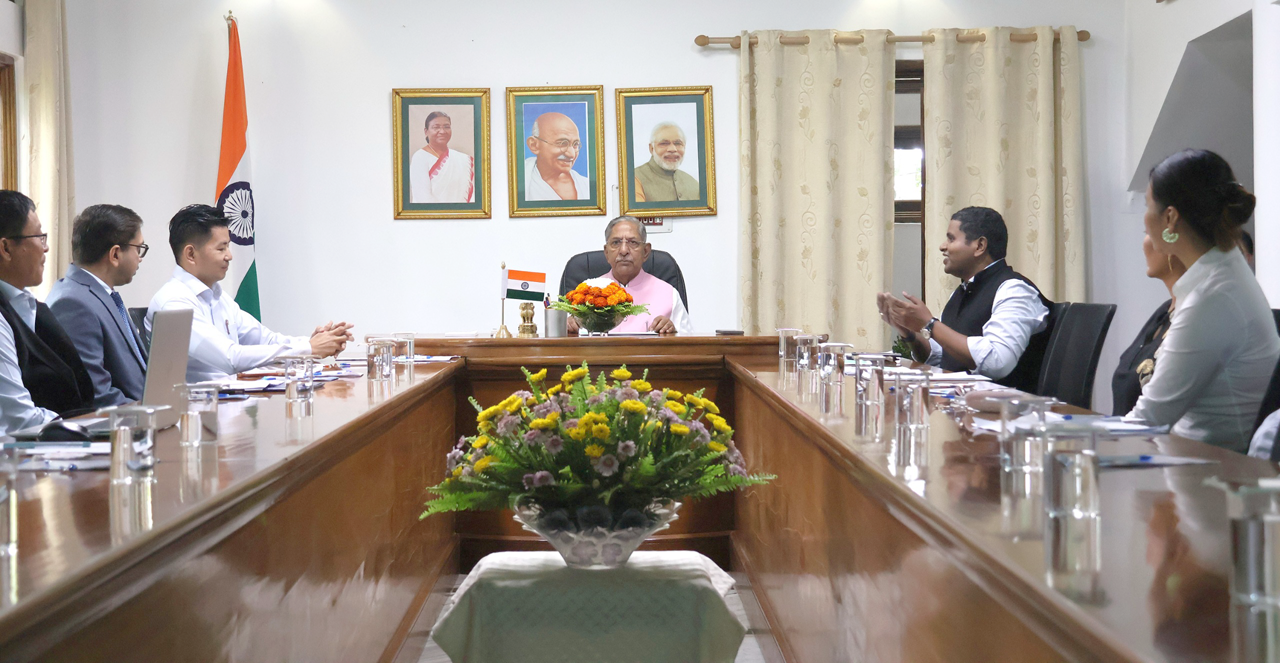
Governor of Nagaland Nand Kishore Yadav reviewed the functioning of the Department of State Taxes at Lok Bhavan, Kohima, on August 10, with the department highlighting a significant rise in tax revenue and outlining plans to strengthen compliance, digital infrastructure and revenue mobilisation.
During the review meeting, the department made a detailed presentation on its organisational structure, revenue performance, major initiatives, achievements, operational challenges and future roadmap.
The department informed that it currently has 11,592 active registered taxpayers across its four zones—Dimapur, Kohima, Mokokchung and Chumoukedima. Its key functions include taxpayer registration, return scrutiny and audit, enforcement, adjudication and recovery, appeals, refunds, and tax education and awareness.
A major highlight of the presentation was the steady growth in the State’s tax revenue. Total tax collection increased from ₹1,427.03 crore in FY 2024-25 to ₹1,597.51 crore in FY 2025-26, registering an increase of ₹170.47 crore. This was substantially higher than the ₹68.05-crore increase recorded in the previous year.
For the first quarter of FY 2026-27, from April to June 2026, the State collected ₹466.98 crore, ₹23.96 crore higher than the corresponding period of the previous financial year.
The five-year revenue trajectory showed sustained growth, with total tax revenue rising from ₹1,122.71 crore in FY 2021-22 to ₹1,597.51 crore in FY 2025-26. GST remained the largest component, contributing ₹1,181.88 crore, or 74 per cent, of total tax revenue during FY 2025-26.
The department further reported that GST collection, comprising SGST and IGST, had increased from ₹187.57 crore in FY 2017-18 to ₹1,181.88 crore in FY 2025-26, representing a 530 per cent increase. GST collection during the current financial year stood at ₹450.35 crore up to July 2026.
To improve tax administration and compliance, the department has introduced several digital and monitoring initiatives, including G-RAMS (GST Returns and Adjudication Management System), online TCC applications, online Professional Tax registration and payment, N-GAIN (Nagaland GST Analytics and Intelligence Network) and GST awareness campaigns. Market surveys, compliance checks and the GST Registration Data Cleansing–Compliance Assessment & Market Survey (GRDC-CAMS) were also highlighted.
The department has also intensified enforcement through inspections targeting fake invoices and registrations, inventory checks and monitoring of goods movement. A counter has been opened at the Railway Parcel Office to track the movement of goods, while greater coordination between Central GST and State GST authorities has also been emphasised.
Among the achievements highlighted was the development of an in-house digital Professional Tax platform and the recovery of ₹17 crore in petroleum arrears as of August 6, 2026. Nagaland was also stated to have ranked first in the Northeast and 16th nationally for the launch of Biometric Aadhaar Authentication Registration.
Download Nagaland Tribune app on Google Play


The presentation also highlighted strong GST revenue growth, with Nagaland recording 37 per cent growth up to December 2025 and 28.4 per cent during FY 2025-26, both higher than the corresponding all-India averages cited by the department.
However, the department identified manpower shortages, the need for continuous upgrading of IT infrastructure, increasing workloads from taxpayer registrations and return filings, and the growing volume of GST data requiring scrutiny and risk assessment as key operational challenges. Enforcement challenges include identifying unregistered taxpayers and tax evasion, verifying high-risk taxpayers, and monitoring works contracts, interstate transactions and other revenue-sensitive sectors.
The department stressed the need to overcome the traditional resistance towards tax payment and proposed making tax compliance a people’s movement.
Under its “Vision 2063 and Beyond,” the department aims to build a robust, transparent and dynamic revenue ecosystem focused on voluntary compliance, innovation, stronger governance and sustainable growth. It has set revenue targets of ₹2,400 crore-plus by 2030, ₹5,000 crore-plus by 2038, ₹11,000 crore-plus by 2047 and ₹50,000 crore-plus by 2063.
Seven key growth drivers have been identified to achieve these targets: expansion and restructuring of the department, state-of-the-art IT infrastructure, establishment of a State Revenue Board, training and capacity building, promoting tax compliance as a people’s movement, creation of a legal cell, and provision of basic conveyance and accommodation facilities for officers and staff.
The review was part of the Governor’s ongoing assessment of the functioning and performance of various departments of the State Government.
Finance Commissioner Kesonyu Yhome, IAS, along with senior officials of the State Taxes Department, attended the meeting.