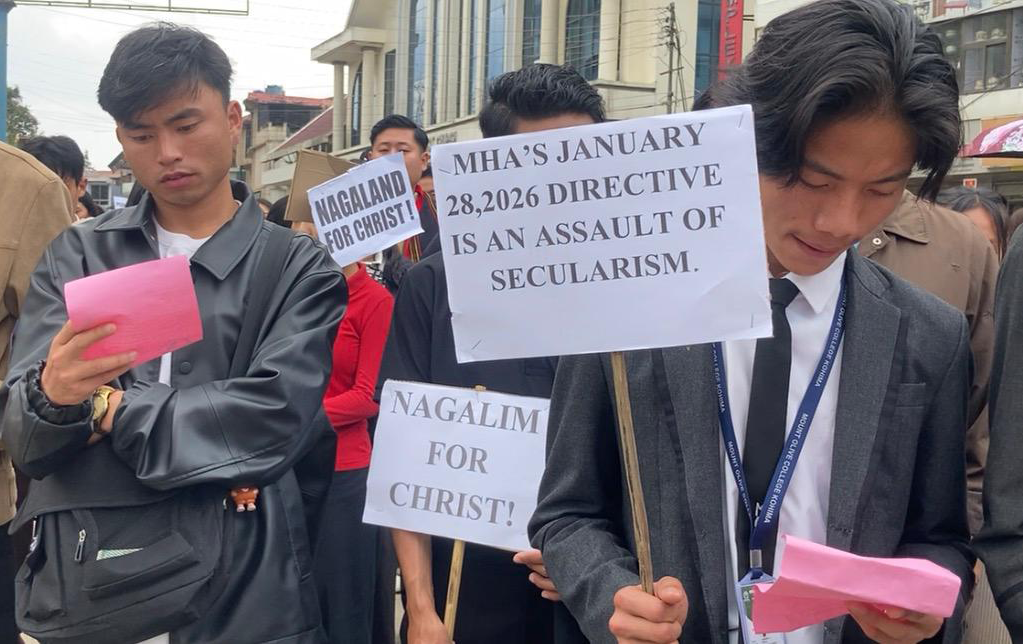
During the mass rally organized by the Naga Students’ Federation (NSF) at the Old MLA Hostel Junction in Kohima on March 16 against the compulsory observance of the song Vande Mataram, NSF General Secretary Kenilo Kent read out a memorandum addressed to Droupadi Murmu.
The memorandum, to be submitted through the Governor of Nagaland, expressed the strongest opposition of the Naga people to the directive issued by the Ministry of Home Affairs mandating the playing or singing of the national song during official functions and its compulsory observance in educational institutions.
According to the memorandum, the Naga people harbour no hostility toward national symbols, songs or cultural expressions of any nation or community and have historically respected the traditions and patriotic sentiments of others. However, it stated that imposing any cultural or symbolic expression—particularly one with religious and devotional connotations—raises serious concerns regarding fundamental freedoms and internationally recognised rights.
The memorandum stated that the revised version of “Vande Mataram” contains devotional imagery associated with the worship of a particular deity. For communities such as the Nagas, whose society places great importance on freedom of conscience and religious belief, the compulsory singing or observance of such a composition is viewed as an infringement on deeply held beliefs and cultural sensitivities.
It further highlighted that the Naga homeland has long been a place of peaceful coexistence where people of different religions and cultures live with mutual respect. Temples, mosques, churches and other places of worship operate freely across Naga areas, and such harmony has been sustained through voluntary respect for diversity rather than coercion.
The memorandum also raised concern that directing educational institutions to begin the day with the collective singing of “Vande Mataram” and efforts to “popularise” the song under compulsion could undermine the role of educational institutions as spaces for intellectual freedom, cultural sensitivity and democratic values.
Beyond India’s democratic framework, the memorandum pointed to international conventions and legal instruments to which India is a signatory. It cited Universal Declaration of Human Rights, which affirms the right to freedom of thought, conscience and religion, including the freedom to refrain from practices that violate one’s beliefs.
Similarly, the memorandum referred to the International Covenant on Civil and Political Rights, which guarantees that no individual should be subjected to coercion that impairs the freedom to adopt or practice a religion or belief of choice. It also cited provisions ensuring that ethnic, religious and linguistic minorities are not denied the right to practice their own culture or religion.
Download Nagaland Tribune app on Google Play

The document additionally referred to the United Nations Declaration on the Rights of Indigenous Peoples, which recognises the rights of indigenous communities to maintain and strengthen their cultural institutions, traditions and beliefs without external imposition.
The memorandum asserted that the Naga people are recognised as an indigenous community with a distinct historical identity and cultural heritage, and warned that the imposition of symbolic practices without consultation risks undermining these protections.
Appealing to the President, the NSF urged the withdrawal of the directive mandating the singing or playing of “Vande Mataram” during official functions and in educational institutions in the Naga homeland. It also called for policies to be implemented in a manner that respects the cultural, religious and historical sensitivities of the Naga people and for dialogue and consultation before introducing measures affecting the region’s social and cultural fabric.
The memorandum stated that it represents the collective voice of the Naga people who gathered in peaceful protest to defend their identity, conscience and dignity, while expressing hope that their concerns would receive earnest consideration in the spirit of justice, democratic values and respect for diversity.