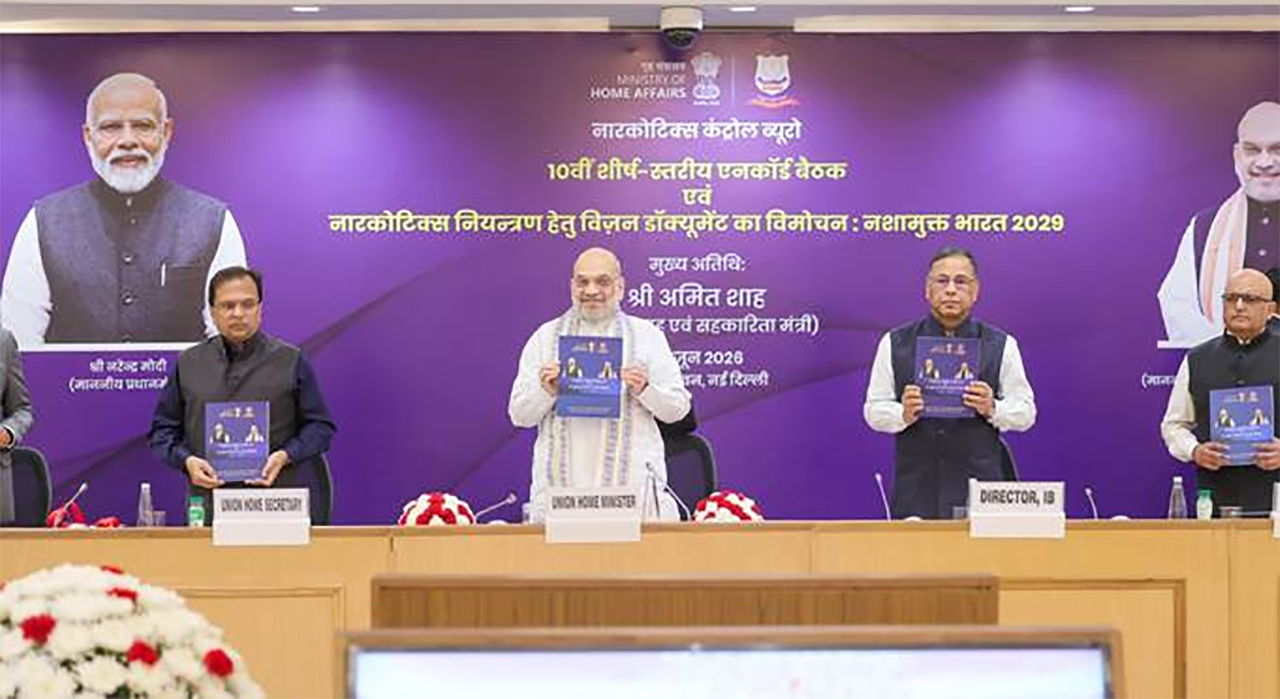
Union Home Minister and Minister of Cooperation Amit Shah on Friday asserted that the next three years would be decisive in India’s fight against narcotics, stating that the country stands at a critical juncture where it must collectively ensure that addiction is defeated for the sake of future generations.
Shah made the remarks while chairing the 10th apex-level meeting of the Narco-Coordination Centre (NCORD) in New Delhi.
During the meeting, he released the Vision Document on Drug Control (2026–2029) and the NCB Annual Report 2025, virtually inaugurated the Narcotics Control Bureau (NCB) zonal offices in Jammu and Guwahati, and launched the Online Drugs Disposal Fortnight Campaign, under which 2,09,500 kg of narcotic substances valued at nearly Rs 6,000 crore would be destroyed.
Addressing senior officials from the Centre and states, Shah said the challenge posed by narcotics extends far beyond law and order or public health.
Shah emphasized that the issue of narcotic drugs is not merely a matter of law and order or public health but deeply connected to the country’s internal security, social stability, protection of economic interests, and the future of youth. He said achieving complete victory over this problem should be a collective national goal for all states of India.
Shah said that along with drug trafficking, organized crime, narco-terror financing, and the funding of cross-border terrorist networks, this problem has also evolved into an Evolving Narco-Terrorism Ecosystem.
According to Shah, India is geographically positioned between the “Death Triangle” and the “Death Crescent”, making it especially vulnerable to transnational drug trafficking networks.
He warned that narcotics syndicates have adopted sophisticated methods such as drone deliveries, containerised maritime cargo, darknet marketplaces, cryptocurrency payments, parcel shipments and technology-enabled order-to-delivery systems.
“Today, narco-offenders have become technology-empowered and network-based. They now confront us as a form of multi-domain crime,” he said adding, “Our response to this difficult battle must also be collective and organized, roadmap-based, modern, and intelligence-led. Our approach should be technology-driven, and we must wage a network-centric war with a ruthless approach. Only then will we be able to secure victory against this problem.”
The Home Minister underlined the need for a balanced strategy that combines strict enforcement with rehabilitation.
“We must maintain a ruthless approach towards those involved in drug trafficking and a sympathetic approach towards the victims of drugs,” Shah said, noting that those trapped in addiction require compassion and goodwill that can reconnect these children with a normal life.
He added that reducing drug demand through awareness and treatment must go hand in hand with dismantling supply chains.
Shah said the Vision Document on Drug Control (2026–2029) has been prepared as a comprehensive roadmap for achieving the Prime Minister’s vision of a ‘Nasha Mukt Bharat’ alongside the broader goal of Viksit Bharat @2047.
The roadmap is built on four key pillars: Enforcement, Intelligence and Operations; Precursors and Synthetic Drug Control; Demand and Harm Reduction; and Capacity Building, Coordination and Monitoring
Download Nagaland Tribune app on Google Play


He said the strategy has clearly defined timelines, measurable targets and accountability mechanisms, with annual reviews to assess progress and make necessary course corrections.
The roadmap adopts both a Whole-of-Government and Whole-of-Society approach, assigning responsibilities not only to government departments but also to citizens, educational institutions, community organisations and local administrations.
‘Detect, Disrupt and Destroy’
Describing the government’s anti-drug strategy in three words—Detect, Disrupt and Destroy—Shah said enforcement agencies must dismantle every layer of the narcotics network.
He directed agencies to identify and eliminate international traffickers, interstate suppliers and local distribution networks through human intelligence (HUMINT), technical intelligence and community policing, particularly in border and vulnerable districts.
He also called for mandatory financial investigations in major NDPS cases; strict monitoring of hawala transactions, cryptocurrency payments and darknet activities; identification and destruction of illegal drug laboratories; eradication of illicit cultivation of narcotic crops; strong action under the Prevention of Money Laundering Act (PMLA) to seize proceeds of crime; and effective monitoring of controlled delivery operations and emerging trafficking techniques.
Shah stressed that financial investigations should become an integral part of every major narcotics case so that traffickers are deprived of their financial resources.
The Home Minister urged Chief Secretaries and Directors General of Police of all states to make NCORD meetings more result-oriented.
He informed that since the formation of NCORD, 15,876 district-level meetings, 266 state-level meetings, seven Executive Committee meetings and 10 apex-level meetings have been held.
He also called upon states to strengthen Anti-Narcotics Task Forces (ANTFs) by converting them into full-time, well-equipped and accountable specialised units.
Shah urged police chiefs to establish exclusive NDPS courts through consultations with High Courts to ensure speedy trials and stronger prosecution. He also advocated the appointment of Special Public Prosecutors for narcotics cases.
Shah further urged state governments to identify major drug traffickers and gang leaders hiding abroad and initiate action through Red Corner Notices with the assistance of the Central Bureau of Investigation (CBI) and international agencies to bring them back to India.
Significant rise in enforcement action
Highlighting the government’s achievements over the past decade, Shah said anti-narcotics operations have expanded substantially.
Between 2004 and 2014, authorities seized 26 lakh kilograms of drugs worth about Rs 40,000 crore.
In contrast, between 2014 and 2026, enforcement agencies seized 1.18 crore kilograms of narcotics valued at Rs 1.84 lakh crore, reflecting a significant increase in enforcement.
Similarly, drugs worth Rs 89,896 crore, weighing 42.47 lakh kilograms, were destroyed during the last 12 years compared to Rs 8,000 crore worth 3.26 lakh kilograms destroyed between 2004 and 2014.
Illegal opium cultivation destroyed also rose sharply—from 10,000 acres in 2020 to 42,282 acres in 2025.
Shah further noted that 8.75 lakh NDPS cases have been registered and 10.97 lakh people arrested since 2014, compared to 1.73 lakh cases and 1.95 lakh arrests during the previous decade.
Shah expressed confidence that India can substantially dismantle narcotics networks over the next three years if all stakeholders work in a coordinated and time-bound manner.
“If we fight this battle together with unity, determination and a shared strategy, our victory is certain. The next three years will determine whether addiction defeats us or we defeat addiction. We must ensure that India moves decisively towards becoming a Nasha Mukt Bharat,” he said.
(With inputs from PIB)