Nagaland has achieved more than 50 per cent of its target under the Prime Minister Street Vendor’s Atmanirbhar Nidhi (PM SVANidhi) scheme, with 6,394 loans sanctioned and 6,511 approved by banks, enabling thousands of street vendors to revive and expand their businesses, Additional Director and State Mission Director of DAY-NULM, Petevilie Khatsu, said on Monday.
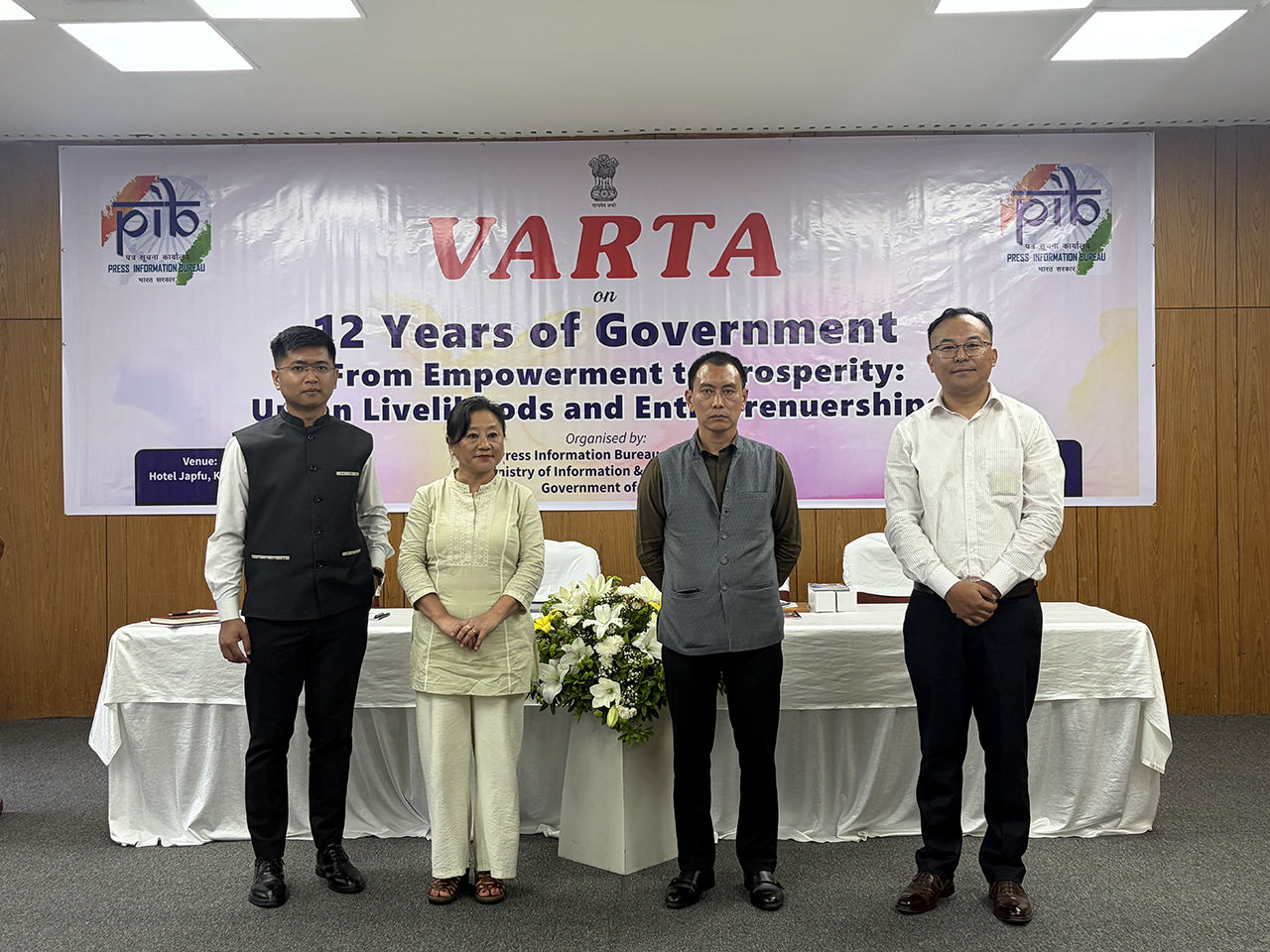
Speaking at a VARTA organised by the Press Information Bureau (PIB), Kohima, under the Ministry of Information and Broadcasting as part of the nationwide outreach programme marking 12 Years of the Government, on the theme “From Empowerment to Prosperity: Urban Livelihoods and Entrepreneurship” at Hotel Japfü, Kohima, Khatsu said the Centre has extended the PM SVANidhi scheme till March 31, 2030.
Tracing the evolution of urban poverty alleviation programmes in Nagaland, Khatsu highlighted the administrative framework for their implementation, and presented the state’s progress under the Prime Minister Street Vendor’s Atmanirbhar Nidhi (PM SVANidhi) scheme.
Khatsu said the Government of Nagaland has been implementing urban poverty alleviation programmes with the support of the Government of India through the Ministry of Housing and Urban Affairs. He informed that the State Urban Development Agency (SUDA) was established in 1999 as the nodal agency for implementing such programmes across the state.
He said SUDA initially implemented the Swarna Jayanti Shahari Rozgar Yojana (SJSRY), which focused on employment generation and self-employment for the urban poor, besides the Prime Minister’s Integrated Urban Poverty Eradication Programme (PMIUPEP) and the Integrated Low Cost Sanitation (ILCS) scheme.
Following the discontinuation of SJSRY in 2013-14, the Government of India launched the National Urban Livelihoods Mission (NULM) with revised guidelines. Khatsu said the mission has now been replaced by Deendayal Jan Aajeevika Yojana–Shehari [D-JAY (S)], introduced in 2024 and presently being implemented as a pilot project in Kohima in partnership with the Kohima Municipal Council.
Expressing optimism over the programme, he said once the Ministry rolls out D-JAY (S) nationwide, it is expected to cover all 39 Urban Local Bodies (ULBs) in Nagaland.
Explaining the implementation structure, Khatsu said SUDA functions under the Urban Development Department, while implementation at the district level is carried out through District Urban Development Agencies (DUDAs) headed by the respective Additional Deputy Commissioners. He noted that this framework has enabled effective implementation of urban livelihood programmes across the state.
Highlighting PM SVANidhi, Khatsu said the scheme was launched on June 1, 2020, to support street vendors whose livelihoods were severely affected by the COVID-19 pandemic.
“Street vendors are an indispensable part of everyday life, providing essential goods and services to communities, yet they often remain one of the most vulnerable sections of society,” he said, adding that the scheme provides collateral-free working capital loans to help vendors restart and expand their businesses.
He informed that the scheme has been restructured from January 1, 2026, and extended until March 31, 2030. The revised framework expands coverage to census towns and involves collaboration between the Ministry of Housing and Urban Affairs, the Department of Financial Services and the Ministry of Rural Development.
Under PM SVANidhi, vendors receive loans in three stages—₹15,000, ₹25,000 and ₹50,000—based on timely repayment of previous loans.
“The phased lending mechanism encourages timely repayment while allowing beneficiaries to progressively expand their businesses,” Khatsu said.
He said beneficiaries receive an interest subsidy of up to seven per cent for prompt repayment, while the loans are backed by the Government of India through the Credit Guarantee Fund Trust for Micro and Small Enterprises without requiring collateral. Vendors are also encouraged to adopt digital transactions through cashback incentives.
Khatsu said vendors who successfully repay their second loan become eligible for a UPI-linked RuPay Credit Card with a credit limit of ₹10,000 to ₹30,000 for emergency financial requirements.
He further informed that PM SVANidhi now serves as a gateway to eight Central Government welfare schemes, with beneficiaries undergoing socio-economic profiling through the Swadeshi Samridhi Card (SSS) to access these benefits.
Presenting the state’s performance, Khatsu said Nagaland has been assigned a target of 13,000 loan sanctions by March 31, 2030.
Download Nagaland Tribune app on Google Play


According to him, banks have approved 6,511 loans worth ₹10.75 crore, while 6,394 loans have already been sanctioned, enabling the state to achieve more than 50 per cent of its target.
He described the repayment performance as particularly encouraging.
“Around 3,861 street vendors, accounting for 60 per cent of beneficiaries, have already repaid their loans. PM SVANidhi has emerged as one of the most successful components of urban poverty alleviation programmes, both in Nagaland and nationally,” he said.
The scheme is currently implemented through nearly 200 bank branches and covers all 39 ULBs in the state. Among the best-performing areas, Aghunato and Meluri have recorded 100 per cent repayment, while Noklak and Chümoukedima have achieved repayment rates of 92 per cent and 90 per cent respectively.
However, Khatsu expressed concern that eight ULBs, including Naginimora, Tizit, Tobu, Satakha, Shamator, Seyochung and Chiephobozou, are yet to register a single loan. He said the department is working closely with banks and local bodies to ensure eligible vendors are brought under the scheme.
He also highlighted implementation challenges, including Aadhaar-mobile linkage issues, low digital literacy, poor internet connectivity and the absence of Core Banking System connectivity in some towns.
Recalling the initial phase of the programme, Khatsu said Nagaland had one of the country’s highest loan rejection rates, with nearly 42 per cent of applications rejected by banks.
“Through sustained coordination, total rejections have now come down to around 1,500 applications,” he said.
Concluding his address, Khatsu described PM SVANidhi as “more than a loan programme,” saying it restores dignity, financial independence and economic security to street vendors. He stressed that continued collaboration among banks, Urban Local Bodies and the department would be essential to improve digital access, reduce loan rejections and ensure deserving beneficiaries receive the scheme’s benefits.
Speaking on the achievements of the Deendayal Antyodaya Yojana-National Urban Livelihoods Mission (DAY-NULM) and its transition to D-JAY (S), Abaii Suokhrie, State Mission Manager, Directorate of Urban Development, said DAY-NULM was implemented in Nagaland from 2014-15 until September 30, 2024.
She said the mission sought to reduce urban poverty by creating sustainable livelihood opportunities through community mobilisation, skill development, entrepreneurship, institutional finance and employment support.
Among its five components, Social Mobilisation and Institutional Development (SM&ID) emerged as the flagship programme as it focused on organising women into Self-Help Groups (SHGs).
“Women were at the centre of the DAY-NULM mission. Through the formation of SHGs, regular training programmes and continuous handholding support, we worked closely with women across the state to strengthen their capacities,” she said.
Suokhrie said officials regularly conducted meetings and training programmes not only at district headquarters but also at colony and ward levels, often reaching beneficiaries in their homes to ensure effective implementation.
Reflecting on the mission’s decade-long implementation, she said it had brought visible improvements in women’s confidence, leadership and financial stability. Members were encouraged to develop savings habits, access institutional credit and undertake income-generating activities while receiving leadership and financial management training.
She informed that 884 Self-Help Groups remain active across the 11 district headquarters where DAY-NULM was implemented. Unlike the earlier mission, she noted, the newer schemes, including PM SVANidhi, now cover all 39 Urban Local Bodies in Nagaland.
According to Suokhrie, SHGs are engaged in a range of livelihood activities, including tailoring, handicrafts, food processing, retail trade, organic farming and other micro-enterprises. They have also participated in financial literacy and community awareness programmes.
To strengthen coordination, SHGs were federated into Area Level Federations (ALFs) and City Level Federations (CLFs), enabling better communication and collective decision-making.
Highlighting the mission’s impact, she said DAY-NULM empowered urban poor households to become self-reliant by improving employability, entrepreneurship, financial inclusion and women’s leadership.
She said the Ministry has now introduced D-JAY (S) under a “test-learn-scale” approach, with Kohima selected among 25 pilot cities nationwide.
Unlike its predecessor, the new mission targets emerging occupational groups such as gig workers, transport workers, construction workers, waste workers, caregivers and domestic workers, combining livelihood promotion with skill development and social protection.
Describing the transition, Suokhrie said D-JAY (S) represents “continuity with improvement.”
“The new mission responds to the changing needs of today’s urban workforce while continuing to uphold the core objectives of women’s empowerment, sustainable livelihoods, social protection and inclusive urban development,” she said.
She expressed confidence that the experience gained under DAY-NULM would help ensure the successful implementation and expansion of D-JAY (S), enabling the state to strengthen livelihood opportunities and social security for a wider section of vulnerable urban workers.
The programme was moderated by Andrew Lalchhandama, Media and Communication Officer, PIB Kohima, while the vote of thanks was delivered by P Sophie, Head of Office, PIB Kohima.