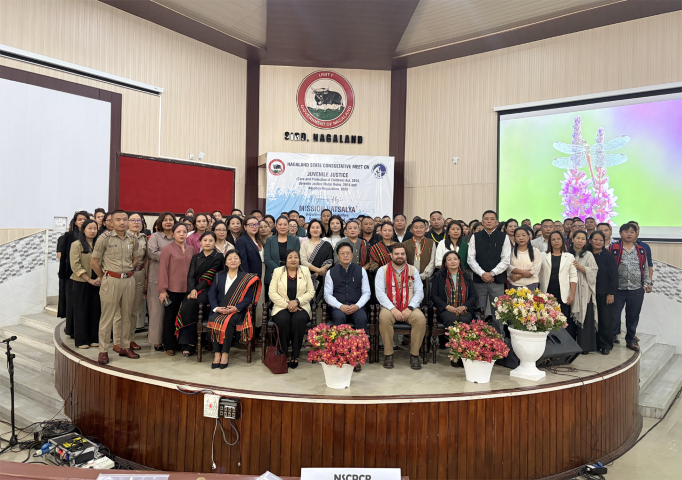
Secretary of the Department of Social Welfare and Mission Director of Mission Vatsalya, Limawabang Jamir on Tuesday called for a culturally sensitive and practical approach to implementing the Juvenile Justice (Care and Protection of Children) Act, 2015 in Nagaland.
Addressing stakeholders during “Nagaland State Consultative Meet on the Nagaland Juvenile Justice (Care and Protection of Children) Act, 2015, Juvenile Justice Model Rules, 2016, and Adoption Regulations, 2022”, organized by the Department of Social Welfare, under Mission Vatsalya, Jamir stated that although the Juvenile Justice Act, JJ Rules, and Adoption Regulations represent a highly progressive legal framework on paper, the real challenge lies in effectively adapting and implementing them within Nagaland’s unique social and cultural realities.
He said the effectiveness of any law should not be judged solely by how well it is drafted at the Centre, but by how successfully it responds to the realities of places like Kohima, Mokokchung, Tuensang, and the state’s remote border regions.
“We are not here simply to debate the text of the law or recite legal provisions. We are here to dissect them,” he said, emphasizing that legal frameworks often assume conditions that do not always exist in Nagaland.
Jamir pointed out that the present system assumes seamless digital connectivity for adoption portals, standardized police handling mechanisms, and institutional care as the primary safety net for children. However, he noted that Nagaland’s reality is shaped by customary laws, community governance, and strong traditional support systems protected under Article 371(A) of the Constitution of India.
He highlighted that customary forms of adoption rooted in clan and village traditions remain common in Naga society. While such practices are carried out with good intentions, he cautioned that they can leave children legally vulnerable in matters relating to identity, inheritance, education, welfare entitlements, and long-term protection.
The Secretary also stressed that many newly formed and remote districts continue to face serious digital connectivity challenges, making centralized online systems difficult to access and navigate.
“We cannot change our geography and topography, and we should not erase our culture,” he remarked.
At the same time, Jamir emphasized that Nagaland has historically maintained strong community-based systems of care through families, clans, village councils, churches, and tribal institutions, which have protected vulnerable children for generations.
He said the task before stakeholders is neither to dilute the law nor disregard Naga customs, but to implement child protection laws in a manner that is practical, culturally sensitive, and legally sound.
Calling on all stakeholders to provide concrete recommendations, he urged representatives from the judiciary, police, medical fraternity, district administrations, child protection agencies, and tribal institutions to work together rather than in isolation.
“Every statistic we discuss today represents a real child in a Naga village, town, or colony who is relying on our collective wisdom for protection, safety, and justice,” he stated.
Quoting officials from the State Adoption Resource Agency (SARA), Jamir said, “Adoption is an act of love, but the process must come from law.”
He concluded by urging participants to move beyond general discussions and instead offer structural, localized, and actionable suggestions that could help create a child protection model that is both legally robust and distinctly Naga.
Director of the Department of Social Welfare and Member Secretary of Mission Vatsalya, Tosheli Zhimomi emphasized the need for stronger coordination and compassionate implementation of child protection laws during her introductory address at a consultation programme on the Juvenile Justice framework in Nagaland.
Zhimomi expressed hope that the discussions and experiences shared by ground-level functionaries during the consultation would meaningfully contribute to strengthening child protection systems at the national level.
She stated that the consultation centred around three major legal frameworks that collectively function as a safety net for vulnerable children: Juvenile Justice (Care and Protection of Children) Act, 2015; Juvenile Justice Model Rules, 2016; and Adoption Regulations, 2022.
According to her, these frameworks form the backbone of India’s child protection and adoption ecosystem by providing legal safeguards, defining responsibilities, and establishing mechanisms to ensure that every child receives proper care, protection, rehabilitation, and opportunities for a dignified future.
Download Nagaland Tribune app on Google Play


Highlighting Nagaland’s progress in implementing child protection laws, Zhimomi said that the Juvenile Justice Act, 2015 was officially notified in the state on March 22, 2018, laying the foundation for statutory child protection mechanisms.
She further noted that the Nagaland Juvenile Justice (Care and Protection of Children) Rules, 2024 were drafted and notified on December 2, 2025, as part of efforts to establish a more tailored and state-specific governance framework.
Describing the consultation as an important platform for reflection and collaborative action, she said the meeting would help stakeholders assess implementation mechanisms, identify existing gaps and challenges, and improve coordination among departments and agencies.
“Most importantly, it gives us an opportunity to reaffirm that the best interest of the child must remain at the centre of every decision we make,” she said.
Zhimomi stressed that children who are orphaned, abandoned, vulnerable, or in need of care and protection depend heavily on the sensitivity, accountability, and effectiveness of existing systems.
She said the responsibility of stakeholders extends beyond policy implementation and includes building a responsive, compassionate, and child-friendly ecosystem throughout the state.
Expressing confidence in the expertise and experiences shared during the consultation, she said the deliberations would lead to meaningful recommendations and actionable outcomes aimed at strengthening institutional support systems and improving interdepartmental convergence.
She concluded by thanking all participants for their commitment to child rights and for contributing toward improving child protection mechanisms in Nagaland.
Speaking during a consultation programme in Nagaland, Junaid Ul Islam, Senior Consultant at the Ministry of Women & Child Development, Government of India, said the Centre had issued letters to all states on May 4 inviting recommendations and inputs for changes to the JJ Act, its rules, and regulations.
He said that nearly a decade has passed since the enactment of the JJ Act 2015, with only a limited amendment introduced in 2021 concerning adoption procedures. The amendment transferred the authority to issue adoption orders from courts to district magistrates to reduce delays in the adoption process.
Highlighting recent achievements in the adoption system, Islam said that after integrating the CARINGS portal of the Central Adoption Resource Authority (CARA) with the Mission Vatsalya portal, India crossed 5,000 adoptions for the first time in the programme’s history this year. He noted that around 40,000 parents are currently waiting for adoption, while only about 2,000 to 3,000 children are available for adoption nationwide.
He stated that the Centre is simultaneously working on amendments to the Act, rules, and subordinate regulations to ensure faster implementation without delays. According to him, consultations are already underway with various stakeholders, including police departments, judiciary members, NGOs, District Legal Services Authorities, child protection activists, and adoption agencies.
Islam said Nagaland became the first state to initiate formal consultations on the proposed amendments, while similar consultations are being planned in Maharashtra and other states.
During the discussion, he pointed out that one of the proposed changes under consideration is removing the “concept of a child” category in adoption regulations to simplify and streamline the adoption process.
Emphasizing that laws must evolve with changing social realities, Islam traced the history of juvenile justice legislation in India from the Apprentice Act of 1850 and Reformatory Schools Act of 1897 to the Children Act of 1960, the JJ Act of 1986, the JJ Act of 2000, and finally the current JJ Act of 2015.
Referring to the latest National Crime Records Bureau (NCRB) report for 2024, he said approximately 34,000 to 35,000 crimes or FIRs were registered against children in conflict with law across the country, with nearly 77 percent involving children aged between 16 and 18 years.
He also spoke about ongoing national discussions surrounding the Protection of Children from Sexual Offences (POCSO) Act.
The consultation also discussed possible reforms related to Child Welfare Committees (CWCs), Juvenile Justice Boards (JJBs), child welfare police officers, and digital integration of child care institutions through the Mission Vatsalya portal.
Islam further revealed that the Centre is considering provisions for dedicated cadres of specially trained Child Welfare Police Officers and state-level officers of IG rank to oversee Special Juvenile Police Units.
Calling the consultations “informative and useful,” he encouraged stakeholders from police departments, CWCs, child rights commissions, medical departments, NGOs, and district child protection units to submit concrete recommendations for the proposed amendments.
Earlier, the programme was chaired by Raitale Zeliang, Programme Manager of the State Child Protection Society (SCPS).
The programme concluded with a vote of thanks delivered by Imkongzenla, Joint Director of the Department of Social Welfare and Nodal Officer of Mission Vatsalya.