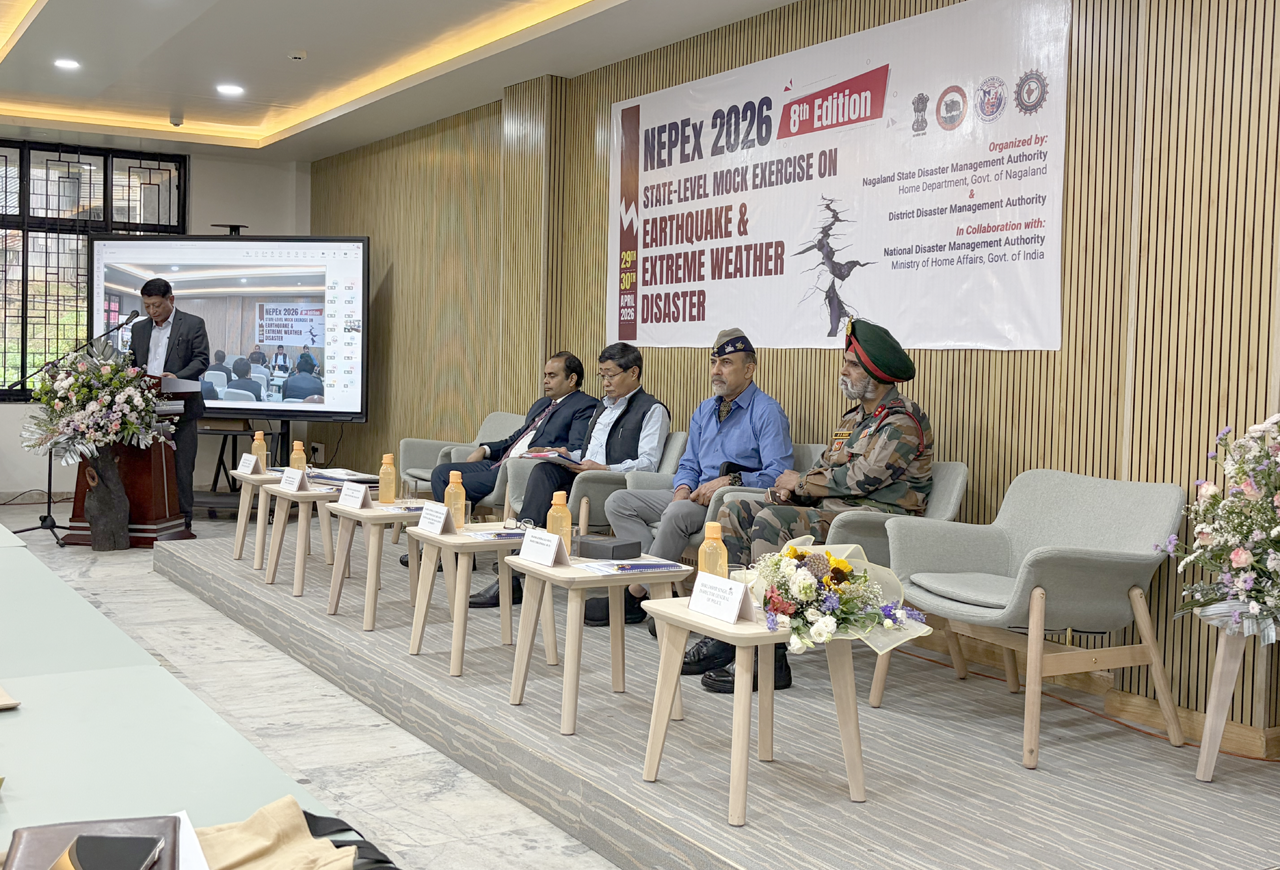
The inaugural of the 8th edition of Nagaland Emergency Preparedness Exercise (NEPEx) commenced with a tabletop exercise held at the State Emergency Operation Centre, Capital Convention Centre, on Tuesday.
The exercise is being organised by the Nagaland State Disaster Management Authority (NSDMA) under the Home Department, Government of Nagaland, along with the District Disaster Management Authorities (DDMAs), in collaboration with the National Disaster Management Authority (NDMA) under the Ministry of Home Affairs, Government of India.
Lead Consultant (ME & IRS) of the National Disaster Management Authority, Sudhir Bahl, in his address highlighted the importance of inter-agency coordination and realistic disaster modelling during the 8th edition of the Nagaland Emergency Preparedness Exercise (NEPEx).
Addressing officials and stakeholders, Maj Gen Bahl stressed the need to strengthen synergy between the State Government of Nagaland and the Indian Armed Forces to enhance preparedness and response capabilities in the event of a major disaster.
Describing Nagaland as “my state,” he reiterated his continued commitment to supporting disaster preparedness efforts and improving institutional response mechanisms. He informed that this year’s tabletop and mock exercises have been completely revamped and are based on a scientifically vetted earthquake scenario developed in consultation with seismologists.
“The scenario is not hypothetical—it is based on a realistic situation that could occur if a major earthquake strikes,” he said, adding that casualty figures and potential damage have also been carefully modelled to guide response strategies.
Referring to the recent coordinating conference, Bahl said the framework for the exercise had been discussed in detail, ensuring that all participating departments understand their roles and responsibilities. The exercise, he noted, aims to test preparedness, improve coordination, and identify gaps in systems and procedures.
He emphasized that disaster management is not the sole responsibility of the Nagaland State Disaster Management Authority (NSDMA), but requires a “whole-of-government” approach where multiple departments work in unison.
Highlighting the structure of the upcoming field exercise, Bahl explained that while all districts will participate, only five to six sites per district will be activated. This, he said, is a scaled-down simulation designed to validate response mechanisms without disrupting normal life across the state.
“In a real disaster, the impact would be widespread across districts and the entire state. However, administratively it is not feasible to simulate such a large-scale event,” he said.
Through the selected sites, different types of disaster scenarios will be enacted to test the effectiveness of response systems and coordination among agencies. The exercise will help assess how well strategies discussed during the tabletop session translate into action on the ground.
Bahl acknowledged the efforts of all departments and agencies involved in organizing the exercise and expressed confidence that NEPEx 2026 would serve as a valuable learning platform.
Concluding his address, Bahl wished participants productive deliberations and emphasized that the ultimate goal of the exercise is to strengthen preparedness and build a more resilient disaster response system.
Chief Secretary and Chairman of the State Executive Committee, Sentiyanger Imchen, highlighted the importance of preparedness, coordination, and continuous learning as the 8th edition of the Nagaland Emergency Preparedness Exercise (NEPEx) commenced with a tabletop exercise.
Addressing participants, Imchen outlined the key objectives of the exercise, stating that NEPEx is designed to assess the preparedness of stakeholders, test and validate standard operating procedures, and strengthen inter-agency coordination across departments. He added that the exercise also seeks to evaluate the functioning of critical systems, identify gaps and challenges, and promote community awareness and preparedness.
Providing an overview of the upcoming simulation, Imchen informed that a magnitude 7.7 earthquake on the Richter scale would be enacted during the exercise. Such a scenario, he noted, would lead to severe structural damage, disruption of critical infrastructure, breakdown of communication systems, and overwhelming pressure on healthcare facilities.
“Earthquakes also trigger secondary disasters such as landslides and fires, further compounding the crisis,” he said, emphasizing the need for a comprehensive and coordinated response.
The exercise will bring together multiple stakeholders, including government departments, security forces, paramilitary units, district administrations, healthcare professionals, urban local bodies, and community institutions such as village councils, NGOs, and churches. Imchen stressed that the objective is not to test performance but to evaluate how effectively the system functions as a whole.
Reflecting on previous editions, he noted that NEPEx has evolved over the years through continuous testing and learning. He urged officials, particularly district administrations and disaster management authorities, to provide honest feedback and identify gaps rather than focusing on presenting a flawless performance.
“This is not an examination with pass marks. What matters is identifying weaknesses so that we can strengthen our systems,” he remarked.
Imchen also suggested that future editions of NEPEx could expand beyond earthquake simulations to include other disaster scenarios. While acknowledging that earthquakes have widespread impact in Nagaland, he noted that they can also trigger cascading events such as dam failures, floods, fires, and large-scale disruptions.
Calling the earthquake a “mother of all disasters,” he said such simulations provide a comprehensive framework to test multiple emergency responses simultaneously. However, he emphasized the need to prepare for a broader range of potential disasters in the years ahead.
Concluding his address, Imchen urged all stakeholders to approach the exercise with seriousness and discipline, treating it as an opportunity to simulate real-life situations, identify shortcomings, and strengthen overall disaster preparedness.
“Let us not treat this as a routine duty, but as a chance to build a more resilient and responsive system,” he said.
Home Commissioner, Abhijit Sinha, IAS, underscored the critical importance of preparedness, coordination, and institutional synergy during emergencies while delivering the welcome address at the 8th edition of the Nagaland Emergency Preparedness Exercise (NEPEx) tabletop exercise.
Highlighting the core responsibilities of the Home Department, Sinha stated that ensuring public safety and maintaining effective coordination during crises remain among its foremost duties. He noted that in today’s rapidly evolving risk environment—driven by climate change and unpredictable disaster events—preparedness must go beyond having plans in place.
“Preparedness is not just about planning but ensuring that all institutions and departments can work together seamlessly when disaster strikes,” he said. He emphasized that while individual departments possess specific expertise and resources, it is the synergy between them that becomes crucial in effectively handling large-scale emergencies.
Download Nagaland Tribune app on Google Play


The NEPEx tabletop exercise, he explained, is designed to strengthen institutional response mechanisms and foster coordination among departments and response agencies. It also provides an opportunity to review operational procedures and clarify command-and-control structures—an essential aspect often tested during real-life emergencies.
Sinha pointed out that disaster situations demand swift decision-making, clear communication, and coordinated action. Exercises like NEPEx help stakeholders better understand their roles, improve information-sharing systems, and enhance overall efficiency in crisis response.
He acknowledged the efforts of the Nagaland State Disaster Management Authority (NSDMA) for consistently organizing the exercise, noting that this year marks its eighth edition. He expressed satisfaction at the resumption of the exercise after a gap last year and lauded the strong participation and support from both state and central agencies.
“The objective is to test our systems, strengthen coordination, and identify gaps,” he said, adding that such gaps often become evident only through rigorous mock exercises. Addressing these shortcomings, he noted, is essential for building a more resilient disaster management framework.
Reinforcing the concept of a “whole-of-government and whole-of-society” approach, Sinha emphasized that preparedness must be built before disasters occur. “When a disaster strikes, there is no time to prepare—you have to act,” he remarked.
He urged all participants to approach the exercise with seriousness and discipline, stating that the effectiveness of such simulations depends on how closely they mirror real-life scenarios. At the same time, he clarified that the exercise is not about achieving perfection but about identifying areas that require improvement.
Concluding his address, Sinha encouraged all departments and agencies to fully utilize the platform to review procedures, strengthen coordination, and enhance readiness. He expressed confidence that the exercise would yield constructive outcomes and contribute significantly to improving disaster preparedness in the state.
The technical session of the Nagaland Emergency Preparedness Exercise (NEPEx) 2026 was conducted with a focus on reviewing past learnings, strengthening disaster management plans, and finalising coordination strategies ahead of the mock exercise.
The session was chaired by Sentiwapang Aier, Secretary of the Nagaland State Disaster Management Authority (NSDMA), Home Department.
An update on key observations and action points from previous mock exercises, along with a detailed presentation on the Disaster Management Plan, was delivered by Dr. Johnny Kadunsin Ruangmei, Joint Chief Executive Officer, NSDMA. The presentation highlighted improvements made over time and outlined strategies to address identified gaps in disaster preparedness and response systems.
The tabletop exercise segment, focusing on response to simulated disaster scenarios, was led by Sudhir Bahl, Lead Consultant (ME & IRS) at the National Disaster Management Authority (NDMA).