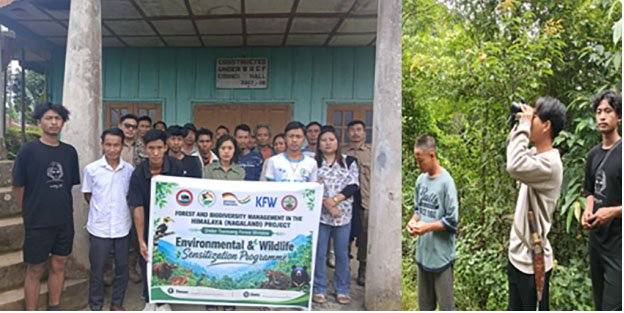
An Environmental and Wildlife Sensitisation Programme was successfully conducted at Lokhung Village under the Tuensang Forest Division as part of the Forest and Biodiversity Management in the Himalaya (Nagaland) Project (FBMP), co-financed by the Federal Republic of Germany through KfW. The programme aimed to strengthen community-led conservation, enhance environmental awareness, and promote sustainable livelihood opportunities.
The programme commenced early in the morning with a field-based learning session led by the Project Implementing Agency (PIA). Participants undertook a guided nature walk through the surrounding forest, where they learned to identify local flora and fauna, observed bird species, and recognized wildlife signs and tracks.
The practical session provided participants with firsthand exposure to the rich biodiversity of the area and highlighted the importance of conserving natural ecosystems.
Following the field activity, a sensitisation program was held at the Lokhung Village Council Hall. The program was chaired by Manchem Cholen, Forest Guard who welcome the participants and conducted the proceedings.
Addressing the gathering, Menya Wongto, Range Forest Officer (RFO), emphasized the importance of collective responsibility in conserving forests and wildlife. He highlighted the need for close coordination among the Village Council, Church, Community Conserved Area (CCA) Committee, student bodies, women’s groups, and other community institutions to ensure the long-term success of conservation initiatives. He also appreciated Lokhung Village for its continued commitment to protecting wildlife and reserved forests through community-led conservation efforts.
Representatives from the Village Council, Church, Community Conserved Area (CCA) Committee, student bodies, and women’s groups shared their views on environmental stewardship, community participation, local conservation rules and resolutions, and the importance of preserving biodiversity for future generations. Their messages reinforced the significance of collective action and community ownership in achieving long-term conservation goals.
Download Nagaland Tribune app on Google Play


The seminar also highlighted the vital role of women in biodiversity conservation and sustainable livelihood development.
Toshila, representing the local Self-Help Group (SHG), spoke on the active role of women in supporting conservation efforts and promoting environmentally sustainable livelihood practices. The discussion noted a gradual decline in hunting and deforestation within the area, attributing this positive trend to increased environmental awareness and the adoption of alternative livelihood opportunities promoted under the project.
To strengthen participants’ understanding of environmental legislation, the PIA conducted a technical session on the Wild Life (Protection) Act, 1972, covering its key provisions, offences, penalties, and the responsibilities of citizens in wildlife conservation. The session also highlighted relevant provisions of Article 371A of the Constitution of India, explaining how statutory wildlife laws and customary institutions can work together to support biodiversity conservation in Nagaland.
The programme concluded with an interactive question-and-answer session, followed by a vote of thanks delivered by I Yongkong, Chairman of the CCA Committee.