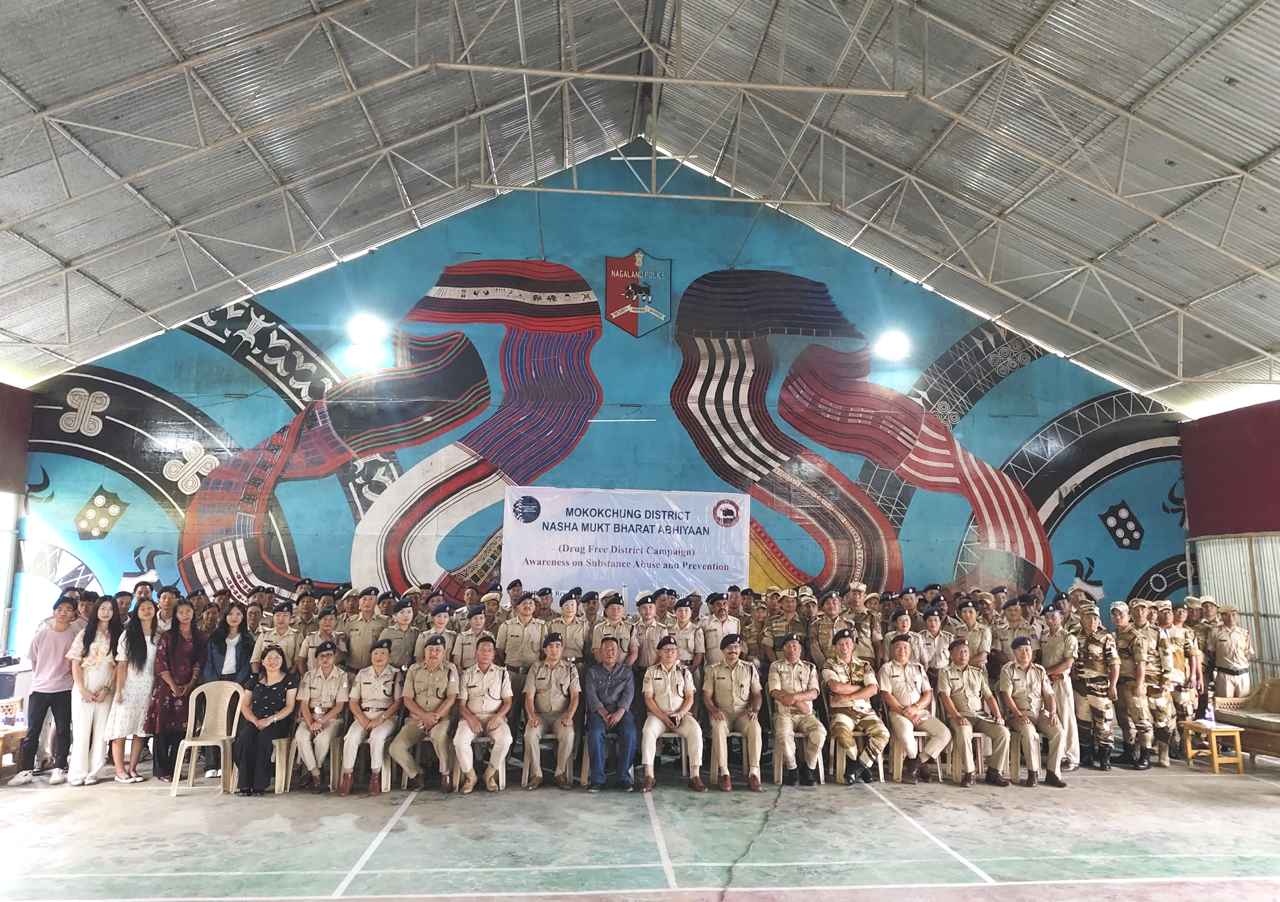
Concerned over the growing issue of abuse and to make police force drug free, the DEF Mokokchung, Nagaland Police, organised an awareness programme under the Nasha Mukt Bharat Abhiyan at the DEF New Reserve, Mokokchung on June 19. The programme was attended by around 200 police personnel.
Delivering the welcome address, Vesupra Kezo, NPS, Senior Superintendent of Police (SP), Mokokchung stated that the campaign was important for the state and particularly for the Nagaland Police due to the prevalence of drug menace and alcoholism in society as well as within the police department.
He said that according to a rough estimate, out of the more than 20,000 police personnel in the state, around 5,000 to 6,000 personnel are affected by alcohol and drug addiction, terming the situation as “very serious.”
He stated that substance abuse is not only a societal concern but also an issue within the police department, and therefore everyone must contribute and work together to make the police department a drug-free community.
The SP further highlighted that many police personnel have lost their lives due to the effects of alcohol consumption and warned that the consequences of alcohol and drug abuse have been witnessed by everyone. He said prevention plays a crucial role as overcoming addiction after getting involved is difficult.
He also stressed the need to focus on awareness and prevention rather than only dealing with cases after addiction has developed. He said people should not ignore those affected but should help them through awareness, treatment and rehabilitation.
The SP stated that if more than 5,000 police personnel are affected by addiction, it would impact the efficiency and capability of the police department, as such personnel would not be able to contribute effectively and could become a liability to the government.
He called for collective efforts involving stakeholders including the Social Welfare Department, civil society organisations, district administration and rehabilitation centres. He also informed that the police department, under the leadership of the Director General of Police (DGP), has been continuing efforts against drugs in all districts.
However, he stated that the police alone cannot control the issue and emphasised the importance of awareness programmes, outreach activities, rehabilitation and treatment, adding that merely catching offenders and sending them to jail would not be the complete solution.
Dr. Madhavi R, IAS (P), Assistant Commissioner, Mokokchung, speaking on behalf of the district administration, stated that the Nasha Mukt Bharat Abhiyan is an upgraded and digitalised version of an earlier programme, with monitoring mechanisms and involvement of different institutions to create a safer, healthier and drug-free society.
She said the campaign is based on four pillars : awareness, prevention, treatment and rehabilitation.
Citing survey figures, she stated that more than 6 lakh people in Nagaland have been affected by substance abuse, including around 1.1 lakh adolescents and children. She also referred to the number of affected personnel within the police department and said it was a serious concern, especially since law enforcement agencies are among the implementing agencies.
She stated that institutions cannot preach what they do not practise and that substance addiction affects not only an individual but also families, society and the future generation.
Download Nagaland Tribune app on Google Play


Dr. Madhavi informed that the district administration has recently launched a district action plan to create a drug free society by bringing together law enforcement agencies, healthcare professionals, educational institutions, civil society organisations and other stakeholders.
She said creating a healthier society is not the responsibility of the government or police alone but the responsibility of every citizen, and concluded with an appeal to stay away from drugs for a better future and to make Mokokchung a drug free society.
The speaker of the programme, Kilang Imsong, Director of Life Anew Foundation, shared experiences from the rehabilitation sector and spoke on addiction as a health concern. He informed that his rehabilitation centre currently has 98 people where 6 are police personnel seeking help for alcohol and drug related issues.
He stated that addiction is increasing and explained the difference between drugs and alcohol, pointing out that alcohol is also a drug. He said substance abuse can affect a person’s self respect, job and overall life.
Citing research, he stated that addiction has been recognised as a disease, with the World Health Organization declaring it as a disease in 1958. He said addiction affects a person’s financial stability, relationships and future if left unaddressed.
During the second session, SDPO (HQ) Mokokchung, Aekant Jain, IPS, conducted a legal awareness session on the Narcotic Drugs and Psychotropic Substances (NDPS) Act, 1985.
Speaking on procedures under the NDPS Act, he explained the importance of following legal procedures during investigations. Referring to Section 42 of the NDPS Act, he said when information is received, police personnel must record it properly and submit it to their superior officer before proceeding.
He stated that punishment is decided through the judiciary and police personnel must prepare cases properly and submit them to prosecutors. He stressed that immediate information must be provided to the concerned superior officer, followed by proper planning and action.
He also spoke about Section 105 of the Bharatiya Nyaya Sanhita (BNS) and the importance of video recording during vehicle checking and other procedures. He said documentation and videography protect both the police and the community, and that such procedures should be followed mandatorily.
Explaining Section 50 of the NDPS Act, he said it is one of the most important provisions as it allows a person suspected of possessing narcotics to be searched. He stated that the person must be informed of the right to be searched in the presence of a gazetted officer or a magistrate.
He said improper compliance with legal procedures has resulted in cases weakening and emphasised that Section 50 notices are mandatory.
He also explained Section 43, relating to search and seizure, and the importance of panchanama, stating that everything happening during a search should be properly recorded in the presence of independent witnesses.
SDPO Jain also spoke on cyber safety and advised WhatsApp users to enable two step verification to prevent unauthorised access. He said protecting oneself from cyber crimes is necessary to protect the wider community. He also informed the gathering about the importance of using the e-Sakshya application during checking and documentation procedures.
He further highlighted that procedures related to female searches are very important under the NDPS Act. He stated that Section 50 notice is mandatory and any body search of a female person must be conducted only by a female officer, whether it involves checking of the body, bags or other belongings.
Additional SP Mokokchung, Y. Tumchobemo Yanthan, NPS, addressed the gathering on Government Employee Conduct Rules and discipline in uniform services.
He stated that uniform services differ from civil services as personnel take an oath to follow the law and maintain discipline.
Explaining Rule 3 of the Conduct Rules, he highlighted three principles : absolute integrity, devotion to duty and conduct unbecoming of a government servant.
He explained that absolute integrity means doing the right thing even when nobody is watching, maintaining honesty and transparency. Devotion to duty requires commitment, efficiency and fairness in carrying out responsibilities, while unbecoming conduct refers to behaviour that affects the dignity of government service.
He stated that police personnel are bound by various regulations, including political neutrality, and should not use their position to influence others.
He also spoke on maintaining confidentiality, stating that official information of the police department should not be circulated through platforms like WhatsApp.
Addressing issues related to misconduct, he said acts such as misuse of government property, illegal handling of arms and ammunition, assaulting seniors, misuse of money and involvement in alcohol or narcotics can attract disciplinary action.
He stated that disciplinary measures may include dismissal from service, compulsory retirement, reduction in pay scale, withholding of promotion and other penalties as per rules.
He also reminded personnel that resignation from government service must follow proper procedures and cannot be done according to personal wishes.